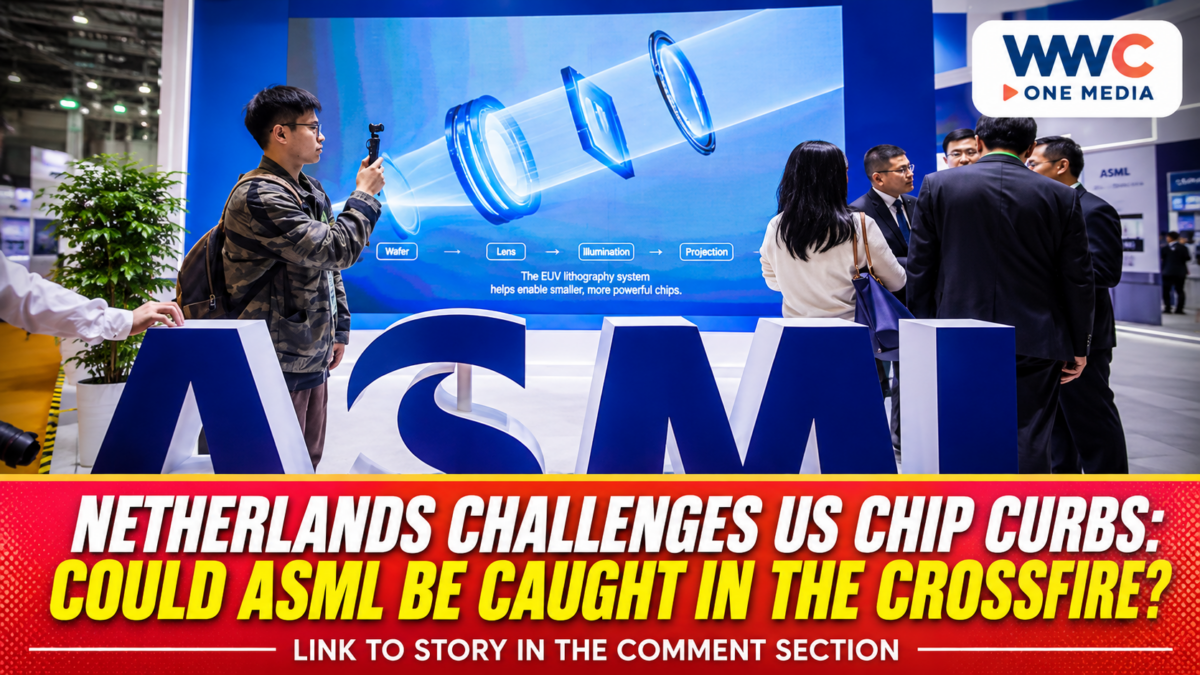
THE HAGUE, Netherlands — Nov. 27, 2026 — The Netherlands is preparing to challenge a proposed US semiconductor law that could widen restrictions on technology supplied to China’s chip industry, placing one of Europe’s most strategically important manufacturers at the centre of a growing dispute between allies.
The controversy involves the proposed Multilateral Alignment of Technology Controls on Hardware (MATCH) Act, a US legislative initiative designed to tighten controls on semiconductor manufacturing equipment and reduce China’s access to technologies used to produce advanced chips.
Dutch Minister for Foreign Trade and Development Cooperation Sjoerd Sjoerdsma told parliament on Nov. 26 that if the legislation is adopted, the Dutch government will urge Washington not to implement it.
The dispute matters because the Netherlands is home to ASML Holding NV, the Veldhoven-based company whose lithography equipment is essential to semiconductor production worldwide.
The proposal could create a difficult choice for the Dutch government: align more closely with Washington’s technology restrictions or defend its authority over a strategic industry that supports Europe’s economic and technological position.
But the MATCH Act is not yet an enacted law. Its final provisions, legislative progress and potential impact on specific ASML products remain important questions.
Why the MATCH Act Has Put ASML in the Spotlight
The MATCH Act seeks to align semiconductor export controls among the United States and its allied supplier countries.
Its central objective is to reduce gaps in restrictions that could allow China to obtain equipment, components or services needed to manufacture advanced semiconductors.
The US House of Representatives introduced H.R. 8170 in April 2026. The House Foreign Affairs Committee advanced an amended version on April 22 by a vote of 36 to 8.
A separate Senate proposal, S. 4281, was introduced on April 13 and referred to the Senate Banking, Housing, and Urban Affairs Committee.
The amended House text calls for US agencies to identify key semiconductor manufacturing equipment and facilities, engage allied supplier countries and pursue aligned export restrictions.
It specifically identifies deep-ultraviolet light sources among the equipment categories that agencies should assess as potential semiconductor manufacturing chokepoints.
The proposal also addresses licensing requirements for exports, re-exports, transfers and servicing of applicable equipment at identified semiconductor facilities.
If allied countries do not adopt controls with the required practical effect, the amended text provides for the United States to extend its own controls through US jurisdiction and regulations.
That is the central concern for the Netherlands. The proposed framework could give Washington greater influence over equipment and services supplied through allied countries, even when those products are manufactured outside the United States.
The distinction is important: the legislation does not simply announce a new ban on all ASML sales to China. Its provisions would require further identification of equipment and facilities, regulatory action and implementation.
Why ASML’s DUV Technology Matters
ASML occupies a distinctive position in the global semiconductor supply chain.
The company develops lithography systems that allow chipmakers to print extremely small patterns onto silicon wafers. These patterns form the electronic circuits inside processors, memory chips and other semiconductor products.
Its extreme ultraviolet (EUV) systems are used for some of the most advanced chip-production layers. Its deep ultraviolet (DUV) systems serve a broader range of manufacturing processes, including technologies used for mature and advanced semiconductor production.
DUV immersion lithography is particularly important because it allows manufacturers to produce complex chip patterns through techniques that can involve multiple exposures.
ASML’s 2025 annual report explains that its DUV immersion systems use argon fluoride light at a wavelength of 193 nanometres. The company also identifies specific DUV immersion systems among products requiring export licences under Dutch, US and other applicable laws.
This existing licensing framework matters. The MATCH Act would not introduce export controls into an otherwise unrestricted business. Instead, it could widen the coordination and enforcement of restrictions already affecting certain semiconductor equipment and destinations.
The proposed law’s amended text identifies DUV light sources as potential chokepoint equipment, but it does not name ASML or expressly list every affected DUV immersion machine. The exact products and services that could face additional restrictions would depend on subsequent government determinations and regulations.
WWC has previously examined the wider European semiconductor dispute involving ASML and its Chinese supplier network. The latest Dutch response adds a separate issue: how far Washington can go in seeking to align the export policies of allied technology producers.
The Netherlands Draws a Line Over Technology Sovereignty
The Dutch government’s position is not simply about protecting one company’s commercial interests.
During the Nov. 26 parliamentary debate on the 2027 Foreign Trade and Development Cooperation budget, lawmakers raised concerns about the proposed US legislation and its implications for ASML.
The official parliamentary summary records Sjoerdsma’s position that if the bill is adopted, the Dutch Cabinet will urge the United States not to implement it.
The minister also agreed to provide lawmakers with a confidential briefing on the geopolitical risks and the government’s response.
The debate reflects a wider concern about national control over strategic industries.
The Netherlands has already participated in semiconductor export restrictions, including licensing requirements affecting certain advanced manufacturing equipment. The disagreement is therefore not necessarily about whether export controls should exist. It concerns the scope of additional US authority and the extent to which Dutch policy should be determined through American legislation.
For ASML, the issue is particularly sensitive because its equipment, software, components and servicing activities form part of an international industrial network.
The company must comply with the export-control rules applicable in the countries where it operates. Additional restrictions could affect which customers it can serve, which machines it can deliver and what support it can provide to installed equipment.
China Remains an Important ASML Market
China’s importance to ASML helps explain why the proposed restrictions have attracted attention.
In its 2025 annual report, ASML recorded €9.52 billion in total net sales attributed to customers’ facilities in China, compared with €10.20 billion in 2024.
The geographic sales figures do not mean that every product sold in China was an advanced lithography machine or that all those sales would be affected by the MATCH Act. They cover ASML’s total net sales attributed to the location of customer facilities.
Nevertheless, the figures demonstrate the commercial significance of the Chinese market.
ASML also reported that its DUV business in China was stronger than anticipated in 2025, helping offset weaker-than-expected DUV business outside China.
That exposure creates a complicated business calculation. Restrictions could limit sales or servicing opportunities, while changes in customer demand and the development of alternative equipment could influence ASML’s longer-term market position.
The company has previously disclosed that changes in export-control laws may materially affect sales volume, product mix and the timing of transactions.
WWC’s reporting on US semiconductor export licences and the distinction between approvals and completed chip deliveries provides another important part of the picture: regulatory permission, commercial orders and completed deliveries are separate events.
Could the Dispute Spread Across Europe?
The Netherlands is not the only country with a stake in the outcome.
The semiconductor supply chain involves equipment manufacturers, component suppliers, chip designers and foundries operating across multiple jurisdictions.
Germany and France are among the European countries whose semiconductor industries could be affected by changes to equipment exports and servicing. The Dutch government has also been working with the European Commission and other European partners on its response.
For the European Union, the challenge is balancing national security concerns with the need to maintain a competitive technology industry.
The issue also has implications for Japan, another major supplier of semiconductor manufacturing equipment. A coordinated approach to export controls could affect how companies in several allied economies compete and serve international customers.
WWC’s coverage of new US AI chip controls and their implications for Southeast Asia’s data-centre industry has examined how export regulations can affect businesses beyond the countries directly targeted.
For semiconductor manufacturers and investors, the uncertainty is not limited to China. Companies may need to reassess supply agreements, servicing arrangements, customer eligibility and the regulatory requirements attached to equipment moving across borders.
Singapore’s discussions with Washington over maintaining legitimate access to advanced US chips illustrate how governments are already trying to manage the commercial consequences of increasingly complex technology restrictions.
What Happens Next?
The immediate question is whether the MATCH Act advances through the US legislative process and whether its provisions are incorporated into broader legislation.
The House Foreign Affairs Committee has advanced an amended version of H.R. 8170, while the Senate’s S. 4281 remains a separate proposal in committee in the official records reviewed.
The Dutch government has made its position clear: if the legislation is adopted, it will urge Washington not to implement it.
The confidential parliamentary briefing promised by Sjoerdsma could provide lawmakers with further information about the government’s diplomatic options. The official parliamentary summary also lists Dec. 1 for votes on motions submitted during the budget debate and Dec. 10 for the budget vote; neither date should be mistaken for a scheduled final vote on the MATCH Act itself.
For ASML, the key issues will be the final scope of any legislation, the equipment and facilities identified by US authorities, and the rules governing exports and servicing.
The dispute raises a broader question for the global semiconductor industry: can the United States and its allies coordinate technology restrictions without creating a conflict over who controls the strategic industries operating within their own borders?
The Netherlands is now signalling that cooperation with Washington does not mean accepting every proposed restriction. Whether that position can change the legislation remains to be seen.
Frequently Asked Questions
What is the US MATCH Act?
The Multilateral Alignment of Technology Controls on Hardware Act is proposed US legislation intended to strengthen controls on semiconductor manufacturing equipment and components, while encouraging allied countries to adopt aligned restrictions.
Why could the MATCH Act affect ASML?
ASML manufactures lithography equipment used in semiconductor production. The proposed legislation would require US agencies to identify key manufacturing equipment and facilities and seek coordinated restrictions on exports, re-exports, transfers and servicing.
Has the MATCH Act become law?
No. The House Foreign Affairs Committee advanced an amended version of H.R. 8170 in April 2026, while a separate Senate bill, S. 4281, was referred to committee. The official records reviewed do not establish that the measure has become law.
What did the Netherlands say?
On Nov. 26, 2026, Dutch Minister for Foreign Trade and Development Cooperation Sjoerd Sjoerdsma told parliament that if the bill is adopted, the Dutch Cabinet will urge the United States not to implement it.
How important is China to ASML?
ASML’s 2025 annual report recorded €9.52 billion in total net sales attributed to customer facilities in China. That figure covers total net sales, not only the specific equipment potentially affected by the proposed legislation.
Would the proposed law ban all ASML sales to China?
The bill does not establish a blanket ban on all ASML sales to China. Its potential effects would depend on which equipment and facilities are identified, the final legislation and the regulations subsequently adopted.