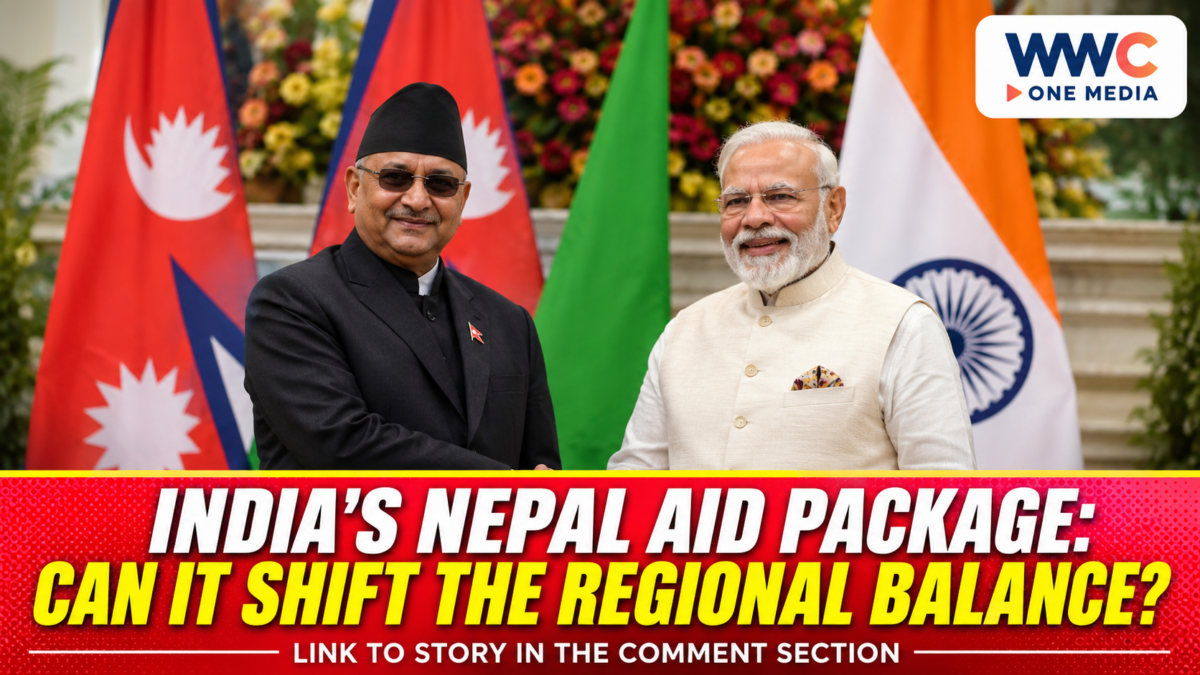
KATHMANDU, Nov. 27, 2026 — India has committed INR 15,000 crore in development assistance to Nepal following devastating Himalayan floods, giving New Delhi a major opportunity to strengthen economic and diplomatic ties with its landlocked neighbour as China continues to expand its regional presence.
The package was announced during Nepal Prime Minister Balendra Shah’s state visit to India on Nov. 22–23, his first visit to the country since taking office.
But the headline amount requires an important distinction: the full INR 15,000 crore is not a cash grant for flood survivors. It consists of INR 3,500 crore in grants for post-disaster reconstruction and new infrastructure, alongside an INR 11,500 crore rupee-denominated line of credit for energy-sector projects.
The financial commitment is substantial, but its eventual impact will depend on which projects receive support, how quickly financing is arranged and whether the assistance translates into functioning infrastructure.
For Nepal, the diplomatic challenge is equally important: rebuilding with India’s support while maintaining its ability to cooperate with China and other development partners.
India’s INR 15,000 Crore Package Has Two Parts
The assistance package is one of the largest development commitments India has made to Nepal.
Its first component is INR 3,500 crore in grant assistance, equivalent to approximately NPR 56 billion, for post-disaster reconstruction and new infrastructure projects.
The second is an INR 11,500 crore line of credit, equivalent to approximately NPR 184 billion, intended for energy-sector projects.
A grant and a credit facility are financially different. Grant assistance does not carry the same repayment obligation as a loan, while a line of credit provides financing under terms that must be established and applied to eligible projects.
The two governments have said that specific projects and the arrangements for providing the assistance will be finalised through mutual consultations. The announcement therefore does not mean the entire amount has already been transferred, spent or allocated to individual reconstruction sites.
The distinction matters because Nepal needs substantial resources to repair damaged roads, bridges, power facilities and other essential infrastructure.
The government’s September assessment estimated total reconstruction requirements at approximately US$4.78 billion. The World Bank’s October 2026 Nepal Development Update separately placed preliminary recovery and reconstruction needs at about US$4.8 billion.
India’s package could contribute significantly to that effort, but the grant component is only one part of the total commitment, and not all of it has been assigned to flood-damaged facilities.
Nepal’s Flood Disaster Created a Major Reconstruction Challenge
The August 26 disaster began in the Rasuwa region near the Nepal-China border and affected communities along the Bhote Koshi and Trishuli river systems.
The consequences extended across Rasuwa, Nuwakot and Dhading, damaging homes, roads, bridges, electricity infrastructure and trade connections.
The World Bank estimated direct economic damage to physical assets at US$1.66 billion. Its October assessment said infrastructure accounted for 83% of that damage.
The disaster also affected Nepal’s energy system. Twelve hydropower projects were affected, including seven operational projects with a combined capacity of 256.1 megawatts and five projects under construction with a combined capacity of 395.02 megawatts.
Damage to transmission infrastructure disrupted an additional 149.6 megawatts, bringing the total affected generation and transmission capacity to approximately 430.7 megawatts.
That represents 10.6% of Nepal’s installed hydropower and solar capacity in fiscal year 2026.
The reconstruction challenge is therefore not limited to replacing damaged buildings. Nepal must restore electricity generation, transport routes, commercial activity and access to essential services.
WWC’s assessment of Nepal’s NPR 723 billion flood-recovery requirement examines how the government’s recovery estimate compares with the international financing currently available.
China Also Provided Emergency Assistance
India’s announcement comes amid a wider regional response to the disaster.
China provided US$2 million in emergency flood-relief assistance to Nepal on Aug. 30, while the Red Cross Society of China contributed another US$200,000 to Nepal’s Prime Minister Disaster Relief Fund.
China also sent relief supplies and specialist teams, including personnel involved in tunnel rescue and forensic identification. Its authorities shared disaster-area imagery, hydrological and meteorological information with Nepal.
The assistance illustrates why Nepal’s relationship with its two large neighbours cannot be reduced to a simple contest in which one country replaces the other.
India and China have different geographical, economic and infrastructure relationships with Nepal. India is a major trade and transit partner, while China has expanded its economic presence through trade, infrastructure and other cooperation.
The two countries have also provided different forms of support during the flood emergency.
WWC previously reported on Chinese rescue teams reaching the devastated China-Nepal border crossing, highlighting the cross-border consequences of the disaster.
The central question for Kathmandu is how to obtain reconstruction financing, investment and technical assistance without allowing external competition to restrict its policy choices.
India and Nepal Are Expanding Energy and Transport Links
The financial package is part of a broader effort to deepen bilateral cooperation.
During the November visit, Shah and Indian Prime Minister Narendra Modi adopted a joint vision document titled “Viksit Bharat and Samunnat Nepal: Re-imagining the Partnership”.
The programme covers economic and development cooperation, connectivity, energy, water resources, climate resilience, disaster management, digital services, technology, education, health and agriculture.
Several infrastructure initiatives were also recorded.
The two leaders jointly inaugurated passenger rail service between Janakpur in Nepal and Ayodhya in India. They also opened a motorable bridge connecting Dharchula in India with Darchula in Nepal.
India agreed to provide Nepal with access to Deendayal Port at Kandla in Gujarat for transit trade. Access to Paradip Port in Odisha is also envisaged once the necessary infrastructure is in place.
Energy cooperation is another major part of the agenda. The two governments agreed to advance new electricity transmission links and jointly laid the foundation stone for the Lower Arun hydropower project.
They also agreed to accelerate work on the detailed project report for the Pancheshwar multipurpose project.
These initiatives could strengthen Nepal’s access to electricity markets and improve its ability to move goods through regional transport networks. However, an announced project or agreed framework is not the same as a completed facility. Financing, technical approvals, construction and implementation remain essential steps.
WWC’s report on Nepal-India power cooperation examines the practical questions surrounding electricity trade, transmission infrastructure and the difference between policy targets and actual power flows.
The 1950 Treaty and Border Issues Remain Unresolved
The two governments also discussed the broader legal framework governing their relationship.
Their joint vision allows existing bilateral agreements, including the 1950 Treaty of Peace and Friendship, to be reviewed by mutual consent.
That does not mean the treaty has already been amended or replaced.
The leaders also directed their respective foreign secretaries to work on outstanding boundary issues. The joint statement says these matters should be addressed through discussion and dialogue.
For Nepal, these questions are politically significant because its relationship with India involves trade access, transit arrangements, energy cooperation and sensitive border matters.
A stronger economic partnership could provide opportunities for both countries, but long-standing disputes will still require diplomatic attention.
What Happens Next?
The immediate test will be implementation.
Nepal and India need to identify the infrastructure projects eligible for grant assistance, determine how the energy-sector credit facility will operate and establish the financial and administrative arrangements for delivering the commitments.
The two governments also need to turn the