
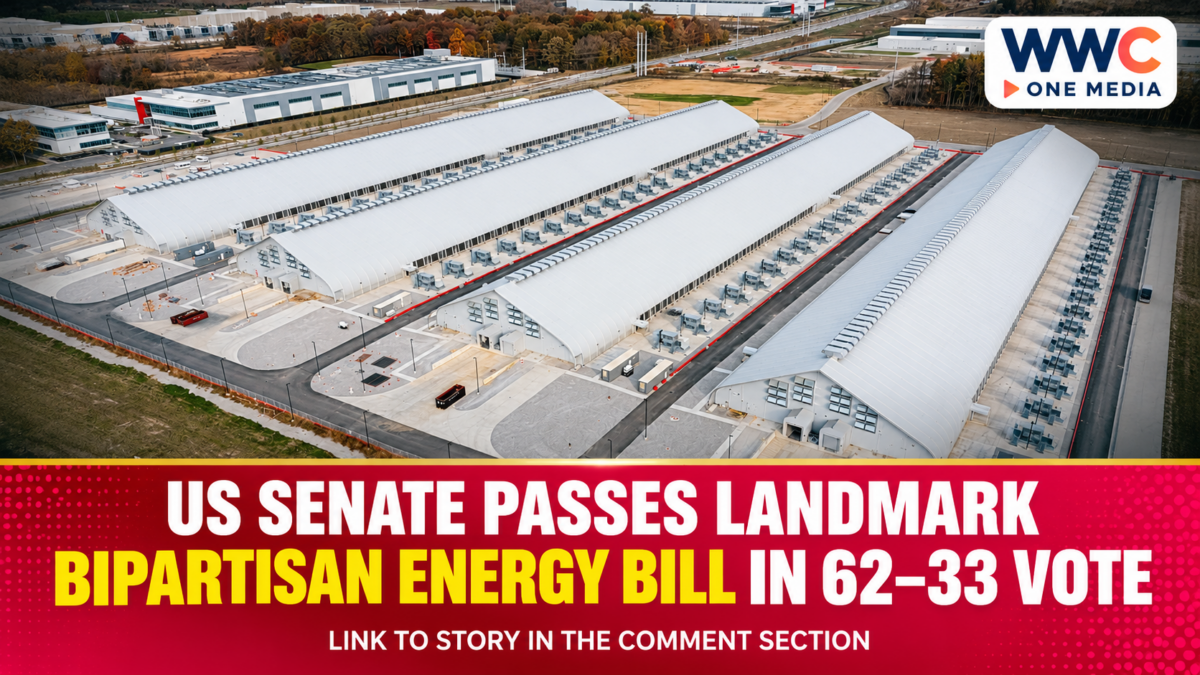
WASHINGTON, UNITED STATES — The US Senate has approved a sweeping bipartisan energy bill aimed at accelerating infrastructure development, reforming environmental approval procedures and preventing artificial intelligence data centres from shifting certain electricity infrastructure costs onto American consumers.
The Bipartisan American Affordability and Jobs Act of 2026 (BAAJA), designated H.R. 2347, passed the Senate on Nov. 19, 2026, with 62 senators voting in favour and 33 against.
The legislation now faces another critical test in the House of Representatives, where disagreements over environmental safeguards, Indigenous rights and regulatory oversight could determine whether the measure becomes law.
At the centre of the debate is a question increasingly relevant to economies across the Asia-Pacific: Who should bear the cost of supplying electricity to rapidly expanding technology industries?
US energy bill targets infrastructure development delays
The legislation was developed by four senators representing both major political parties:
- Mike Lee, Republican of Utah
- Shelley Moore Capito, Republican of West Virginia
- Martin Heinrich, Democrat of New Mexico
- Sheldon Whitehouse, Democrat of Rhode Island
The measure seeks to make federal approval procedures more predictable for developers undertaking major infrastructure and energy projects.
Among its proposed changes are deadlines of one year for environmental assessments and two years for more comprehensive environmental impact statements.
The legislation would also generally require legal challenges under the National Environmental Policy Act (NEPA) to be filed within 150 days.
Supporters contend that clearer regulatory schedules could reduce uncertainty, encourage investment and allow infrastructure projects to progress more efficiently.
Similar questions surrounding energy regulation and affordability have emerged elsewhere in the Asia-Pacific, including efforts to reduce regulatory barriers to rooftop solar development.
However, faster regulatory approval does not automatically guarantee that construction will begin immediately or that electricity prices will fall.
AI data centres face greater financial responsibility
One of the most consequential components of the legislation concerns the electricity infrastructure requirements of data centres.
The Senate-approved measure would require data centres to assume greater financial responsibility for transmission infrastructure associated with their electricity consumption, including relevant upgrades to the wider transmission network.
The objective is to prevent households and small businesses from absorbing infrastructure expenses attributable to large technology facilities.
Data centres require dependable electricity supplies to operate computing equipment, cooling systems and other essential infrastructure.
As technology companies expand artificial intelligence operations, the availability and affordability of electricity become increasingly important considerations for investment decisions.
The proposed legislation places greater emphasis on assigning infrastructure costs to the businesses responsible for creating additional demand.
It also highlights the importance of developing generation, transmission and storage together, an issue examined in the continuing debate over solar energy expansion and battery storage reliability.
For American consumers, the central objective is to reduce the risk of paying for electricity infrastructure primarily required by large commercial users.
Renewable energy and conventional power projects could benefit
The bipartisan legislation is not limited to a single electricity generation technology.
It includes provisions intended to support electricity transmission development and accelerate regulatory processes affecting geothermal, nuclear and other energy infrastructure projects.
The measure would also restrict the circumstances under which federal authorities could suspend or withdraw existing project permits.
Supporters argue that greater regulatory certainty could help developers make long-term investment decisions without facing unexpected administrative reversals.
For renewable energy developers, transmission infrastructure remains particularly important because electricity generated in one location must reach consumers elsewhere.
Nevertheless, infrastructure expansion can create competing demands involving land use, environmental conservation and community interests.
Similar tensions have surfaced in regional debates such as Taiwan’s controversy over solar development at reservoirs.
The challenge extends beyond determining which technologies should receive investment. It also involves establishing where projects can operate and how their environmental consequences should be addressed.
Environmental protections become a major political obstacle
Despite receiving bipartisan support in the Senate, the bill has encountered resistance over its proposed changes to environmental oversight.
On Nov. 24, Congressman Jared Huffman, the ranking member of the House Natural Resources Committee, outlined five areas where he wanted changes before supporting the legislation.
His concerns involved Indigenous sovereignty, access to judicial remedies, the government’s ability to revise existing permits, endangered species protections and the preservation of public lands.
Huffman supports improving infrastructure approval procedures but argues that the Senate-approved legislation would weaken important environmental safeguards.
The disagreement highlights competing priorities within Congress.
Supporters favour more predictable approval procedures and investment conditions, while opponents of the current version are concerned about the consequences of limiting regulatory intervention and legal challenges.
The dispute also intersects with wider international discussions surrounding fossil fuel development and global climate commitments.
Whether Congress can reconcile these priorities remains an unresolved question.
Can the legislation actually lower electricity bills?
Reducing electricity costs is one of the principal objectives promoted by the legislation’s authors.
However, the measure does not establish a guaranteed reduction in household electricity bills.
The eventual financial impact would depend on several factors, including how transmission costs are allocated, whether new generating facilities become operational, how regulators implement the legislation and whether infrastructure investment keeps pace with electricity demand.
Faster approvals may remove one barrier to development, but financing, construction and equipment availability remain separate considerations.
The distinction is important for consumers expecting immediate financial relief.
The legislation proposes changes to the conditions under which energy infrastructure is developed. It does not, by itself, deliver additional electricity to households.
What happens next?
The House Committee on Rules has scheduled consideration of the Senate amendment to H.R. 2347 for Nov. 30, 2026.
The legislation must still complete the necessary congressional approval procedures before it can be presented to President Donald Trump.
Should the House make further amendments, additional agreement between the two chambers would be required.
For businesses, technology companies and electricity consumers, the forthcoming legislative proceedings could determine how the United States balances infrastructure investment, energy affordability and environmental accountability.
The Senate has delivered a significant political breakthrough. Whether that breakthrough becomes lasting energy policy remains uncertain.










