
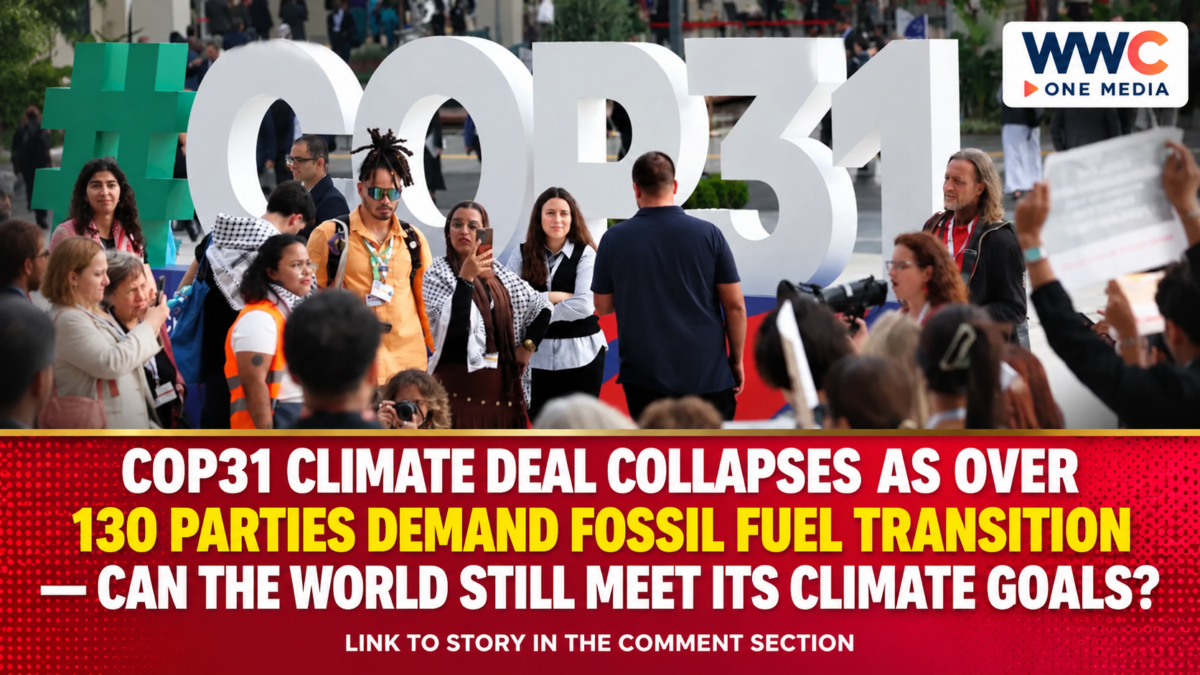
ANTALYA, TÜRKİYE — The COP31 climate deal collapsed on November 22, 2026, after international negotiators failed to reach consensus on an overarching agreement amid deep disagreements over the global transition away from fossil fuels.
A coalition of more than 130 parties, including the European Union and its 27 member states, with Panama playing a leading role, pushed for stronger recognition of the need to move away from coal, oil and natural gas.
The failure has exposed a fundamental challenge confronting international climate diplomacy: how to accelerate the clean energy transition while accommodating economies with different energy requirements, financial capabilities and development priorities.
Although the summit delivered progress in several other areas, the absence of a comprehensive agreement leaves critical questions about the direction of global climate policy unresolved.
COP31 Climate Deal Exposes Deep International Divisions
The 31st United Nations Climate Change Conference brought governments together in Antalya to advance the implementation of existing climate commitments.
However, the proposed overarching decision became a major point of disagreement.
The European Union maintained that an agreement that failed to acknowledge the urgent need to transition away from fossil fuels would undermine previous climate commitments.
The dispute builds on the landmark COP28 agreement reached in Dubai in 2023, when governments recognised the need to transition away from fossil fuels in energy systems.
The challenge now is translating that commitment into national policies, infrastructure development and measurable emissions reductions.
The difficulty of implementing climate commitments can also be seen in the increase in carbon emissions across the Greater Toronto and Hamilton Area, illustrating the importance of turning long-term environmental targets into practical action.
For governments, the central question is no longer simply whether cleaner energy systems are desirable, but how quickly and affordably they can be developed.
Fossil Fuel Debate Highlights Competing Economic Priorities
The controversy surrounding COP31 extends beyond environmental policy.
Energy production and consumption are closely connected to industrial competitiveness, employment, transportation, government revenue and household expenses.
A rapid transition could create opportunities for renewable energy developers, electricity providers, battery manufacturers and infrastructure companies.
However, economies dependent on conventional energy industries could face significant adjustment costs if the transition is poorly managed.
Energy investment decisions also reflect national development priorities, as demonstrated by Pakistan and China’s expanding energy cooperation.
Australia’s Minister for Climate Change and Energy Chris Bowen, who served as COP31 President of Negotiations, emphasised electrification as a central pathway towards reducing fossil fuel dependence during the November 20 negotiations.
The failure to secure the overarching decision demonstrates the difficulty of reconciling these different priorities through a consensus-based international process.
It does not, however, establish that private-sector fossil fuel lobbying was directly responsible for the outcome.
Global Electrification Push Continues Despite Diplomatic Setback
While the overarching climate agreement failed, efforts to expand electricity use gained momentum in Antalya.
The 35-by-35 Global Electrification Pledge aims to increase electricity’s share of worldwide final energy consumption to 35% by 2035.
Economies accounting for approximately half of global economic output expressed support for the target or indicated ambitions to reach it earlier.
Electrification involves replacing technologies that directly consume fossil fuels with electricity-powered alternatives.
Examples include electric vehicles, industrial electric heating and electric systems for residential and commercial buildings.
Its environmental benefits depend partly on how electricity is generated.
Expanding renewable generation, strengthening transmission networks and improving energy storage could help countries electrify their economies while reducing emissions.
However, infrastructure development can also face environmental concerns, community opposition and regulatory challenges, as illustrated by Taiwan’s debate over floating solar installations and reservoir protection.
The transition therefore requires more than ambitious targets. It also requires investment, effective regulation and public confidence.
Climate Finance Remains Critical for Vulnerable Economies
The failure of COP31’s overarching decision does not mean that all climate negotiations ended unsuccessfully.
Governments advanced work on climate financing, adaptation and mechanisms intended to support workers and communities affected by changes in energy systems.
These areas remain particularly important for developing economies and communities exposed to extreme weather.
Climate adaptation can involve strengthening infrastructure, improving water management, protecting agricultural production and developing more effective disaster preparedness systems.
Recent developments, including US assistance addressing El Niño-related challenges in Philippine communities, highlight the continuing relevance of international assistance during periods of environmental stress.
Climate financing remains an important consideration because countries have substantially different capacities to fund resilient infrastructure and cleaner energy systems.
An effective transition must account for those differences rather than assume that every economy can follow an identical timetable.
What the COP31 Outcome Means for Asia-Pacific Economies
For Asia-Pacific economies, the unresolved international negotiations create a complex policy environment.
Governments must balance electricity affordability and industrial expansion with environmental commitments and infrastructure requirements.
Businesses evaluating long-term investments in energy generation, manufacturing and transportation may also need to consider different national decarbonisation strategies.
The absence of a new overarching agreement does not automatically prevent renewable energy projects from proceeding.
National policies, commercial investment decisions and voluntary international partnerships can continue independently of the failed COP31 decision.
Nevertheless, stronger international coordination could help reduce uncertainty surrounding future energy policies and financing arrangements.
The implications will differ across economies depending on their domestic resources, electricity systems, industrial structures and access to capital.
What Happens Next After COP31?
The international climate process will continue beyond Antalya.
COP31 initiated the second global stocktake under the Paris Agreement, which will assess collective progress and inform future climate action.
The process is expected to conclude at COP33 in November 2028.
COP32 in Addis Ababa, Ethiopia, will provide another opportunity to address unresolved issues and advance existing commitments.
The ultimate test of international climate cooperation will not be measured exclusively by diplomatic declarations.
It will also depend on whether governments deliver cleaner electricity, resilient infrastructure, accessible financing and measurable emissions reductions.
The setback in Antalya has made that challenge more urgent.
Whether the international community can overcome its disagreements before the next major negotiations remains one of the most consequential questions facing global climate policy.










