
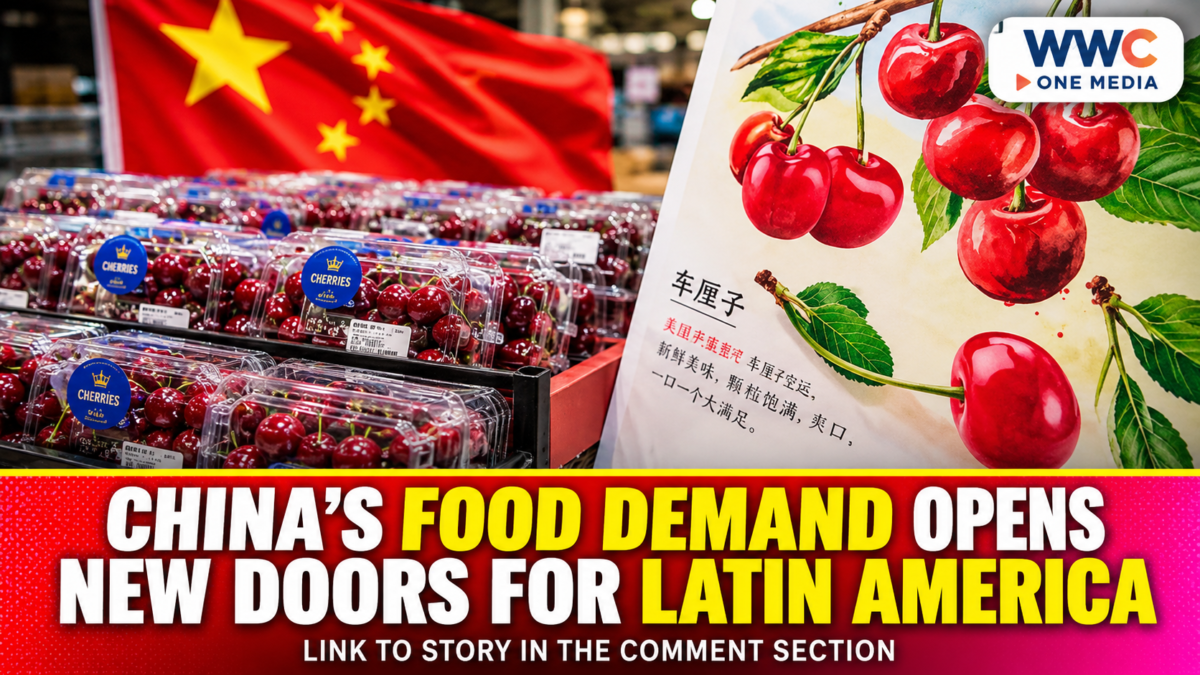
BEIJING AND SÃO PAULO — Nov. 27, 2026 — China’s demand for agricultural commodities is creating significant opportunities for Latin American exporters, with Brazil, Argentina and other regional producers positioned to expand their role in global food supply chains.
The opportunity is backed by the region’s existing agricultural strength. Latin America and the Caribbean account for approximately 18% of global agrifood exports, while China has become one of the most important overseas markets for South American commodity producers.
But greater access to China’s market does not automatically translate into higher profits for farmers or exporters. Sanitary approvals, import quotas, shipping costs, commodity prices and competition between suppliers can all influence which countries benefit.
The commercial relationship is already substantial. The next challenge is turning that scale into more diversified exports, higher-value products and more resilient agricultural supply chains.
Latin America has become a major global food supplier
Latin America’s agricultural position extends well beyond individual commodities.
The region accounts for approximately 14% of global agricultural and fisheries production and 18% of global agrifood exports. Its agricultural output is sufficient to feed an estimated 1.3 billion people, more than twice its own population.
Its net agricultural trade surplus is projected to increase from approximately US$109 billion in 2024 to US$126 billion in 2035.
Brazil, Argentina and Paraguay are among the countries expected to contribute significantly to that expansion.
The region’s agricultural importance also reflects its ability to supply different products to international markets. Brazil is a major producer of soybeans, meat, coffee and sugar-related products, while Argentina has an established position in grains and vegetable oils. Other countries contribute fruit, seafood, wine and specialised agricultural goods.
China’s importance to this trade has increased over time. East Asia’s share of Latin American and Caribbean exports rose from 5% in 2000 to 17% in 2024, making it the region’s second-largest export market.
That shift has created a commercial relationship that reaches beyond agricultural commodities into infrastructure, financing, investment and industrial supply chains.
WWC has previously examined why Latin America’s political changes may not weaken China’s economic influence. Agricultural trade is one of the reasons the relationship remains commercially important.
Brazil leads the soybean trade with China
Brazil provides one of the clearest examples of how Latin America benefits from China’s agricultural demand.
World Bank World Integrated Trade Solution data, based on UN Comtrade figures, show that China imported approximately 111.82 million tonnes of soybeans in 2025, valued at about US$50.41 billion.
Brazil supplied approximately 82.33 million tonnes, worth US$36.96 billion.
Argentina supplied another 7.89 million tonnes, valued at approximately US$3.56 billion, while Uruguay contributed approximately 3.06 million tonnes.
These figures demonstrate Brazil’s dominant position in China’s soybean supply network.
The relationship is also supported by formal agricultural cooperation. On March 23, 2026, the seventh meeting of the China-Brazil Subcommittee on Agriculture took place in Beijing. China’s Vice Minister of Agriculture and Rural Affairs Zhang Zhili and Brazil’s Vice Minister of Agriculture and Livestock Luis Rua co-chaired the meeting.
The discussions covered agricultural investment and trade, scientific and technological cooperation, agricultural machinery, supply-chain resilience and bio-input regulation.
The meeting indicates that the relationship is not limited to buying and selling crops. Both governments have identified areas where cooperation could extend into agricultural technology and production systems.
Brazil’s agricultural export figures reinforce the scale of the opportunity. From January to September 2026, its agribusiness exports totalled US$133.60 billion. China was the largest destination, accounting for US$44.06 billion.
The soybean complex led Brazil’s export sectors, followed by meat, forest products, coffee and sugar-related products.
Argentina and other producers are also seeking opportunities
Brazil may dominate soybean shipments, but the wider opportunity is not restricted to one country.
Argentina remains important to China’s agricultural supply strategy, particularly for soybeans, maize and vegetable oil.
The OECD’s 2026 agricultural policy assessment records a reported US$900 million non-binding agreement covering those products. It also describes discussions involving Chinese state-owned companies COFCO International and Sinograin on increased imports and potential investment in grain-processing capacity in Argentina.
The non-binding nature of the reported agreement matters. It should not be presented as a completed investment or guaranteed purchase contract.
For Argentina, stronger agricultural trade with China could support demand for grain producers and processors. For Chinese buyers, the relationship can help diversify sourcing and strengthen access to agricultural commodities.
Other Latin American countries have opportunities in different product categories. Mexico, Chile and Peru are already important trading partners in the broader China-Latin America relationship.
A March 2026 analysis by ODI Global estimated that Brazil, Mexico, Chile and Peru together accounted for 76% of China’s total trade volume with Latin America and the Caribbean between 2013 and 2024. Brazil alone represented 36%.
This concentration shows that the opportunity is substantial but unevenly distributed.
China’s market is not open without restrictions
One of the biggest mistakes exporters could make is assuming that strong Chinese demand guarantees access.
Agricultural imports are subject to sanitary and phytosanitary requirements, product registration, inspections, quarantine rules and other regulatory conditions.
China’s beef market provides a clear example of the limits.
From Jan. 1, 2026, China introduced a tariff-rate quota of 2.688 million tonnes for fresh, chilled and frozen beef imports. The quota was allocated based on countries’ average market shares during July 2021 to June 2024.
Imports exceeding the quota face an additional 55% safeguard duty.
The measure followed a safeguard investigation into rising beef imports and concerns about the impact on China’s domestic producers.
This creates a different commercial environment for meat exporters compared with soybean suppliers. A country may have the capacity to produce more beef, but its ability to expand sales in China can be constrained by quota allocations and additional duties.
The lesson for agricultural businesses is straightforward: market access must be evaluated product by product.
Exporters also need to consider the costs of meeting Chinese food-safety standards, maintaining traceability and securing the required establishment approvals.
Trade opportunities extend beyond raw commodities
The next phase of Latin American agricultural growth could depend on whether exporters move beyond selling unprocessed commodities.
The region’s agricultural trade surplus is expected to grow, but the biggest long-term gains may come from improving productivity, processing capacity, technology and logistics.
Instead of exporting only raw agricultural products, producers could capture more value through food processing, storage, packaging, animal-feed production and other activities linked to the agricultural supply chain.
China’s agricultural cooperation with Brazil provides examples of this broader direction. The two governments have discussed machinery, supply-chain resilience, scientific innovation and the green transformation of agriculture.
This is particularly relevant as food producers face increasing pressure to improve productivity while managing climate and environmental risks.
WWC has also examined China’s agricultural purchasing commitments involving the United States. The wider trade picture shows that Latin American exporters are competing within a market where purchasing decisions are shaped by commercial demand, diplomatic relations and regulatory arrangements.
Competition and supply-chain risks remain significant
China’s growing agricultural relationship with Latin America does not remove the risks facing exporters.
Commodity prices can change rapidly. Weather disruptions can affect harvest volumes, while shipping costs and exchange-rate movements can alter the competitiveness of suppliers.
Trade restrictions can also change market conditions. China’s beef safeguard measures demonstrate how domestic industry concerns can influence import policies, even when foreign suppliers are commercially competitive.
There is also a concentration risk. Heavy reliance on one major export destination can leave producers vulnerable if demand weakens or import regulations change.
Diversifying markets is therefore important for Latin American agricultural businesses.
That challenge is not unique to South America. WWC’s report on Canada and Brazil as potential markets for Philippine agricultural exports examines how market access must be supported by reliable supply, regulatory compliance and commercially sustainable logistics.
For Latin America, the same requirements will determine whether the region can convert its agricultural advantages into long-term growth.
What happens next?
China is likely to remain a major market for Latin American agricultural products, particularly soybeans, grains and meat.
Brazil enters this relationship from a position of strength, supported by its export capacity and established agricultural cooperation with Beijing. Argentina also has opportunities to expand its grain and processing links, while other regional producers can pursue more specialised export markets.
However, the next stage will depend on more than demand.
Producers will need to meet China’s import requirements, manage price volatility, maintain reliable supply and compete with exporters from other regions.
For Latin America, the strategic opportunity is not simply to sell more agricultural commodities to China. It is to strengthen the value chains, technology and market diversification needed to make agricultural exports more competitive over the long term.
Frequently asked questions
Why is China important to Latin America’s agricultural sector?
China is a major destination for South American agricultural commodities, including soybeans, grains and meat. Its demand supports a substantial trading relationship with producers across the region.
Which Latin American country exports the most soybeans to China?
Brazil is the leading supplier. World Bank WITS data based on UN Comtrade figures show that Brazil supplied approximately 82.33 million tonnes of soybeans to China in 2025.
How much did Brazil export to China in 2026?
From January to September 2026, Brazil’s agribusiness exports to China reached US$44.06 billion, according to Brazil’s Ministry of Agriculture and Livestock.
What agricultural products does China buy from Latin America?
Major traded products include soybeans, maize, meat and vegetable oils. Other agricultural products vary by country and depend on market-access approvals.
Does China allow unlimited beef imports?
No. China introduced a 2.688-million-tonne tariff-rate quota for beef imports from Jan. 1, 2026. Imports exceeding the quota face an additional 55% safeguard duty.
What could help Latin America increase agricultural export earnings?
Higher productivity, food processing, improved logistics, technology adoption, stronger traceability and access to additional markets could help the region capture more value from its agricultural production.










