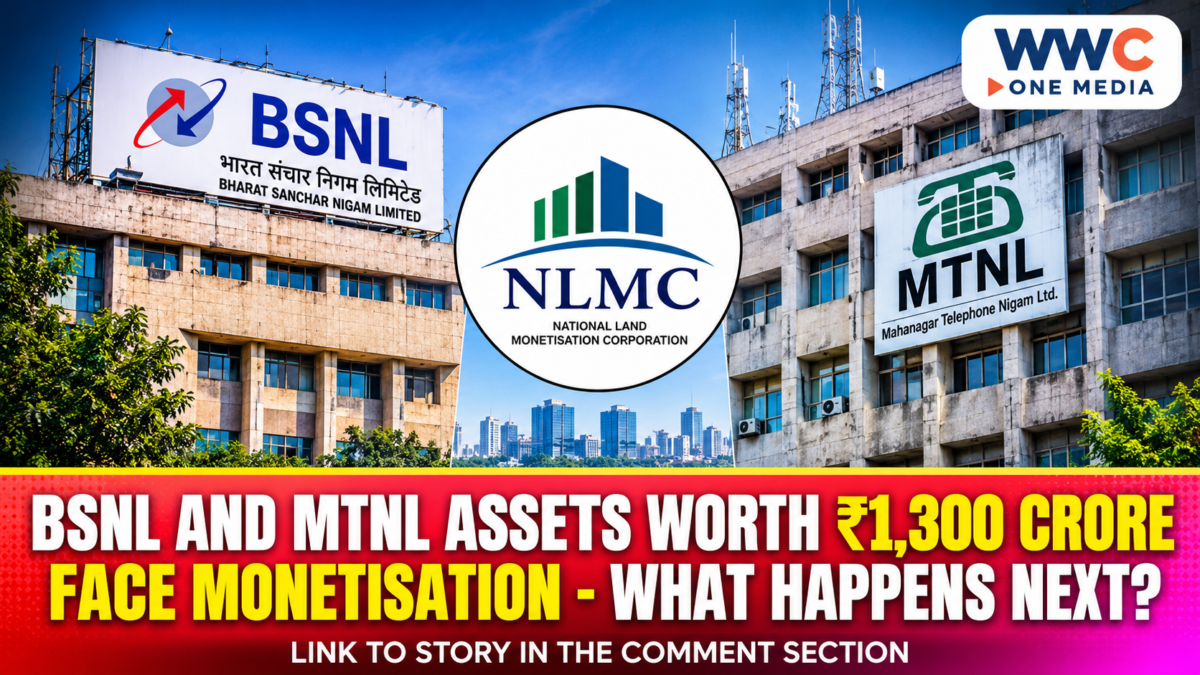
NEW DELHI, INDIA — Nov. 27, 2026 — India is moving forward with another major effort to unlock value from government-owned property, as the National Land Monetization Corporation (NLMC) considers fresh asset monetisation and valuation proposals involving state-run telecom companies Bharat Sanchar Nigam Limited (BSNL) and Mahanagar Telephone Nigam Limited (MTNL), with a combined assessed value of approximately ₹1,300 crore.
The proposals were considered during NLMC’s 22nd board meeting in New Delhi on Nov. 25. They will undergo further processing under prescribed government procedures, meaning the latest development is not yet confirmation that the properties have been sold or that the full amount has been collected.
The move forms part of a broader government programme to put surplus and underutilised public-sector land and buildings to more productive use.
But the bigger question is whether monetising these assets can help strengthen two state-owned telecom operators while India continues investing in next-generation connectivity.
NLMC considers ₹1,300 crore in BSNL and MTNL proposals
The Ministry of Finance confirmed that NLMC’s board considered fresh asset monetisation and valuation proposals relating to BSNL and MTNL, with a combined assessed value of approximately ₹1,300 crore.
The distinction between an assessed value and completed proceeds is important.
The announcement does not identify the individual properties, provide a breakdown of the ₹1,300 crore between BSNL and MTNL, or specify a final transaction schedule. It also does not confirm that buyers have been selected or that the assets have already changed ownership.
Instead, the proposals are moving into further processing under the government’s established procedures.
NLMC is a wholly owned government enterprise under the Department of Public Enterprises within the Ministry of Finance. Its mandate is to identify, assess and facilitate the monetisation of surplus land and building assets belonging to central public-sector enterprises and other government organisations.
The corporation works with asset-owning entities on valuation, due diligence and transaction arrangements, with the stated objective of unlocking value through structured and transparent processes.
The latest telecom proposals are part of a larger programme. NLMC reported that it had monetised assets worth more than ₹9,000 crore during the current financial year, FY2026–27.
That figure covers the corporation’s wider monetisation activity and should not be interpreted as money collected exclusively from BSNL and MTNL.
Why India is monetising government-owned telecom property
The asset monetisation programme is not a new policy direction.
India’s Union Cabinet approved a revival plan for BSNL and MTNL on Oct. 23, 2019. The programme included measures to reduce employee costs through a voluntary retirement scheme, restructure debt, allocate spectrum for telecom services and monetise core and non-core assets.
The stated purpose of asset monetisation was to generate resources that could support debt retirement, capital expenditure and other requirements.
The government subsequently continued its support for BSNL through additional revival measures. In July 2022, the Union Cabinet approved a ₹1.64-lakh-crore revival package for the company, focusing on capital support, spectrum allocation, balance-sheet relief and expansion of its fibre network.
These measures demonstrate that the government’s approach has involved more than property transactions. It has also included direct financial support and investment in telecom infrastructure.
The distinction matters because selling or monetising a surplus property is not the same as selling the telecom operator itself.
The government has presented asset monetisation as one component of a wider restructuring and revival strategy.
BSNL and MTNL have different asset-monetisation histories
Government records show that BSNL had already completed several asset transactions before the latest proposals were announced.
In a written Rajya Sabha response dated July 31, 2025, the Ministry of Communications reported that BSNL had monetised 25 listed land assets or related property interests since 2019, with a combined reported value of ₹1,341 crore.
The listed transactions included properties in Bambolim, Goa; Sector 33A, Noida; Gachibowli, Hyderabad; Jabalpur; Indore; Vijayawada; Thiruvananthapuram; Chennai; Prayagraj; Lucknow; Dehradun and other locations.
The same parliamentary response stated that there had been no sale of MTNL assets as of the date of that answer.
It also set asset monetisation targets for FY2025–26 of ₹900 crore for BSNL and ₹4,573 crore for MTNL.
Those figures are historical targets, not confirmation of what either company ultimately collected during that financial year. They also should not be confused with the new ₹1,300-crore combined proposals considered in November 2026.
The difference in the companies’ earlier records makes the latest development particularly significant: it brings both operators into the same newly announced valuation and monetisation proposal.
The telecom revival must continue beyond property sales
India’s telecom sector is undergoing a major infrastructure transition, with 4G expansion, 5G services, fibre deployment and growing demand for reliable digital connectivity.
BSNL’s network modernisation is a central part of that transition.
In March 2026, the government reported that BSNL was rolling out 100,000 indigenously developed 4G sites for nationwide deployment. As of Feb. 28, 2026, the company had installed 97,906 4G sites, of which 96,103 were operational.
The government also stated that three revival packages approved for BSNL amounted to approximately ₹3.22 lakh crore. These measures covered capital infusion, debt restructuring, viability-gap funding for rural telephony and the provision of 4G and 5G spectrum.
The figures show why the property programme should be viewed in the context of a much larger infrastructure and financial restructuring effort.
Telecom networks require continuous investment in equipment, fibre, transmission capacity, maintenance and coverage. Property monetisation may release capital, but it does not automatically improve network quality or guarantee that investment will be directed towards service upgrades.
The long-term value of the programme will depend on how the proceeds are used and whether the companies can strengthen their operational and commercial performance.
The broader relationship between public assets and digital infrastructure is also becoming an important issue internationally. WWC has examined how PLDT’s planned VITRO REIT listing could unlock value from digital infrastructure, while another report explored how governments can use private capital and asset structures to finance public-sector needs.
These approaches are not identical to India’s land monetisation programme, but they highlight a shared financial question: how can public or state-backed organisations unlock capital without undermining the long-term value of essential infrastructure?
What the ₹1,300 crore proposal means for public assets
Asset monetisation can take different forms, including outright sale, transfer, leasing or other structured arrangements, depending on the asset and the applicable government procedures.
For the BSNL and MTNL proposals, however, the latest official announcement does not disclose the specific transaction structure.
That information will matter.
A property that is genuinely surplus to an operator’s requirements may be suitable for monetisation. A site that supports existing network operations or future expansion could carry a different strategic value.
The financial assessment should therefore consider more than the headline valuation. It should also account for the property’s operational importance, legal status, market demand and potential future use.
The issue is not unique to India. Public authorities in other markets have also faced questions about whether selling infrastructure-related assets can improve financial flexibility without sacrificing long-term public value. WWC previously examined Christchurch’s proposed review of its publicly owned fibre network and the trade-offs involved in disposing of strategic infrastructure.
For BSNL and MTNL, transparency over the assets selected and the eventual use of proceeds will be essential to evaluating the programme.
What happens next?
The immediate next step is further processing of the proposals under the government’s prescribed procedures.
The public announcement has not yet provided the property inventory, individual valuations, transaction timetable or expected proceeds for each company. Those details will be necessary to assess how the ₹1,300-crore proposal moves from valuation to completed monetisation.
The government will also need to balance financial objectives with the operational requirements of its telecom businesses.
India’s wider digital infrastructure ambitions depend on reliable networks, broader coverage and continued investment. WWC’s coverage of international fibre disruptions and the importance of backup connectivity illustrates how much modern economies depend on resilient telecommunications infrastructure.
For now, the ₹1,300-crore proposal represents another step in India’s effort to unlock value from public-sector property.
Whether it becomes a meaningful contribution to BSNL and MTNL’s financial and operational recovery will depend on the assets ultimately selected, the terms of the transactions and how the resulting funds are deployed.
Frequently asked questions
What is the value of the new BSNL and MTNL asset monetisation proposals?
The National Land Monetization Corporation considered proposals with a combined assessed value of approximately ₹1,300 crore.
Have the BSNL and MTNL properties already been sold?
The official announcement confirms that the proposals were considered for further processing under government procedures. It does not confirm completed sales.
What is NLMC?
The National Land Monetization Corporation is a wholly owned Government of India enterprise under the Department of Public Enterprises, Ministry of Finance. It facilitates the monetisation of surplus land and building assets held by government organisations and central public-sector enterprises.
How much has NLMC monetised during FY2026–27?
The Ministry of Finance reported that NLMC had monetised assets worth more than ₹9,000 crore during the current financial year. This is a corporation-wide figure, not a total attributable only to BSNL and MTNL.
Has BSNL previously monetised land?
Yes. A July 31, 2025, parliamentary response listed 25 BSNL land transactions or related property interests since 2019, with a combined reported value of ₹1,341 crore.
Does asset monetisation mean BSNL and MTNL are being shut down?
The monetisation of selected surplus properties is not the same as shutting down the telecom operators. A July 2025 parliamentary response stated that no shutdown proposal was under consideration at that time. The latest announcement concerns asset proposals, not a company closure decision.