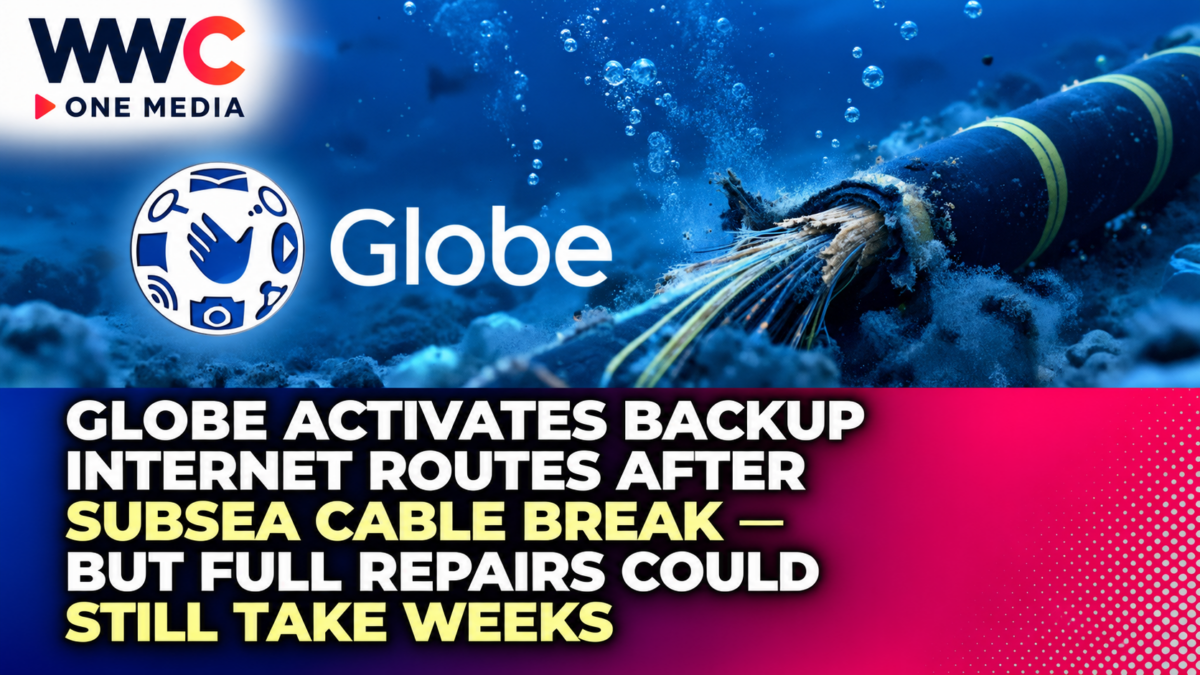
MANILA — Globe Telecom has shifted internet traffic onto backup international routes after a damaged subsea fiber-optic cable reduced overseas bandwidth and caused slower browsing, higher latency and intermittent connections for some mobile and broadband customers across the Philippines.
Globe said the disruption began Thursday night and forced the company to activate built-in network redundancies and other international links to keep traffic moving while repairs are underway.
The problem was most noticeable when users tried to access websites, cloud services and applications hosted outside the Philippines.
Globe said its main information-technology systems remained operational throughout the incident and that a separate problem affecting some Android login attempts had already been resolved.
The company warned that physical repair of the affected subsea fiber could take several weeks.
That means backup routes may continue carrying part of Globe’s international traffic even after the most severe slowdown has eased.
Globe Started Rerouting Traffic Thursday Night
Globe said it began diverting traffic through redundant international links shortly after the problem emerged.
The goal was to keep:
mobile-data customers,
Globe At Home users,
and enterprise clients
connected while international bandwidth was constrained.
Joel Agustin, Globe’s senior vice president and head of network planning and engineering, said technical teams were working to reduce congestion while coordinating with partners to determine exactly what caused the break.
That last point is important.
Globe has confirmed the damaged fiber.
It has not publicly confirmed the cause.
The Exact Globe Cable Has Not Been Identified
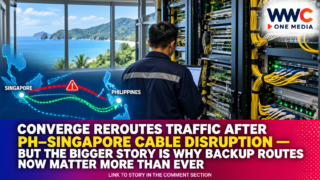
Several early reports linked the Philippine slowdown to an undersea route between the Philippines and Singapore.
But monitoring services and carrier advisories initially did not establish which specific cable had failed.
One commonly mentioned system was the City-to-City, or C2C, submarine cable.
InfiniVAN later said the Philippines–Singapore segment of that system had been permanently restored and was operating normally by around 12:48 p.m. on October 3.
However, Globe itself did not publicly say its own damaged international fiber was C2C.
That means the two events should not automatically be treated as identical.
The safer conclusion is that the Philippines experienced a wider international-connectivity disruption involving offshore routes, while individual carriers used their own backup systems to limit the impact.
PLDT and Converge Were Affected Too
This was not exclusively a Globe problem.
Users of PLDT, Smart and Converge also reported connectivity issues during the disruption, particularly when connecting to overseas services.
NewsBytes reported that all three major fixed-line operators—Globe, PLDT and Converge—shifted traffic onto alternative international cable systems.
That suggests the disruption affected shared international routes or capacity used across several Philippine networks.
It also demonstrates why telecom companies invest in multiple submarine cables rather than depending on a single link.
Latency Reportedly Tripled on Some Routes
Independent network monitoring showed just how noticeable the disruption became.
CableStatus recorded average latency on the Philippines–Singapore route at roughly 177 milliseconds, compared with a recent baseline near 53 milliseconds.
That is more than three times normal latency.
High latency can make an internet connection feel slow even if the nominal download speed remains relatively high.
Users may notice:
websites loading more slowly,
video calls responding with delays,
online games lagging,
cloud applications taking longer to react,
and streaming platforms buffering.
That is why many customers can experience degraded service even when they have not completely lost internet access.
Overseas Websites Were Hit Harder
Domestic traffic often stays inside the Philippines or uses local caching systems.
International traffic is different.
A user opening a website hosted in Singapore, Hong Kong, Japan or the United States may need data to cross one or more international submarine cable systems.
If one of those routes loses capacity, remaining links become more congested.
That is why the October disruption was especially noticeable for offshore services.
The internet did not disappear.
It became less efficient.
Why Backup Links Matter
Modern telecom networks are deliberately built with redundancy.
A major carrier does not want one broken cable to isolate millions of customers.
Instead, networks maintain multiple routes so traffic can be redirected when something fails.
Globe’s own infrastructure disclosures show the company is connected to several major international systems, including:
the Tata Global Network Intra-Asia cable,
Southeast Asia-Japan Cable,
East Asia Cable-City to City Cable,
and SEA-US.
The company is also expanding its cable footprint through new systems and landing stations.
That redundancy is why a serious submarine-cable fault produced slower service instead of a nationwide blackout.
But Redundancy Does Not Mean Unlimited Capacity
Backup links are extremely useful.
They are not magical.
When traffic normally spread across several cables is suddenly concentrated onto fewer routes, congestion can develop.
Imagine a six-lane highway suddenly losing two lanes.
Cars still move.
But they move more slowly.
That is essentially what happens when a major international fiber path loses capacity.
The remaining routes have to absorb traffic they were not normally carrying.
Globe Has Been Building More International Paths
The outage highlights why Globe has been spending on additional submarine capacity.
Its 2025 integrated report said the company was increasing international entry points and strengthening redundancy through new landing stations and submarine-cable investments.
Globe currently has cable landing facilities in locations including:
Ballesteros,
Nasugbu,
and Davao,
while expanding toward additional sites in Northern Luzon.
Multiple landing stations reduce the risk that one geographic disaster or cable incident disrupts every route simultaneously.
Globe Is Also Joining a Massive New Cable System
In April, Globe announced that it had joined the Candle submarine cable consortium, alongside companies including Meta, SoftBank, IPS, TM, XLSmart and NEC.
Candle is planned as an approximately 8,000-kilometer system connecting:
Japan,
Taiwan,
the Philippines,
Indonesia,
Malaysia,
and Singapore.
The system is expected to begin operations in 2028 and provide up to 570 terabits per second of capacity.
For consumers, those numbers may sound abstract.
The bigger point is resilience.
More cables mean more alternative paths when something breaks.
Subsea Cables Carry Almost Everything International
People often imagine international internet traffic moving primarily through satellites.
In reality, the overwhelming majority of global data travels through submarine fiber-optic cables.
These cables carry:
web traffic,
banking data,
video calls,
cloud computing,
corporate systems,
streaming,
and international business communications.
For an island nation such as the Philippines, they are critical infrastructure.
If major international cable routes fail simultaneously, the economic impact can extend far beyond slower Netflix streams.
Cloud Services Depend on Them
Philippine companies increasingly rely on cloud services hosted in overseas data centers.
That includes:
Microsoft Azure,
Amazon Web Services,
Google Cloud,
software-as-a-service platforms,
and international corporate applications.
If international bandwidth becomes constrained, employees may experience slower access even when their local office network remains healthy.
That makes subsea-cable resilience increasingly important for the business-process outsourcing industry, banks, technology companies and remote workers.
The BPO Industry Has a Lot at Stake
The Philippines is one of the world’s largest business-process outsourcing centers.
Its contact centers, shared-service operations and remote back-office businesses depend heavily on stable connectivity to overseas customers.
Even small increases in latency can matter for:
voice calls,
video conferencing,
cloud desktops,
customer databases,
and real-time support systems.
For a country whose outsourcing industry generates billions of dollars annually, international fiber is therefore economic infrastructure—not merely telecom infrastructure.
Repairs Under the Ocean Are Complicated
Globe’s warning that repairs could take weeks is realistic.
Repairing a damaged submarine cable is nothing like repairing a fiber line along a city street.
Operators first need to:
identify the exact fault location,
secure a specialized cable-repair vessel,
sail to the site,
recover the damaged cable from the seabed,
splice or replace the affected section,
test the connection,
and return the cable to the sea floor.
Weather can slow the process.
So can water depth.
Permits and maritime coordination may also be required.
That is why even a small physical break can take days or weeks to resolve fully.
The Cause Is Still Being Investigated
Submarine cables can be damaged in several ways.
Common causes include:
ship anchors,
fishing activity,
underwater landslides,
earthquakes,
equipment failures,
and other maritime incidents.
Globe said it was still working with partners to validate the cause of the disruption.
Until that investigation is complete, attributing the break to a specific vessel, country or act of sabotage would be speculation.
That Matters Because Another Maritime Story Is Unfolding
The timing has attracted extra attention because Philippine authorities are separately investigating the movements of the Chinese research vessel Jiang Hai Ke 7 near northern Philippine waters.
The Philippine Coast Guard said it was coordinating with telecom companies and other agencies to map undersea cables and compare their locations with the vessel’s movements.
But there is currently no verified evidence tying that vessel to Globe’s cable break.
That distinction is crucial.
The PCG inquiry is about determining whether there is any connection.
It is not proof that one exists.
The Chinese Vessel Was Challenged Off Batanes
On October 1, the Philippine Coast Guard deployed its largest ship and an aircraft to challenge a Chinese research vessel operating near Batanes.
The Philippine government said the vessel was conducting unauthorized marine scientific activity and eventually left the area after being confronted.
That incident naturally raised security concerns because northern Philippine waters contain important communications infrastructure.
But again, proximity does not establish responsibility for any cable damage.
The technical investigation needs to come first.
DICT Is Monitoring the Situation
The Department of Information and Communications Technology has also been monitoring reports involving offshore connectivity.
Separate reporting said possible causes being examined included:
physical fiber cuts,
equipment failures,
and other technical or external events.
That is the correct investigative approach.
Submarine cable failures are common enough globally that a physical break should not automatically be treated as sabotage.
The Philippines Has More Than Two Dozen International Cables
GeoCables lists roughly 26 submarine cables connecting the Philippines.
That number has grown dramatically over the years.
More connections make the country harder to isolate.
They also create competition among routes and providers.
But not every cable has the same capacity or destination.
Losing a major route toward Singapore or Hong Kong can still create noticeable congestion because those cities are important internet hubs for Southeast Asia.
Singapore Is Especially Important
Singapore hosts enormous numbers of:
data centers,
cloud services,
financial platforms,
and international network exchange points.
A large amount of Philippine internet traffic therefore moves toward or through Singapore.
That is why a Philippines–Singapore cable problem can affect users trying to reach services that may not obviously appear “Singaporean.”
The service might be American.
Its nearest regional data center could still be in Singapore.
Hong Kong Plays a Similar Role
Hong Kong is another major communications hub.
Connections between the Philippines, Hong Kong, Japan and Singapore form part of the backbone linking the country with the wider internet.
Routing algorithms can move traffic between these regions dynamically.
But every alternative route adds distance and potentially congestion.
That translates into increased latency for users.
Gamers Usually Notice First
Online gamers are among the first users to detect problems with international routing.
Games often depend on servers located in:
Singapore,
Hong Kong,
Japan,
or other overseas markets.
An additional 50 or 100 milliseconds of delay can make competitive games feel significantly less responsive.
That explains why gaming communities often report submarine-cable problems before ordinary users understand what has happened.
The connection still technically works.
But the latency reveals something is wrong.
Video Calls Can Suffer Too
Real-time communications are similarly sensitive.
A website can tolerate a one-second delay.
A conversation cannot.
High latency creates:
people speaking over each other,
delayed responses,
frozen video,
and poor audio quality.
For remote workers and outsourcing companies, that can become much more disruptive than slower file downloads.
Content Delivery Networks Help Cushion the Impact
The internet has become more resilient partly because large companies store copies of popular content close to users.
Content delivery networks operated by companies such as Cloudflare, Akamai, Google and others can serve data from local or nearby caches.
That means a Filipino user watching a popular video may not need to retrieve the entire file from a server in the United States.
This architecture can reduce the effect of international cable disruptions.
But services requiring real-time access to overseas servers cannot be cached as easily.
Those remain more vulnerable.
This Is Why Local Data Centers Matter
The Philippines has been attracting more data-center investment.
One argument for building more local facilities is precisely to keep more data inside the country.
If Philippine websites, businesses and cloud applications can operate from domestic data centers, less traffic needs to cross international cables.
That does not eliminate the need for subsea infrastructure.
Global businesses still need overseas connectivity.
But it reduces unnecessary dependence.
Globe Says Its Core Systems Stayed Operational
One important reassurance from the company is that its primary IT systems remained fully operational during the event.
This means the problem was primarily one of international network capacity rather than a catastrophic failure of Globe’s internal systems.
Users may have experienced:
lag,
slower access,
or intermittent overseas connections,
but Globe’s core telecom infrastructure did not completely shut down.
That distinction explains why experiences varied widely between customers.
Some Users May Have Experienced Almost Nothing
Internet outages are rarely uniform.
One customer may connect primarily to locally cached services and barely notice.
Another may spend the entire day using an overseas cloud platform and experience constant delays.
Different providers also use different cable systems and routing policies.
That is why reports of a “nationwide slowdown” do not mean every Filipino internet user had identical service problems.
The Broader Philippine Internet Was Not Completely Down
GeoCables’ national-level monitoring did not record a countrywide internet outage during the disruption.
Its data showed the Philippine internet continuing to operate overall.
That supports what customers experienced:
degraded international connectivity rather than a national internet blackout.
It is an important distinction for accuracy.
The Incident Comes During Growing Scrutiny of Telcos
The outage also occurred while the National Telecommunications Commission was already pressuring major mobile operators over service quality.
The NTC recently conducted revalidation tests involving Globe, Smart and DITO after issuing show-cause orders related to mobile broadband performance.
The subsea cable incident is technically different from ordinary network-quality issues.
A carrier cannot simply prevent every undersea fiber break.
But customers often judge all service disruptions together.
That increases pressure on operators to demonstrate strong redundancy.
Globe Has Been Investing in Resilience Beyond Subsea Cables
The company has also been strengthening backup power and contingency systems across its domestic network, partly because power outages can disable telecom facilities.
That reflects a larger reality.
Telecom resilience requires protection from multiple threats:
power failures,
typhoons,
earthquakes,
fiber cuts,
cyberattacks,
and international cable faults.
A strong network cannot depend on any single point of failure.
Cable Redundancy Is Becoming a National-Security Issue
The Philippines’ geographic position makes undersea infrastructure strategically significant.
The country sits near major shipping lanes and contested maritime areas.
At the same time, digital dependence is increasing.
Government services.
Banks.
Businesses.
Military communications.
And ordinary citizens.
All rely on connectivity.
That means submarine-cable resilience is increasingly discussed not only as a commercial telecom issue but as part of national security.
More Routes Reduce the Risk — But Cannot Eliminate It
The logical response is diversification.
More submarine cables.
More landing stations.
More domestic data centers.
More alternative routes.
And more spare capacity.
Globe’s investments in additional systems such as Candle point in that direction.
But no network can guarantee zero disruption.
Natural disasters and maritime accidents will still happen.
The objective is to ensure one failure creates inconvenience—not isolation.
That Is Essentially What Happened Here
The outage slowed internet connections.
Users complained.
International services became laggy.
But traffic kept moving.
Globe rerouted customers.
Other carriers did the same.
Some affected cable capacity was restored quickly, while Globe says full repairs to its damaged link may take longer.
That demonstrates both the vulnerability and resilience of the system at the same time.
The Biggest Unanswered Question Is the Cause
At this point, the most important unknown is still what physically damaged Globe’s cable.
Until Globe and its cable partners complete their investigation, several possibilities remain open.
A routine maritime accident is possible.
A technical failure is possible.
A natural event is possible.
Other explanations cannot be ruled out.
But none should be asserted without evidence.
The Bigger Story Is How Dependent the Philippines Is on Invisible Infrastructure
Most internet users never see a submarine cable.
It sits thousands of meters below the ocean.
Yet one break can immediately affect:
Zoom meetings,
online games,
streaming,
cloud applications,
international websites,
and business systems.
That makes the October disruption a useful reminder.
The “cloud” is not floating somewhere in the sky.
Much of it is connected by physical fiber lying on the seabed.
And for an archipelago like the Philippines, those invisible links are among the most important pieces of infrastructure in the country.
Globe’s backup routes prevented a much larger outage this time.
But until the damaged fiber is fully repaired and the cause is established, the incident leaves one major lesson:
the Philippine internet is only as resilient as the number of alternative paths available when one of its undersea lifelines breaks.