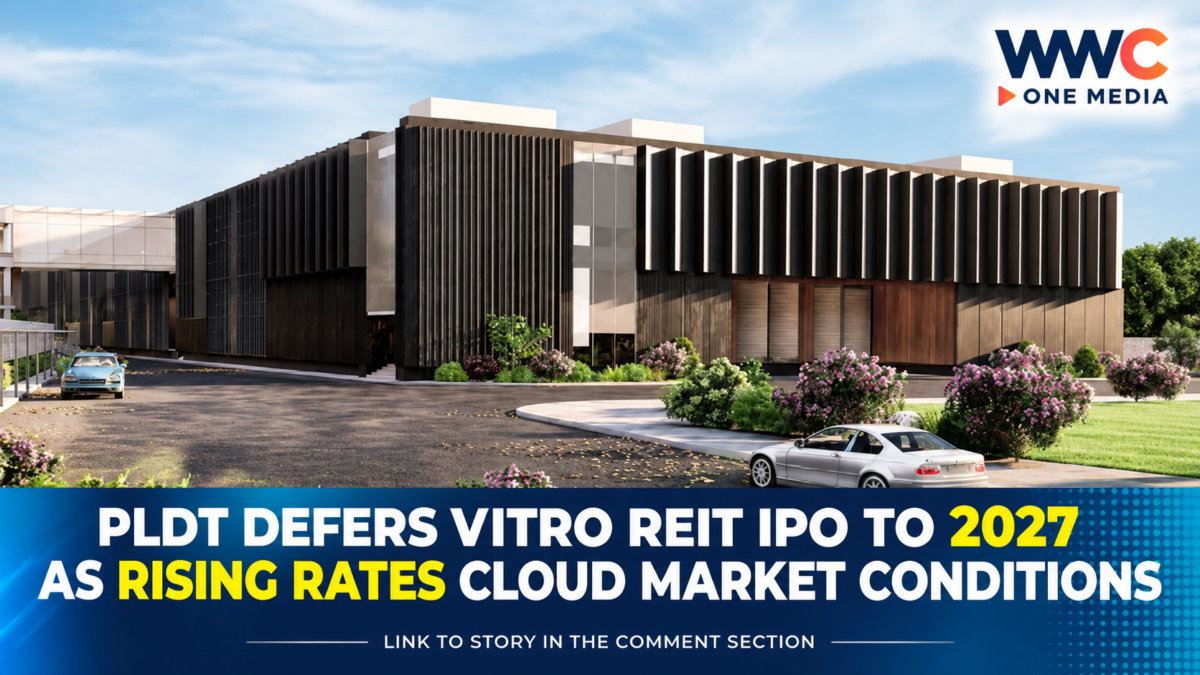
MANILA, Philippines — PLDT Inc. has postponed the planned initial public offering of its data center business VITRO REIT, Inc. to 2027, citing challenging market conditions and rising interest rates.
The delay pushes back what was expected to become the Philippines’ first digital infrastructure real estate investment trust (REIT) listing, as PLDT waits for more favourable conditions to complete the offering.
In a disclosure, PLDT said VITRO REIT would continue working with the Securities and Exchange Commission (SEC) and the Philippine Stock Exchange (PSE) toward completing the necessary requirements for a 2027 offering.
PLDT remains committed to the listing
Despite the postponement, PLDT said the planned REIT offering remains an important part of its broader strategy.
The company described the IPO as a key component of its asset monetisation and deleveraging plans, while also supporting the expansion of VITRO’s data center portfolio and the continued growth of its digital infrastructure business.
The decision to defer the IPO was attributed specifically to current market conditions and rising interest rates.
Rather than abandon the transaction, VITRO REIT will continue coordinating with regulators and the exchange, with the aim of completing the offering next year.
Proposed IPO could raise up to P24.2 billion
VITRO had been preparing for an IPO that could raise as much as P24.2 billion, according to previous reports.
The proceeds were expected to help fund additional data center development while supporting PLDT’s efforts to reduce debt.
The planned listing would also have been significant for the Philippine capital market because it would give investors direct exposure to the country’s rapidly expanding data center industry.
The REIT structure would allow PLDT to monetise a portfolio of stabilised, income-generating data center assets while retaining exposure to the sector’s longer-term growth.
VITRO is building a larger data center footprint
VITRO is one of the Philippines’ largest data center operators and is expanding its capacity to meet growing demand from enterprise customers, cloud providers and hyperscale companies.
PLDT’s original REIT proposal was expected to initially include eight data center projects with combined capacity of about 24 megawatts, according to reports.
The portfolio could eventually become larger as additional facilities are developed and stabilised.
One major facility, VITRO Sta. Rosa, has a potential capacity of up to 50 megawatts but was not initially included in the proposed REIT portfolio.
VITRO is also developing a planned P40-billion data center campus in General Trias, Cavite, designed to eventually support up to 100 megawatts of capacity.
These projects highlight the scale of PLDT’s ambitions in digital infrastructure.
First digital infrastructure REIT in the Philippines
The proposed VITRO listing would mark a new development in the Philippine REIT market.
PLDT announced its pursuit of the listing after the SEC revised the implementing rules of the Real Estate Investment Trust Act of 2009.
The amended framework expanded the definition of eligible income-generating real estate to include certain information and communications technology infrastructure and data centers with recurring and predictable cash flows.
That regulatory change opened the door for digital infrastructure assets to be placed within a REIT structure.
PLDT subsequently moved to take advantage of the new framework, with VITRO filing its registration statement and REIT plan with the SEC in June.
The company later filed its application for listing on the PSE Main Board in July.
Rising rates make timing more difficult
The postponement comes against a more challenging backdrop for capital markets.
Higher interest rates can make equity offerings less attractive by increasing the cost of financing and changing the relative appeal of dividend-paying assets such as REITs.
REIT valuations can also be affected when bond yields and other interest rates rise, as investors reassess the returns they expect from property-related securities.
For VITRO, the issue is particularly relevant because the planned REIT would depend on investor appetite for a relatively new asset class in the Philippine market.
Delaying the offering gives PLDT more time to assess market conditions and potentially pursue the transaction when investor demand is stronger.
Inflation adds another layer of uncertainty
The decision also comes as the Philippine economy faces renewed inflationary pressure.
The country’s headline inflation rate accelerated to 7.2% in September, up from 6.1% in August, according to the Philippine Statistics Authority.
The sharp increase has added uncertainty over the domestic interest-rate outlook and contributed to a more difficult environment for companies seeking to raise capital.
For PLDT, waiting until 2027 could provide more time for financial-market conditions to stabilise.
However, the timing will ultimately depend on interest rates, investor demand, regulatory approvals and the performance of the broader Philippine economy.
Data center demand remains strong
Despite the IPO delay, the underlying business opportunity for VITRO remains significant.
Demand for data centers has been increasing as companies expand cloud computing, artificial intelligence, digital services and data-intensive operations.
The Philippines has also been positioning itself as a potential regional destination for data center investment because of its growing digital economy and demand for cloud and connectivity services.
VITRO’s nationwide network gives PLDT an established platform from which to capture some of that demand.
The company has said its data center business continues to expand capacity to serve enterprise, hyperscale and cloud customers.
Energy costs remain a challenge
Data centers, however, are highly energy-intensive facilities.
That makes electricity costs an important consideration for operators seeking to expand their capacity.
VITRO’s planned expansion therefore comes with both significant growth potential and substantial infrastructure requirements.
The ability to secure reliable and competitively priced electricity will be an important factor as the company develops larger facilities and responds to increasing demand from AI and cloud customers.
A test for the Philippine REIT market
The eventual VITRO REIT offering could also provide an important test for whether investors are ready to embrace digital infrastructure as a new REIT asset class.
Traditional Philippine REITs have largely focused on office buildings, shopping malls, warehouses and other conventional income-generating properties.
Data centers operate differently.
Their value is closely linked not only to the physical facilities themselves but also to long-term customer contracts, power availability, connectivity and the continued expansion of digital services.
A successful VITRO listing could potentially encourage other infrastructure companies to explore similar structures.
PLDT’s broader deleveraging strategy
For PLDT, the IPO is about more than creating a new publicly traded vehicle.
The company has been pursuing asset monetisation as part of its efforts to strengthen its balance sheet and manage debt while continuing to invest in telecommunications and digital infrastructure.
VITRO’s growth provides an opportunity to unlock the value of assets that PLDT has already developed while potentially attracting outside capital to fund future expansion.
The company therefore continues to regard the proposed listing as strategically important despite the delay.
2027 becomes the new target
For now, the VITRO REIT IPO is no longer expected to take place in 2026.
Instead, PLDT is targeting 2027, while continuing to complete regulatory and listing requirements with the SEC and PSE.
The postponement does not cancel the proposed transaction. It reflects PLDT’s decision to wait for market conditions that it considers more suitable for a major capital-market offering.
The eventual timing will depend on how interest rates, inflation, investor sentiment and the Philippine capital markets develop over the coming months.
For PLDT, the strategy remains unchanged: unlock value from VITRO’s growing data center portfolio, reduce financial leverage and raise capital to support further digital infrastructure expansion.
The question now is not whether PLDT intends to pursue the VITRO REIT listing, but when market conditions will be favourable enough for the company to take it public.