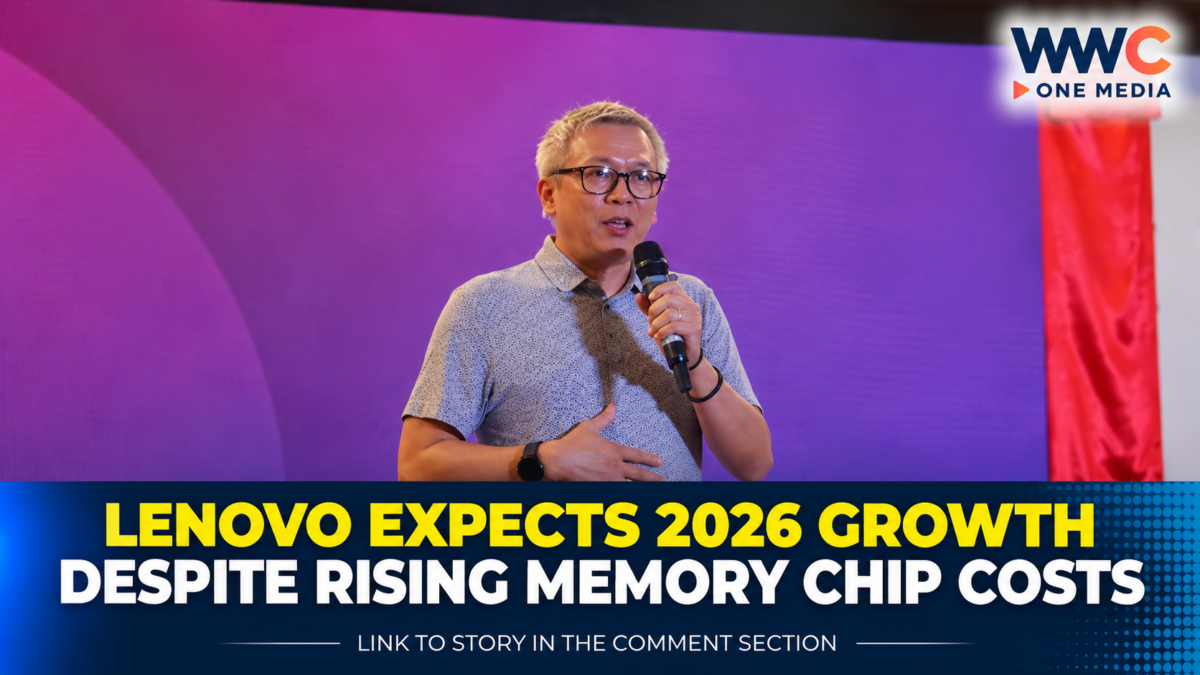
MANILA, Philippines — Lenovo Group expects to maintain growth in 2026 despite surging memory-chip prices, as strong demand for artificial intelligence infrastructure and higher-priced devices helps offset rising component costs.
The world’s largest personal-computer maker has been navigating a global memory shortage that has pushed up the cost of DRAM and NAND chips. Rather than allowing those higher costs to fully erode margins, Lenovo has raised prices and shifted toward higher-end products while expanding its artificial-intelligence business.
The strategy has helped the company remain optimistic about its growth outlook even as higher memory costs threaten to weigh on consumer electronics demand.
AI demand drives Lenovo’s growth
Lenovo’s strongest growth driver has been its expanding AI business.
In the company’s fiscal first quarter ended June 30, revenue jumped 43% year on year to US$26.94 billion, its strongest quarterly revenue growth in five years. AI-related revenue climbed 60% to US$9.3 billion, accounting for about 35% of total revenue.
Chief Executive Yang Yuanqing said Lenovo had anticipated shortages and higher memory costs and had been able to manage the impact through its scale, global supply chain and diversified sourcing.
The company has also been benefiting from growing demand for AI servers, with its AI server order pipeline reaching US$54 billion, up 157% from the previous quarter.
Yang said Lenovo remained confident about sustaining its growth momentum and reaching US$100 billion in revenue for the fiscal year.
Memory prices remain a major challenge
The rapid expansion of AI infrastructure has created an unusual squeeze in the memory market.
Chip manufacturers are allocating more production capacity to high-performance memory used in AI servers, including high-bandwidth memory, leaving tighter supplies for conventional DRAM and NAND products used in PCs, smartphones and other consumer electronics.
TrendForce expects conventional DRAM contract prices to rise another 10% to 15% quarter on quarter in the fourth quarter of 2026, while NAND Flash prices are projected to increase 15% to 20%.
The firm said AI-server demand remains strong enough to keep server memory supplies tight, while suppliers continue shifting capacity toward higher-margin products.
That creates a difficult environment for PC manufacturers such as Lenovo because memory is an important component of overall device costs.
Lenovo has raised PC prices
Lenovo has responded by increasing prices.
The company has already raised PC prices twice this year as it attempts to offset higher memory expenses. The strategy means that even if unit sales are constrained, higher average selling prices can still support revenue growth.
Yang has acknowledged that higher prices could affect demand.
He said PC demand could remain constrained in terms of unit volumes, but Lenovo expects higher average selling prices and a shift toward premium products to help compensate.
The company is also developing more powerful AI-enabled PCs and edge-computing devices as consumers and businesses increasingly adopt AI applications.
PC market faces pressure
The memory shortage is already affecting the broader PC market.
Global PC shipments declined 2% year on year in the second quarter of 2026 to 16.6 million units, according to Counterpoint Research data cited by Reuters. Lenovo nevertheless retained its position as the world’s largest PC maker, with a 25.6% market share during the quarter.
The pressure could intensify if memory prices remain elevated.
Higher component costs can force manufacturers to choose between raising retail prices, accepting lower margins or reducing specifications to keep products affordable.
For consumers, the result could be more expensive laptops and computers, particularly at the higher end of the market.
AI creates both opportunity and cost pressure
The situation illustrates the unusual dynamics created by the AI boom.
AI infrastructure is generating enormous demand for advanced processors, servers and memory. That demand is benefiting companies such as Lenovo, whose infrastructure business has become an increasingly important source of growth.
At the same time, the industry’s appetite for memory is competing with the needs of traditional consumer electronics.
Reuters reported that memory shortages are expected to persist, with major chipmakers anticipating tight market conditions into 2027 and potentially beyond.
This could keep pressure on manufacturers even as AI-related sales continue to grow.
Lenovo’s diversified supply chain offers some protection
Lenovo has sought to reduce its exposure to shortages by maintaining a diversified supplier base across China, South Korea and the United States.
That strategy has helped the company secure memory supplies while competitors have also faced rising costs.
The company is competing in a market where suppliers increasingly have greater pricing power because demand from AI infrastructure is absorbing available memory capacity.
Long-term agreements between chipmakers and customers are also becoming more common, potentially providing greater supply security while limiting the ability of buyers to benefit from short-term price declines.
Smartphone and PC makers face the same squeeze
Lenovo is not alone in confronting higher memory costs.
Samsung Electronics recently raised prices for its flagship Galaxy S26 smartphones, with rising memory-chip costs cited as a factor behind the increase.
Other consumer-electronics manufacturers are also dealing with the same supply constraints.
HSBC analysts have warned that the impact of higher memory procurement costs could become more visible in the second half of 2026 as manufacturers exhaust cheaper inventories acquired earlier.
That could lead to broader price increases across computers, smartphones and other electronics.
Lenovo bets on premium devices and AI infrastructure
Lenovo’s strategy is therefore increasingly centred on two areas: selling higher-value consumer devices and expanding its AI infrastructure business.
Its PC, tablet and smartphone division remains its largest business, accounting for about 64% of revenue in the latest fiscal quarter. But its infrastructure solutions group is growing rapidly, with revenue increasing 37% year on year in the fiscal fourth quarter.
The company is also increasing research and development spending as it develops AI-capable computers and other products designed to take advantage of the growing demand for on-device AI.
Higher prices could reshape consumer demand
The key risk for Lenovo is that continued memory inflation could eventually outweigh the benefits of higher selling prices.
If consumers respond to more expensive PCs by delaying purchases or choosing cheaper models, unit shipments could weaken further.
The company is therefore relying on a combination of pricing power, supply-chain management and growing AI demand to protect revenue and profitability.
For now, that strategy appears to be supporting its growth outlook.
But the broader memory market remains unusually tight. TrendForce expects price increases to continue in the fourth quarter, while AI demand continues to redirect semiconductor capacity toward data centres and servers.
Growth outlook remains intact — for now
Lenovo’s 2026 outlook reflects a broader transformation taking place across the technology industry.
AI is creating a powerful new source of demand for servers, processors and memory, but it is also raising the cost of components used in everyday consumer devices.
Lenovo’s ability to pass some of those costs on to customers while expanding its AI business has allowed it to remain confident about growth.
The challenge will be maintaining that momentum if memory prices remain elevated for longer than expected and consumers become increasingly resistant to higher device prices.
For Lenovo, the AI boom is creating a significant growth opportunity — but it is also making one of the most basic components inside its products considerably more expensive.