
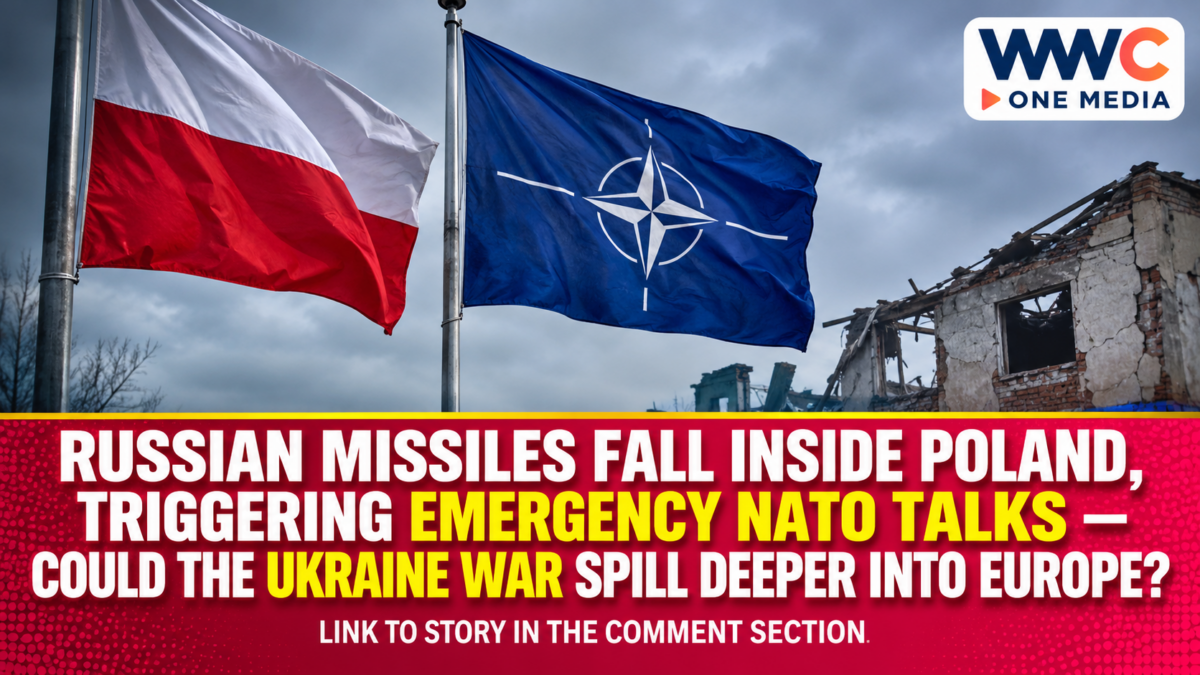
WARSAW, Poland — Russian missiles in Poland have triggered an emergency meeting of the North Atlantic Treaty Organization (NATO), intensifying security concerns across Europe as Russia’s war against Ukraine threatens to spill beyond Ukrainian territory.
Polish Prime Minister Donald Tusk raised the possibility of a deliberate Russian provocation following the violation of Polish airspace on November 20, 2026, which coincided with multinational military exercises involving Ukraine’s European allies.
Although no casualties or material damage were initially reported in Poland, the incident prompted Warsaw to seek stronger defensive commitments from its international partners.
On November 23, NATO’s North Atlantic Council convened an extraordinary meeting at Poland’s request, with allies expressing unanimous solidarity with Warsaw.
Russian Missiles in Poland Raise European Security Concerns
Polish authorities identified three locations where Russian aerial objects had fallen following a large-scale attack against Ukraine.
Tusk confirmed their Russian origin and questioned whether the airspace violations were accidental.
The incident occurred while Poland was hosting multinational military exercises intended to prepare European forces for a possible future peacekeeping or stabilisation mission in Ukraine.
However, a direct connection between the Russian airspace violations and the exercises has not been conclusively established.
The developments come amid broader concerns over Russia’s military spending and proposed 2027 national budget, as the prolonged conflict continues to dominate European security discussions.
NATO Holds Emergency Meeting as Poland Seeks Stronger Protection
The November 23 emergency meeting marked a significant diplomatic response to the incident.
Polish Deputy Minister of National Defence Paweł Zalewski and military counterintelligence chief Brigadier General Jarosław Stróżyk presented findings from Poland’s investigation.
Warsaw also proposed measures to reinforce the alliance’s eastern defences and discourage further violations of its territory.
An airborne surveillance and warning aircraft was deployed to Poland, while NATO’s military leadership began considering whether additional defensive resources would be necessary.
Poland has also sought further reconnaissance capabilities, with some allies expressing willingness to provide additional assistance.
The response underscores Warsaw’s preference for strengthening defensive preparedness while maintaining coordination with its international partners.
Eleven Countries Participate in Military Exercises
The airspace violations coincided with KOALICJA 26.2, the first military exercise involving forces from the Coalition of the Willing operating under the Multinational Force–Ukraine framework.
The participating countries included Belgium, Estonia, France, Spain, the Netherlands, Lithuania, Germany, Sweden, Türkiye, the United Kingdom and Poland.
The initiative is intended to prepare multinational forces that could support stability in Ukraine following an armistice or peace agreement.
Poland serves as the exercise’s host and provides logistical support for participating personnel.
The exercise does not, by itself, mean that participating countries have entered the war against Russia.
International assistance to Ukraine also extends beyond European military cooperation, including humanitarian and reconstruction initiatives such as Taiwan’s financial assistance for Ukraine.
Does the Incident Trigger NATO’s Article 5?
The Russian airspace violations raise questions about the circumstances under which NATO could invoke its collective defence obligations.
Under Article 4 of the North Atlantic Treaty, members can request consultations when they believe their national security, territorial integrity or political independence is threatened.
Article 5 establishes collective defence obligations when a member suffers a qualifying armed attack.
However, each member determines the action it considers necessary to assist the affected ally. This means collective defence does not automatically require every NATO country to declare war.
The emergency meeting in response to the Polish incident should not be confused with an invocation of Article 5.
The official measures announced following the November 23 meeting focused on stronger defensive capabilities, allied coordination and deterrence.
European Peace Efforts Face Another Security Challenge
The latest developments highlight the difficulty of pursuing diplomatic efforts to end the Ukraine war while addressing security threats affecting neighbouring countries.
Military preparedness and diplomatic negotiations remain important but distinct elements of Europe’s response to the conflict.
Parallel discussions surrounding a potential winter ceasefire and protection of Ukraine’s energy infrastructure provide further context to the continuing international efforts to reduce hostilities.
Poland’s response also reflects the importance of national and collective security preparations, an issue similarly explored in Norway’s Arctic energy and defence strategy near Russia.
For governments and businesses across the Asia-Pacific, developments involving NATO and Russia remain relevant to wider assessments of international security, energy resilience and geopolitical uncertainty.
Nevertheless, the Polish incident alone does not establish that a wider European war is imminent.
What Happens Next?
NATO’s military leadership will assess whether further defensive resources are required in Poland.
The Polish government is seeking increased allied participation in strengthening its air defences and surveillance capabilities.
Diplomatic coordination will remain central to determining the alliance’s response, particularly if additional violations of Polish territory occur.
One of the most important unresolved questions is whether the November 20 incident was deliberately intended to challenge NATO or was a consequence of Russia’s military operations against Ukraine.
That distinction could influence how European governments assess future security threats and respond to potential escalation.
For now, the alliance’s publicly announced response remains centred on protecting its members and strengthening deterrence.
The next test will be whether these measures can prevent further violations without allowing the conflict to expand into a wider military confrontation.










