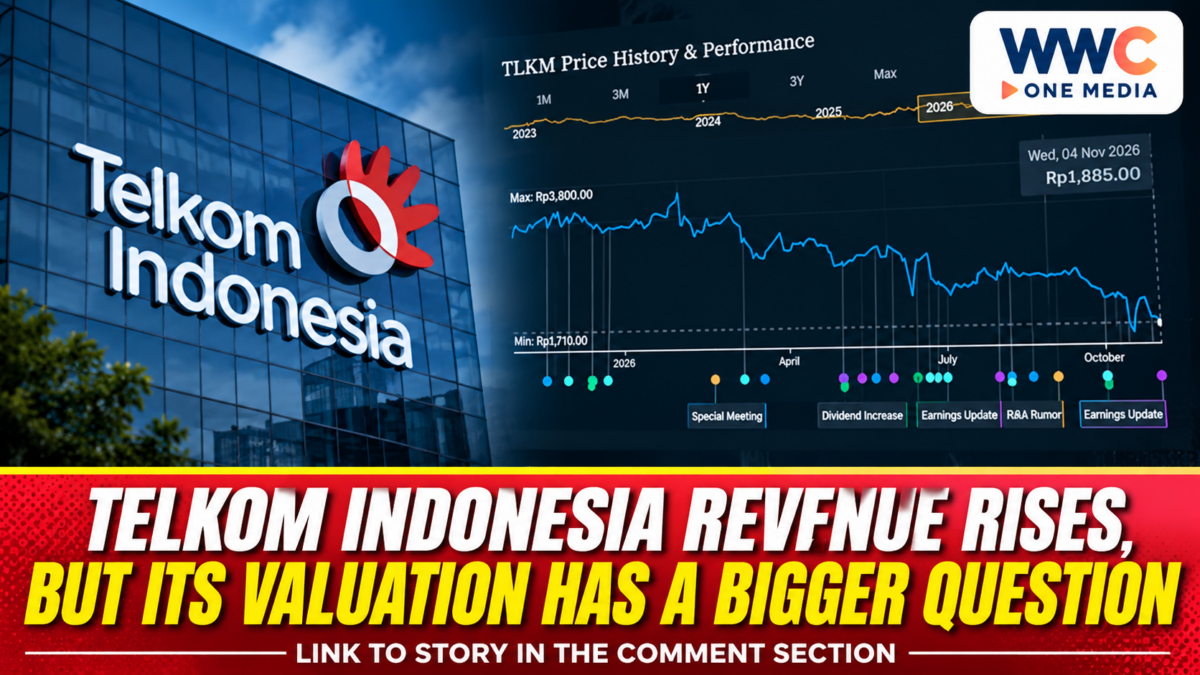
JAKARTA, Indonesia — Telkom Indonesia delivered higher revenue during the first nine months of 2026, but weaker reported earnings and an unavailable forward price-to-sales figure on a TradingView valuation page leave investors with an important question: how much should they pay for the telecommunications group’s future growth?
The company, officially known as PT Telkom Indonesia (Persero) Tbk, recorded consolidated revenue of Rp113.502 trillion for the nine months ended Sept. 30, 2026, up 3.5% from Rp109.617 trillion a year earlier.
However, profit attributable to the owners of the parent company declined to Rp14.446 trillion from Rp15.031 trillion. The contrast between growing revenue and lower reported profit makes the company’s valuation more complicated than a simple growth story.
The issue is relevant to investors tracking Telkom’s Singapore-listed security under ticker ITKD, a Singapore Depository Receipt (SDR) representing the Indonesian telecommunications company’s underlying shares.
TradingView has a dedicated page for ITKD’s forward price-to-sales ratio. But the page reviewed for this report displays the metric heading without a numerical value in its period, value or change fields. It also displays a “No trades” status.
That means the page does not provide a confirmed forward P/S figure that can responsibly be presented as Telkom’s current valuation.
Telkom Indonesia grows revenue, but reported profit falls
Telkom’s nine-month financial statements show that revenue increased 3.5% year on year, while EBITDA reached Rp55.487 trillion, up 2.0%.
Its EBITDA margin was 48.9%, compared with 49.6% in the corresponding 2025 period.
Reported profit attributable to parent-company owners declined 3.9% to Rp14.446 trillion. The company’s net income margin was 12.7%, down from 13.7% a year earlier.
Telkom also presented a separate adjusted measure: normalized net income increased 3.9% to Rp16.533 trillion.
That figure needs to be distinguished from statutory reported profit. The company’s reconciliation adjusts for specified advisory costs, depreciation changes, investment valuation movements, tax effects and a divestment-related item.
For investors, the difference matters. Normalized earnings can help explain underlying performance, but they do not replace the reported figure in the financial statements.
The company’s latest results therefore present two sides of the business: revenue and EBITDA continued to grow, while reported profit declined.
Why the forward price-to-sales ratio matters
The forward price-to-sales ratio compares a company’s market value with its expected future revenue.
Unlike the traditional price-to-sales ratio, which uses historical or trailing revenue, the forward measure depends on estimates of sales in a future period.
A lower ratio can indicate that investors are paying less for each unit of expected revenue. But it does not automatically mean a stock is undervalued.
Investors also need to consider profitability, debt, capital expenditure, competition and the reliability of revenue forecasts.
For a telecommunications group such as Telkom, the distinction is particularly important. Network infrastructure requires substantial investment, while mobile, broadband, enterprise and wholesale services can have different growth and profitability profiles.
A forward P/S figure also depends on the share price, the company’s market capitalisation, the expected revenue period and the data provider’s methodology.
Because TradingView’s ITKD page does not currently display a numerical forward P/S value, investors should not treat the page as evidence that the security is trading at a particular valuation multiple.
ITKD is not the same as buying Telkom shares directly in Jakarta
One detail is especially important for investors comparing Telkom’s Indonesian listing with its Singapore-traded security.
ITKD is the trading code for Telkom Indonesia ID SDR 1to5 on the Singapore Exchange. The instrument represents five underlying Telkom shares for each Singapore Depository Receipt.
The SDR was introduced as part of the Indonesia-Singapore Depository Receipt linkage launched in October 2025. It gives eligible investors a way to access selected Indonesian companies through a security traded in Singapore dollars.
However, an SDR is not simply an ordinary share traded in a different currency.
Investors must consider the instrument’s depositary arrangements, applicable fees, exchange-rate movements and the terms governing corporate-action entitlements.
For example, Telkom’s June 2026 dividend announcement for the SDR specified a final net distribution of SGD0.06207 per SDR, following currency conversion and applicable deductions.
That illustrates why investors should examine the SDR’s own terms and distribution notices rather than assuming that the dividend received will be identical to the amount declared for an underlying Indonesian share.
The Singapore listing also does not eliminate exposure to Telkom’s business performance or movements in the Indonesian market.
Digital services are becoming a bigger part of Telkom’s business
Telkom’s revenue breakdown shows why its valuation cannot be assessed solely as a traditional telephone operator.
Data, internet and information technology services generated Rp71.547 trillion during the first nine months of 2026, compared with Rp66.066 trillion a year earlier.
The company’s IndiHome revenue, however, declined to Rp19.129 trillion from Rp19.731 trillion. Interconnection revenue also decreased to Rp6.720 trillion from Rp7.107 trillion.
These figures suggest that growth is increasingly concentrated in data and digital services rather than every part of the group’s traditional telecommunications portfolio.
Telkom is also reorganising its infrastructure operations. Its corporate presentation says the two-phase spin-off of network assets into InfraNexia was completed on Sept. 30, 2026, consolidating more than 90% of its network assets into the new infrastructure entity.
The transaction was valued at Rp35.8 trillion for Phase 1 and Rp49.9 trillion for Phase 2.
The company says the restructuring is intended to improve asset utilisation, support commercialisation of network capacity and create opportunities for strategic partnerships. Whether those objectives translate into stronger financial returns will depend on execution.
The changes reflect a wider regional shift towards digital infrastructure, data centres and enterprise connectivity. WWC ONE MEDIA has examined a similar commercial transition in its report on Converge’s plans to expand from broadband into AI and digital infrastructure.
Indonesia’s market conditions add another valuation risk
Telkom’s valuation also needs to be considered within the wider Indonesian equity market.
Investor confidence, market liquidity, foreign participation and the availability of shares for trading can affect how listed companies are valued.
Indonesia’s market has faced scrutiny over transparency, free-float availability and investability. These concerns have become particularly relevant to international investors assessing whether Indonesian shares can maintain their place in global investment benchmarks.
WWC’s coverage of Indonesia’s stock-market volatility and the MSCI classification debate examines how market-structure concerns can influence international investor sentiment.
The Singapore-Indonesia investment relationship is also relevant because the SDR linkage was designed to make selected Indonesian companies accessible through Singapore’s market infrastructure. WWC has explored the broader relationship in its report on Singapore-Indonesia cooperation and its investment agenda.
Still, broader market concerns should not be confused with evidence of a specific problem at Telkom. The company’s financial performance and the Indonesian market’s structural issues are separate subjects that investors should assess independently.
What investors should watch next
Telkom’s latest results leave several questions for investors.
First, can the company sustain revenue growth while improving its reported profit margin? Revenue increased during the first nine months of 2026, but reported profit attributable to parent-company owners declined.
Second, can the InfraNexia restructuring generate measurable commercial benefits? The transfer of network assets is complete, but future partnerships, capacity utilisation and financial returns will determine whether the restructuring creates additional value.
Third, will the ITKD forward price-to-sales metric become available with a clearly identified forecast period and estimate? Without that information, investors cannot use the TradingView page to make a reliable forward-sales valuation comparison.
The next assessment should combine the company’s published financial statements, its market price, the SDR’s terms and a clearly sourced revenue forecast.
Telkom’s revenue growth provides a positive operating signal, but the decline in reported profit makes the investment case more nuanced. Until a verifiable forward valuation figure is available, the central question is not whether ITKD looks cheap or expensive on a missing ratio.
It is whether Telkom can turn its expanding digital-services business and infrastructure restructuring into stronger, sustainable earnings.