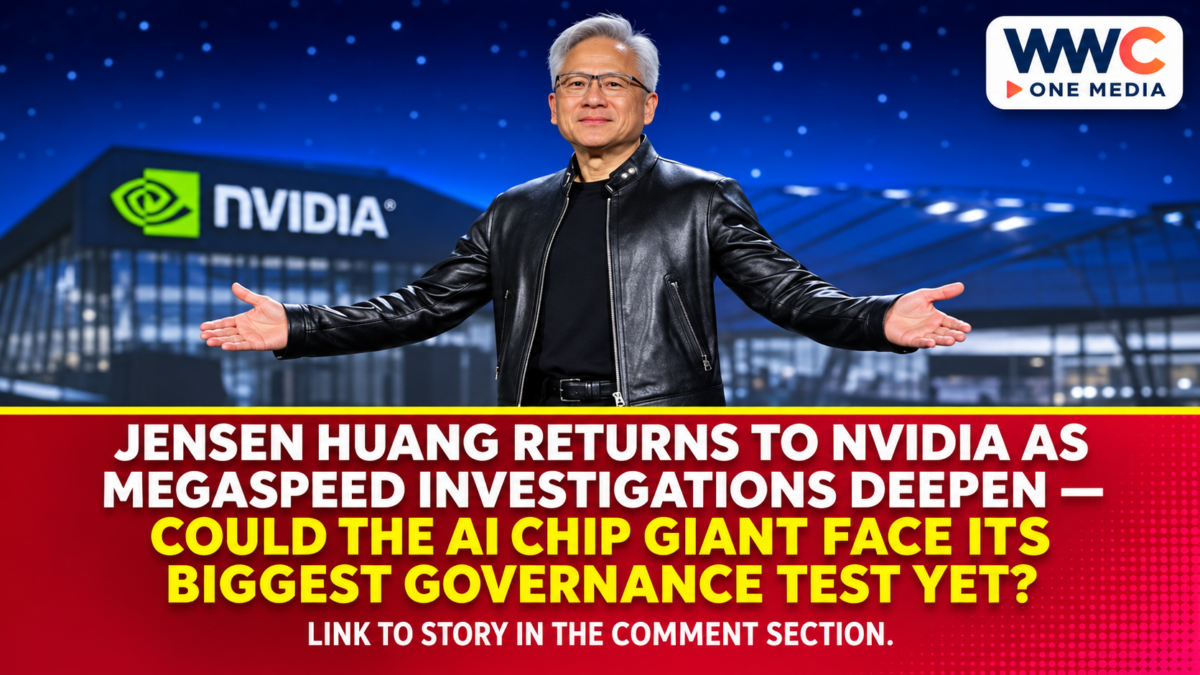
November 26, 2026 | International Business Desk — The Nvidia Megaspeed investigation is emerging as a significant corporate governance challenge for the global artificial intelligence industry as Jensen Huang returns to lead Nvidia Corporation (NASDAQ: NVDA) amid continuing government scrutiny of semiconductor exports.
Nvidia announced Huang’s reinstatement on November 23, restoring its longtime leader as president, chief executive officer and board member.
However, his return has not ended the independent investigation initiated by Nvidia’s directors or the separate government inquiries involving semiconductor export compliance.
The controversy extends beyond the leadership of a single technology company. It raises broader questions about corporate accountability, national security and the movement of advanced computing technology across international borders.
For investors and technology businesses across the Asia-Pacific region, the eventual findings could influence how semiconductor companies manage regulatory compliance and overseas commercial relationships.
Nvidia Megaspeed Investigation: A Regulatory Inquiry That Began in 2024
The investigation into Singapore-based Megaspeed predates Nvidia’s recent leadership upheaval.
The US Department of Commerce began examining the company in 2024 over possible violations of semiconductor export restrictions.
By May 2025, investigators had requested documentation from Nvidia concerning direct and indirect sales involving Megaspeed.
Nvidia subsequently restricted sales to the Singapore-based company in June 2025.
American and Singaporean enforcement personnel also examined Megaspeed’s operations that month.
The US Department of Justice subsequently assumed primary responsibility for the criminal investigation into Megaspeed.
These developments establish that the regulatory inquiry began well before Huang’s November 2026 resignation and reinstatement.
They do not, however, establish that Nvidia or its chief executive committed criminal offences.
The distinction is essential when assessing the potential legal and commercial consequences of an ongoing investigation.
Singapore Conducts Its Own Investigation
Singapore’s involvement represents a separate dimension of the controversy.
In February 2025, the Singapore Police Force and Singapore Customs initiated an independent investigation involving Megaspeed, its controllers and other companies.
The inquiry concerns suspected domestic offences, including possible false declarations associated with server purchases.
Singapore’s government has clarified that its investigation was not initiated at the request of another country.
Authorities also investigated Alice Huang, otherwise known as Huang Le, in connection with her role at Megaspeed during the relevant period.
Importantly, Singapore’s Ministry of Home Affairs explicitly stated that its investigation into her did not concern espionage.
That clarification prevents two distinct matters from being incorrectly treated as the same investigation.
The legal questions arising from potential commercial documentation offences are different from allegations involving foreign intelligence activities.
For multinational technology businesses, the case illustrates why compliance with domestic laws and international export restrictions requires separate but coordinated oversight.
California Investigates Potential Risks to Nvidia Investors
The regulatory scrutiny expanded on November 19, 2026, when California Attorney General Rob Bonta served an investigative subpoena on Nvidia.
California’s Department of Justice is examining whether advanced semiconductor technology or confidential information may have reached China and whether Nvidia misrepresented related risks to investors and the public.
The inquiry seeks information that could help determine whether California law was violated.
An investigative subpoena is a mechanism for obtaining relevant evidence. It does not establish that the company has committed an offence.
Nevertheless, the investigation introduces an additional corporate governance concern.
Publicly listed businesses must consider whether information about significant operational and regulatory risks has been appropriately communicated to shareholders.
The eventual findings could therefore become relevant not only to export compliance but also to Nvidia’s corporate disclosures and internal oversight procedures.
Jensen Huang Returns, but Nvidia’s Internal Investigation Continues
Nvidia announced Huang’s resignation on November 12 and appointed executive vice president and chief financial officer Colette Kress as interim chief executive.
The board subsequently reversed its leadership decision, announcing Huang’s return on November 23.
Directors voted unanimously in favour of his reinstatement after discussions with Huang and receiving input from senior levels of the US government.
The board expressed confidence that his return would not create a national security risk.
However, that assessment did not terminate the independent investigation.
As detailed in WWC ONE MEDIA’s earlier coverage of Jensen Huang’s reinstatement and Nvidia’s continuing security investigation, resolving the company’s leadership uncertainty is different from resolving its regulatory and governance questions.
Nvidia’s directors have confirmed that their investigation will continue until completion and that Huang has committed to cooperating with it.
The company’s confidence in its chief executive should therefore not be interpreted as a final legal determination concerning every outstanding allegation.
Nvidia Introduces Additional Corporate Governance Safeguards
Beyond reinstating Huang, Nvidia has established additional oversight arrangements addressing national security and trade compliance.
The company has created a board committee consisting exclusively of independent directors to oversee these responsibilities.
It is also searching for a chief compliance officer who will report to the Nominating and Corporate Governance Committee.
These measures expand the company’s formal oversight structure at a time when its international operations face heightened scrutiny.
WWC ONE MEDIA previously examined Nvidia’s leadership transition and changes to board-level security oversight.
The next challenge will be determining whether these organisational changes produce effective monitoring, meaningful accountability and timely reporting of potential compliance problems.
The creation of a committee does not itself establish that previous compliance arrangements were inadequate.
Similarly, appointing additional compliance personnel cannot guarantee that future violations will never occur.
The effectiveness of these safeguards will depend on their implementation and the authority given to those responsible for overseeing corporate conduct.
Why the Investigation Matters to Asia-Pacific Technology Markets
The semiconductor industry depends on international commercial relationships involving manufacturers, equipment suppliers, data centre operators and technology service providers.
Export restrictions introduce additional legal responsibilities for businesses participating in these networks.
For semiconductor suppliers, these responsibilities may include assessing customers, documenting transactions and complying with applicable restrictions on technology distribution.
For data centre operators, regulatory uncertainty could affect equipment procurement and long-term infrastructure investment.
The commercial implications of the Nvidia Megaspeed investigation could therefore extend beyond the two companies directly associated with the controversy.
However, the extent of any future industry-wide impact remains uncertain.
It would be premature to conclude that the investigations will result in broader semiconductor shortages, widespread contract cancellations or restrictions affecting every technology company operating in Southeast Asia.
Such outcomes would depend on subsequent regulatory decisions and the circumstances of individual businesses.
What Happens Next?
Congressional oversight represents another important development.
The US Senate Committee on Banking, Housing, and Urban Affairs has scheduled a public hearing for December 3, 2026, concerning American AI export controls, with Jensen Huang listed as a witness.
The upcoming proceedings follow expanding congressional scrutiny of Nvidia’s semiconductor export practices.
Investors will also need to monitor the findings of Nvidia’s independent investigation, developments in Singapore and further announcements from American enforcement authorities.
These proceedings may provide greater clarity about the company’s regulatory exposure and the effectiveness of its newly established governance arrangements.
For now, Huang’s return has resolved an immediate leadership question.
Whether Nvidia can demonstrate that its compliance systems are sufficiently robust to support its international growth remains a separate and potentially more consequential challenge.
Frequently Asked Questions
What is the Nvidia Megaspeed investigation?
It concerns possible semiconductor export-control violations involving Singapore-based Megaspeed. Separate inquiries also address potential domestic offences in Singapore and Nvidia’s corporate disclosures in California.
When did the Megaspeed investigation begin?
The US Department of Commerce began investigating Megaspeed in 2024. Singapore authorities initiated their independent investigation in February 2025.
Is Jensen Huang back as Nvidia CEO?
Yes. Nvidia announced his reinstatement as president, chief executive officer and board director on November 23, 2026.
Has Nvidia been found guilty of illegally exporting AI chips?
The primary records reviewed do not establish such a finding. Investigations and requests for information must not be interpreted as criminal convictions.
When is Jensen Huang scheduled to appear before the US Senate?
The Senate Banking Committee has scheduled a public hearing on AI export controls for December 3, 2026, with Huang listed as a witness.