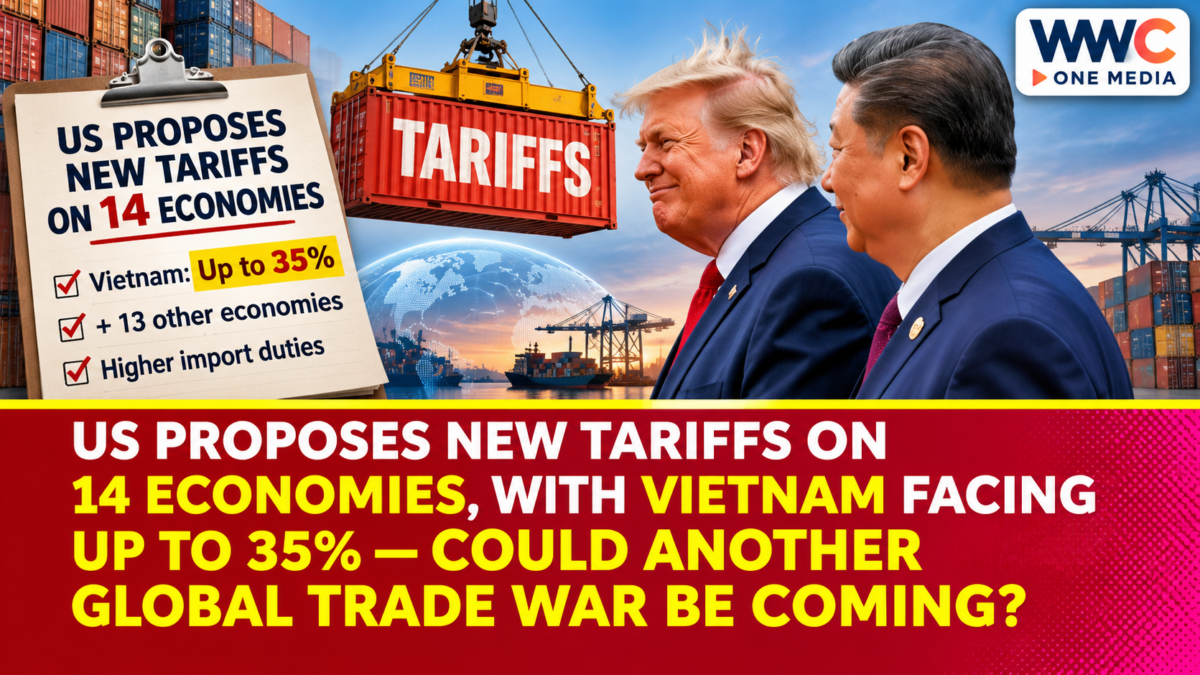
WASHINGTON, UNITED STATES — The United States has opened a new chapter in global trade tensions after proposing tariffs against 14 major trading partners, including China, Japan, South Korea, Vietnam, Singapore and the European Union.
On Nov. 25, 2026, US Trade Representative Jamieson Greer announced formal findings under Section 301 of the Trade Act of 1974, concluding that manufacturing-related policies and practices in the targeted economies burden or restrict American commerce.
Vietnam faces a proposed tariff rate of up to 35%, while India could face duties of up to 25%. Existing trade agreements and future negotiations could substantially influence the final rates.
The announcement introduces fresh uncertainty for international manufacturers, retailers, exporters and logistics companies, particularly across the Asia-Pacific region.
However, the proposed measures remain subject to public consultation and further government decisions. They have not automatically become effective customs duties.
US Section 301 tariffs: Which economies are affected?
Washington’s latest determinations cover 14 economies:
- China
- European Union
- Singapore
- Switzerland
- Indonesia
- Malaysia
- Cambodia
- Thailand
- South Korea
- Vietnam
- Taiwan
- Bangladesh
- Japan
- India
The original investigation, initiated on March 11, 2026, covered 16 economies, including Mexico and Norway. Neither is included in the 14 determinations announced on Nov. 25.
The latest announcement represents a significant development from the earlier investigation examined in WWC ONE MEDIA’s coverage of the US tariff probe involving China and the European Union.
Unlike the initial investigation, the November announcement establishes formal US government findings and identifies proposed responsive measures.
Nevertheless, an administrative determination under American trade law is not equivalent to an international ruling establishing that every targeted economy has breached global trade rules.
Vietnam and India face significant tariff uncertainty
Vietnam is among the economies facing particularly consequential proposed tariff measures.
Washington has outlined a potential rate of up to 35% on Vietnamese goods, subject to specified exemptions and adjustments for existing Section 301 duties.
However, the proposal also provides for consideration of a 20% rate if Vietnam concludes a reciprocal trade agreement that adequately addresses the investigation’s findings.
India faces a similar negotiating structure. Its proposed rate could reach 25%, with a potential adjustment to 17% under an appropriate reciprocal trade agreement.
Singapore faces a proposed rate of up to 20%, with a possible reduction to 10% depending on the outcome of trade negotiations.
These conditional arrangements introduce an important commercial distinction: the highest proposed rate is not necessarily the rate that businesses will ultimately pay.
| Economy | Published tariff proposal |
|---|---|
| Vietnam | Up to 35%; possible 20% negotiated rate |
| India | Up to 25%; possible 17% negotiated rate |
| Singapore | Up to 20%; possible 10% negotiated rate |
| Indonesia | Up to 18% |
| Malaysia | Up to 18% |
| Thailand | Up to 18% |
| Japan | Up to 15% |
| South Korea | Up to 15% |
| Taiwan | Up to 15% |
| Switzerland | Up to 15% |
| European Union | 15% |
These figures are subject to economy-specific conditions, product exemptions and interactions with existing duties. They should not be interpreted as identical additional charges across all imported goods.
Japan and South Korea face a test of existing trade agreements
The inclusion of Japan and South Korea demonstrates that Washington’s latest trade investigation extends beyond its longstanding economic disagreements with China.
For Japanese products, the US proposal considers a rate of up to 15%, accounting for existing most-favoured-nation and Section 301 duties, alongside other relevant tariff measures and bilateral commitments.
This development adds another dimension to the US$550-billion Japan–US investment partnership.
For South Korea, Washington has proposed comparable treatment of up to 15%, taking into consideration commitments under the Korea Strategic Trade and Investment Deal.
The latest announcement provides greater clarity on uncertainties previously examined in WWC ONE MEDIA’s analysis of South Korea’s exposure to new American tariffs.
For companies operating in both economies, the critical question is how the final implementing rules will treat individual products rather than simply whether a 15% framework exists.
China faces renewed pressure despite trade negotiations
Washington’s proposal for China includes tariffs of up to 20% on goods outside specified annexes, with proposed rates of up to 10% for certain listed products and exemptions for others.
The calculation also accounts for applicable duties under the separate Section 301 investigation concerning prohibitions on imports produced with forced labour.
China’s tariff treatment therefore cannot be reduced to a single universal percentage.
The announcement comes amid continuing bilateral negotiations previously examined in the US–China trade truce and proposed tariff discussions covering US$60 billion in merchandise.
The new investigation illustrates how progress in one area of trade negotiations can coexist with additional regulatory pressure elsewhere.
Why Washington is targeting manufacturing overcapacity
The economic concept at the centre of the investigation is structural manufacturing overcapacity.
It generally describes production capacity that exceeds the demand an industry can sustainably accommodate.
Washington’s position is that certain foreign industrial policies encourage excessive production and disadvantage American manufacturers.
However, manufacturing scale alone does not establish unfair trade practices.
High production volumes may also reflect productivity improvements, economies of scale, technological capabilities or legitimate comparative advantages.
The policy challenge is distinguishing internationally competitive manufacturing from production sustained by measures that distort market conditions.
Tariffs intended to protect domestic producers may also increase costs for businesses relying on imported components or finished goods.
The eventual economic consequences will depend on the final measures, supplier responses and the extent to which businesses can absorb or pass on additional costs.
What happens next for global trade?
Written public comments and requests to participate in hearings are due by Jan. 5, 2027.
Public hearings concerning the proposed actions are scheduled to begin on Jan. 25, 2027.
These proceedings provide an opportunity for interested businesses and other stakeholders to present information about the proposed measures and their possible consequences.
For exporters and importers, the immediate priority is evaluating product classifications, contractual responsibilities, tariff exemptions and alternative sourcing arrangements.
Companies should avoid assuming that every shipment will automatically face the maximum rate announced.
The decisive question is whether negotiations can produce mutually acceptable trade arrangements before new duties take effect.
Washington’s November announcement has established the next stage of the dispute. Whether it leads to another prolonged global trade confrontation remains dependent on the outcome of negotiations and the final regulatory measures.
Frequently asked questions
Has the US imposed new Section 301 tariffs on 14 economies?
The United States announced formal findings and proposed tariff measures on Nov. 25, 2026. The latest proposals are subject to public consultation and have not automatically taken effect.
How high could US tariffs on Vietnam become?
Washington has proposed rates of up to 35%, with consideration of a 20% rate under a qualifying reciprocal trade agreement.
What tariffs has the United States proposed for Japan?
The proposal considers tariffs of up to 15%, subject to existing duties, exemptions and relevant bilateral trade commitments.
Why is the US proposing additional tariffs?
The US government has determined that certain foreign manufacturing policies associated with structural excess capacity burden or restrict American commerce.
When will the proposed tariffs take effect?
A final implementation date has not been established in the November 25 announcement. Public comments are due Jan. 5, 2027, with hearings scheduled to begin Jan. 25.