
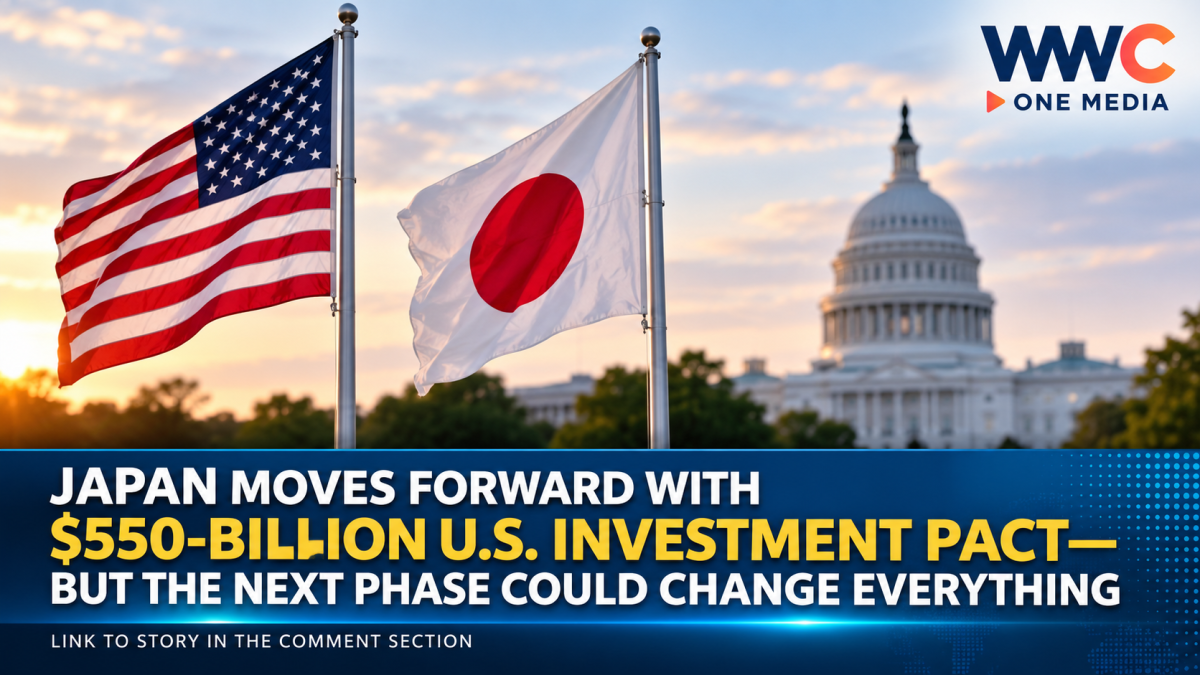
TOKYO/WASHINGTON — Japan says it is making progress on a massive $550-billion investment initiative with the United States, with artificial intelligence and semiconductor projects emerging as potentially crucial areas in the next stage of the agreement.
Japanese Trade Minister Ryosei Akazawa said Tokyo and Washington will continue working closely to implement the investment framework after meetings in Washington with U.S. Commerce Secretary Howard Lutnick and U.S. Trade Representative Jamieson Greer.
Akazawa stopped short of providing details about a possible third tranche of projects, but indicated that AI and semiconductor-related investments are likely to carry significant weight as the two countries decide where the next wave of capital could be directed.
AI and semiconductors emerge as key priorities
The renewed focus on artificial intelligence and chips reflects the growing strategic importance of both industries to the United States and Japan.
Akazawa said discussions involving AI and semiconductors would have “very significant weight,” while emphasizing that the two governments are seeking projects that provide mutual economic benefits.
The emphasis could place semiconductor manufacturing, AI infrastructure and related technology supply chains at the center of future investment announcements.
For both countries, the issue extends beyond ordinary trade. Semiconductors and AI have become closely linked to economic security, industrial competitiveness and efforts to reduce vulnerabilities in critical supply chains.
What is the $550-billion Japan-U.S. deal?
The investment initiative was established as a major component of the U.S.-Japan trade agreement reached in 2025.
Under the arrangement, Japan committed to facilitate up to $550 billion in investments and loans for U.S. projects, while the United States agreed to reduce the tariff burden on Japanese imports, including setting a 15% tariff framework for Japanese goods and lowering automobile tariffs compared with rates previously threatened or imposed.
The agreement was designed to encourage Japanese capital into strategically important sectors of the U.S. economy while strengthening the broader economic relationship between Washington and Tokyo.
Billions already tied to projects
The $550-billion headline figure does not mean that $550 billion has already been spent.
Instead, the initiative is being implemented through individual projects and financing arrangements.
Reuters reported in May that Japan had signed a $2.2-billion loan agreement connected to the first group of projects. Japan Bank for International Cooperation was set to provide about one-third of that financing, with commercial banks providing the remainder.
The first group included projects with a combined potential value of about $36 billion, involving an oil export facility in Texas, an industrial diamond plant in Georgia and a natural-gas-fired power plant in Ohio.
A second package announced in March was valued at as much as $73 billion, including small modular nuclear reactor projects in Tennessee and Alabama and natural-gas power facilities in Pennsylvania and Texas. Some of the planned electricity generation is expected to serve the rapidly growing power needs of U.S. data centers.
Japan has been moving cautiously
Despite the enormous headline figure, implementation has been gradual.
A July report from the Japan Times said projects selected under the pledge represented about 20% of the planned total one year after the trade agreement was reached. At that point, six projects had been selected for Japanese investment or financing.
That makes the latest comments from Akazawa significant: the two governments appear to be preparing for another stage of project selection rather than simply announcing a single massive transfer of capital.
Why the next projects matter
The next tranche could reveal where Washington and Tokyo believe their strategic interests overlap most strongly.
Energy has already featured heavily in the initial rounds, but AI and semiconductors could give the investment initiative a stronger technology component.
That could mean greater attention to semiconductor manufacturing capacity, AI-related infrastructure and other technologies viewed as strategically important to both countries.
The shift would also align with Japan’s own domestic economic-security priorities, as Tokyo has been increasing its focus on AI, semiconductors and strategic industries.
A deal with bigger implications than investment
The pact is about more than Japanese companies putting money into American projects.
It also represents a broader effort by Washington and Tokyo to deepen economic and strategic cooperation at a time when both countries are seeking more resilient supply chains for critical technologies and resources.
The investment framework has therefore become an important part of the U.S.-Japan relationship, linking trade policy, industrial policy, energy security, semiconductor supply chains and artificial intelligence.
But the most important question may now be what comes next.
Japan has confirmed progress, yet officials have not disclosed the full details of a third package. As negotiations continue, the eventual list of projects could show whether AI and semiconductors become the next major pillars of the $550-billion initiative.
For now, the money is moving—but the biggest technology bets may still be waiting to be revealed.
WWC ONE MEDIA M.J.E




Leave a Reply