
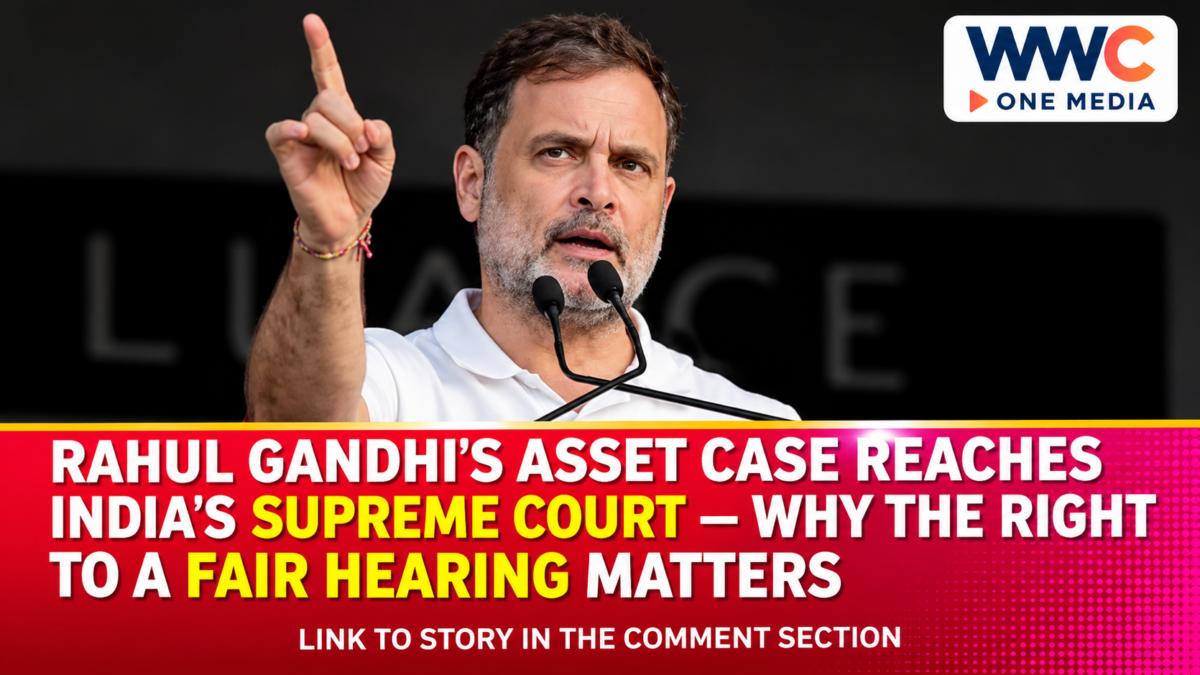
NEW DELHI — Legal proceedings involving Indian opposition leader Rahul Gandhi have placed judicial fairness, financial accountability and the powers of investigative authorities under renewed scrutiny.
The Supreme Court of India listed Gandhi’s petitions against earlier Allahabad High Court orders for consideration on November 25, 2026, bringing attention to a legal dispute that has been before the country’s highest court since August.
Gandhi, who has served as Leader of the Opposition in the Lok Sabha since June 9, 2024, challenged three orders issued by the Allahabad High Court’s Lucknow Bench.
The proceedings raise important questions about how courts should handle complaints involving public officials while protecting the legal rights of the individuals concerned.
At the centre of the controversy is a fundamental distinction: challenging the legality of an investigative procedure is not the same as determining whether the underlying allegations are true.
Rahul Gandhi Asset Case: What the Court Records Establish
The Supreme Court’s August 17, 2026, record of proceedings identifies three challenged Allahabad High Court orders dated May 6, May 12 and July 20.
All three arose from proceedings registered under Criminal Miscellaneous Writ Petition No. 4180/2026.
Gandhi subsequently approached the Supreme Court through special leave petitions initially recorded under Diary No. 47728/2026.
The case involves S. Vignesh Shishir and other respondents.
On August 17, the Supreme Court granted permission to file the special leave petitions, issued notices and established temporary restrictions concerning the proceedings.
The judicial directions included preventing the Central Bureau of Investigation (CBI), Directorate of Enforcement and other authorities from submitting reports to the High Court pursuant to the challenged orders.
The Supreme Court also instructed the High Court to postpone its next hearing until further orders.
These directions established procedural safeguards while the higher court considered the dispute.
They did not, by themselves, determine whether any financial allegation against Gandhi was accurate.
Why the Supreme Court’s Intervention Matters
The August proceedings illustrate the important distinction between judicial oversight and the substantive examination of allegations.
When a court reviews an earlier judicial order, it may need to determine whether the appropriate procedures were followed, whether the relevant parties received adequate notice and whether the original proceedings had a sufficient legal basis.
These questions can be significant even before the underlying factual allegations are considered.
A temporary restriction on submitting investigative reports does not necessarily establish that every investigative activity is unlawful.
Similarly, a decision permitting a complaint to proceed would not automatically establish that the person concerned committed an offence.
The wider importance of judicial safeguards was previously examined in WWC ONE MEDIA’s coverage of India’s Supreme Court and the legal boundaries governing voter registration and citizenship.
Although that litigation concerns a separate legal issue, it illustrates why the authority of government institutions must be considered alongside the procedures through which their decisions are made.
For Gandhi’s case, the written judicial directions remain essential to understanding the precise scope of any restrictions or subsequent proceedings.
What Happened After the August Supreme Court Hearing?
The legal proceedings continued through September.
On September 8, 2026, the Supreme Court’s Registrar recorded further procedural developments concerning the parties, legal representation and service of notices.
The proceedings were identified under Special Leave Petition (Criminal) Nos. 15416–15418/2026.
The Registrar directed Gandhi’s legal representative to provide the first respondent with a copy of the petition and recorded matters involving the representation of other respondents.
The order also addressed the filing of documents and instructed that the case be processed in accordance with the Supreme Court’s August 17 directions.
These procedural developments demonstrate that litigation involving a prominent political figure can require several administrative and judicial steps before substantive questions are resolved.
The Supreme Court’s November 25 cause list subsequently included Gandhi’s special leave petitions as Item No. 31.
Connected transfer petitions were listed separately as Item No. 31.1.
A cause list establishes that a matter is scheduled for consideration. It does not, by itself, establish the outcome of the hearing.
The complete written order is therefore necessary to determine the precise legal consequences of the November proceedings.
Financial Transparency and the Rights of Public Officials
Financial accountability is an important component of democratic governance.
Public confidence depends partly on whether institutions can examine legitimate concerns involving public officials through credible and legally authorised procedures.
However, public accountability must coexist with safeguards against unsupported accusations and prejudicial treatment.
An allegation involving disproportionate assets requires more than speculation about a person’s apparent wealth.
Any substantive examination would need to consider relevant financial evidence, applicable legal requirements and the person’s opportunity to respond.
The existence of a complaint does not establish that its allegations are accurate.
Likewise, political prominence should not automatically place an individual beyond legitimate scrutiny.
The broader importance of financial transparency in democratic institutions has been examined in WWC ONE MEDIA’s coverage of political donations and the role of disclosure requirements.
Although campaign financing and personal asset verification involve different legal frameworks, both demonstrate why transparency measures must operate within clearly established rules.
The objective should be accountability supported by reliable evidence and fair procedures rather than conclusions driven by political affiliation.
Why the Case Carries Wider Political Significance
Gandhi occupies a prominent position within India’s parliamentary opposition.
The Lok Sabha’s official records identify him as Leader of the Opposition, a position he has held since June 9, 2024.
His political activities have also placed him at the centre of wider debates involving government accountability and electoral administration.
WWC ONE MEDIA has previously covered Rahul Gandhi’s involvement in protests over India’s electoral-roll revision.
Those political developments are separate from the present asset-related litigation and should not be treated as evidence concerning the financial allegations.
Nevertheless, the visibility of the individuals involved makes accurate reporting particularly important.
A procedural court decision can easily be interpreted as a political victory or defeat, even when the judicial questions concern narrower legal issues.
For citizens, investors and international observers, confidence in democratic institutions depends on whether legal processes are applied consistently, irrespective of political influence.
What Happens Next?
The immediate priority is examining the complete written record of the Supreme Court’s November 25 proceedings.
That document will establish the precise disposition of the challenged High Court orders, any further directions concerning the parties and the legal questions that remain open.
Any future proceedings should also distinguish between the admissibility of a petition, the authority to conduct an investigation and the substantive evidence supporting individual allegations.
These are related but legally distinct issues.
For now, the previously examined court records establish that Gandhi challenged earlier judicial orders and that the Supreme Court intervened in August to regulate the continuation of those proceedings.
They do not establish financial misconduct or provide a basis for declaring Gandhi guilty or innocent of the underlying allegations.
The wider significance of the dispute lies in whether India’s legal institutions can balance legitimate public scrutiny with procedural fairness.
That balance matters not only to the individuals involved but also to public confidence in the country’s judicial system.
Frequently Asked Questions
What is the Rahul Gandhi asset case?
The case concerns legal proceedings connected to complaints about Rahul Gandhi’s assets and his challenge to three orders issued by the Allahabad High Court’s Lucknow Bench.
What did the Supreme Court order on August 17, 2026?
The Supreme Court directed the High Court to defer its next hearing and instructed the CBI, Directorate of Enforcement and other authorities not to submit reports pursuant to the challenged orders until the court directed otherwise.
What is the Supreme Court case number?
The special leave petitions are registered as SLP (Criminal) Nos. 15416–15418/2026. The original Supreme Court diary number was 47728/2026.
Has Rahul Gandhi been found guilty of financial misconduct in this case?
The primary court records examined do not establish a finding of financial misconduct against Gandhi. Allegations and judicial findings must be distinguished.
Was Rahul Gandhi’s case listed on November 25, 2026?
Yes. The Supreme Court’s official cause list included Gandhi’s special leave petitions and connected transfer petitions on that date. The cause list alone does not establish the outcome.










