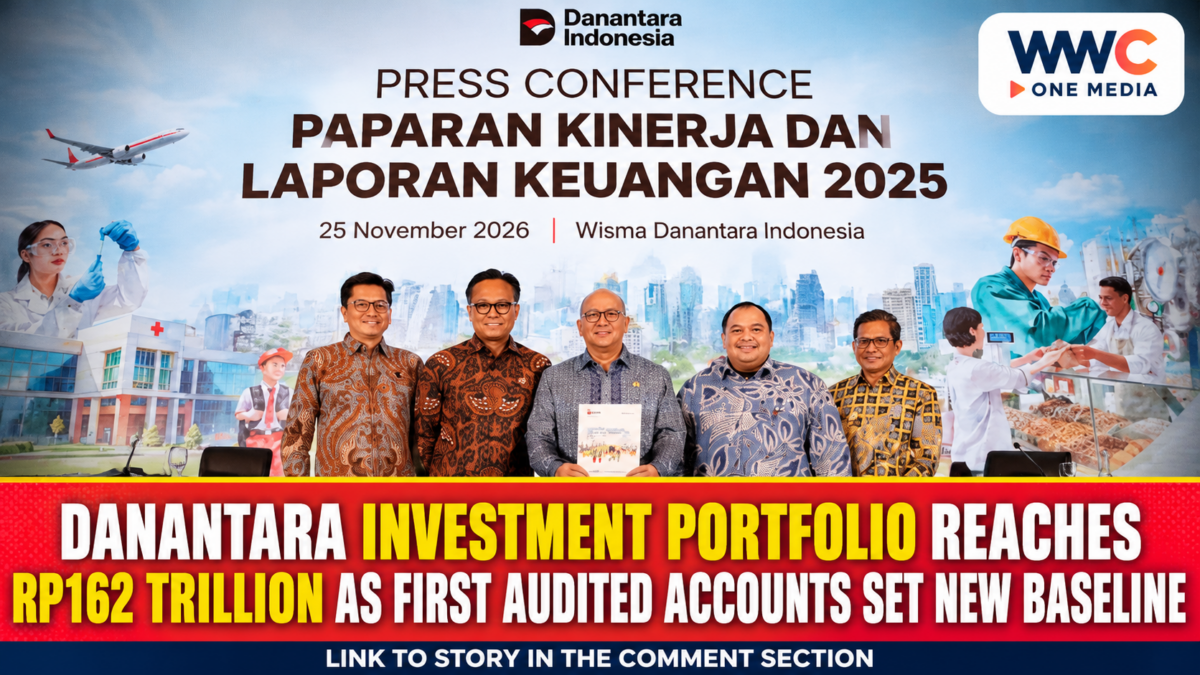
Jakarta, Indonesia — November 26, 2026. Indonesia’s state investment institution Danantara has published its first audited consolidated financial results, reporting Rp203.4 trillion in net profit for the April-to-December 2025 consolidation period, while its investment arm disclosed approximately Rp162 trillion in total investment assets as of October 2026. The disclosures establish a public financial baseline for the institution, but the next test is whether its expanding portfolio can deliver measurable and sustainable results.
The figures come at an important stage in Danantara’s development. Established to manage and optimise government investments and assets associated with state-owned enterprises, the institution is expected to play a significant role in Indonesia’s industrial and economic development. Its financial scale is considerable, but the quality of its investment decisions, transparency and long-term performance will matter more than the size of its portfolio alone. danantaraindonesia.co.id
Danantara’s first audited results establish a financial baseline
Danantara’s first consolidated financial statements cover the period from April to December 2025, following the transfer of state-owned enterprise shares in March that year.
The institution reported Rp2,385.2 trillion in operating revenue, Rp203.4 trillion in net profit and Rp563.1 trillion in net cash flow from operating activities. Its consolidated assets stood at Rp11,607 trillion as of December 31, 2025.
The financial statements received an unqualified opinion from Indonesia’s Audit Board, known as BPK. The audit opinion means the statements were considered fairly presented, in all material respects, under the applicable financial reporting standards. It should not be interpreted as a guarantee that every investment will perform successfully or that future returns are assured. danantaraindonesia.co.id+1
The reporting period also requires context. The profit figure covers nine months of consolidated operations, not a full calendar year of comparable performance. Danantara itself describes the results as an initial baseline for measuring asset management and performance in the years ahead.
That distinction will matter when future financial statements are compared with the inaugural report.
The Danantara investment portfolio has expanded beyond public markets
Danantara Investment Management, or DIM, reported approximately Rp162 trillion in total investment assets as of October 2026. The disclosed figure includes Rp60.6 trillion in public investments.
The institution also said DIM was targeting US$3.8 billion, equivalent to approximately Rp69 trillion, in private investments to be deployed and signed during 2026. This is a target, not confirmation that the entire amount has already been invested or that all projects have reached financial close. danantaraindonesia.co.id
The distinction between public and private investments is important. Public investments can include marketable securities such as shares and bonds, while private investments may involve projects or businesses whose value and performance are not continuously reflected in public market prices.
Private investments can offer access to infrastructure, industrial development and other long-term opportunities. They can also involve more complicated valuations, longer holding periods, limited liquidity and project-specific risks.
The fund’s ability to explain those risks and disclose how individual investments progress will be an important part of its accountability.
The regional context is relevant. WWC’s previous coverage of Indonesia’s sovereign investment partnership with Vena Group examined how institutional capital can support renewable-energy portfolios across Indonesia and the Philippines. Such arrangements show why the financial terms, ownership interests and operating status of individual projects matter when evaluating a large investment announcement. Read WWC’s Vena investment report.
Industrial projects are central to the institution’s next phase
Danantara’s official financial announcement identifies downstreaming projects across energy, minerals and metals, and food and agro-industry as part of its investment direction.
The institution said it had begun developing more than 20 downstreaming projects with an approximate combined value of Rp225 trillion.
It also identified a national waste-to-energy programme involving 33 regencies and cities, with a projected programme value of approximately Rp40 trillion to Rp50 trillion. DIM’s investment contribution was described as around Rp10 trillion.
Other investments and transactions disclosed by Danantara include the acquisition of the 1,461-room Novotel Thakher Makkah and 4.4 hectares of land, participation in a Chlor Alkali–Ethylene Dichloride project that was approximately 80% constructed, and a signed investment for a 25% stake in JBS’s protein business in Australia and New Zealand. danantaraindonesia.co.id
These disclosures demonstrate the breadth of the institution’s investment interests. They do not, by themselves, establish the final returns, completion dates or economic impact of each project.
For example, a project that is 80% constructed has not necessarily entered commercial operation. A signed investment is not the same as a fully completed transaction, and a programme’s estimated total value should not be confused with the amount already spent.
Those distinctions are essential when public investment institutions report progress.
Lawmakers are pressing for clearer domestic investment priorities
The institution’s next challenge is not only financial. It also concerns how its investments support Indonesia’s wider economic objectives.
In a November 24 working meeting on the 2027 annual work plan and budget, members of the House of Representatives’ Commission XI raised questions about the direction of Danantara’s investment activity.
Commission XI member Didik Haryadi urged DIM to prioritise investments that strengthen domestic industry, support national products and create employment. The parliamentary account of the meeting said he wanted the company’s work plan to explain more clearly how its investment choices would contribute to domestic industrial development. Referensi Berita Parlemen Terkini+1
That is a policy question with practical consequences. Investments can produce financial returns while delivering different levels of benefit to the domestic economy. A transaction involving overseas assets may diversify a portfolio, for example, but it does not automatically create jobs or expand industrial capacity inside Indonesia.
The challenge for Danantara is to explain how it weighs financial returns against national development priorities, and how those priorities are reflected in actual project selection.
Financial returns need to be measured against risk
A large investment portfolio is not necessarily a successful one. Its performance depends on the returns generated after accounting for financing costs, operating expenses, market movements and the risks attached to individual projects.
Danantara’s audited 2025 results provide a starting point, but the institution’s future reporting will need to make comparisons meaningful. Readers and investors will want to understand which parts of the portfolio are generating income, which remain under construction, which are exposed to market fluctuations and which have yet to produce measurable returns.
This is a challenge faced by sovereign investment institutions internationally. WWC’s review of New Zealand’s sovereign wealth fund performance explored why a headline return should be assessed against benchmarks, costs and long-term performance rather than in isolation. Read WWC’s sovereign fund performance analysis.
For Danantara, the same principle applies: portfolio size and reported consolidated profit are important, but they do not replace detailed disclosure about investment performance.
What happens next
The next important developments will be Danantara’s execution of its 2026 investment targets and the publication of more detailed financial and portfolio updates.
The institution has outlined a 2026–2027 phase focused on portfolio-company transformation, diversification, consistent returns and stronger capital structures. It has also set out a longer-term ambition to build Indonesian global champions in strategic sectors during 2028–2029. danantaraindonesia.co.id
Investors and the public will need to track whether announced projects progress into completed investments, operating assets and sustainable sources of income. Further disclosures should also clarify how much capital has actually been deployed, how projects are performing and what benefits are reaching Indonesia’s domestic economy.
The broader investment environment will matter, too. Indonesia’s ability to attract capital depends on confidence in its financial markets, institutions and policy framework. WWC has previously examined Indonesia’s efforts to raise funds through the Chinese bond market amid wider questions about market confidence. Read WWC’s report on Indonesia’s bond-market financing.
Danantara has now provided an audited starting point and disclosed a substantial investment pipeline. The next measure of success will be what those numbers become: completed projects, reliable returns, stronger domestic businesses and transparent evidence of public value.
Frequently asked questions
What was Danantara’s net profit in 2025?
Danantara reported Rp203.4 trillion in audited consolidated net profit for the April-to-December 2025 period.
How large was Danantara Investment Management’s portfolio in October 2026?
DIM reported approximately Rp162 trillion in total investment assets, including Rp60.6 trillion in public investments.
Is the Rp69 trillion private investment figure already fully deployed?
No. Danantara described approximately Rp69 trillion as DIM’s 2026 target for private investments to be deployed and signed. A target is not proof that the full amount has already been invested.
What sectors is Danantara targeting?
Its disclosed investment priorities include energy, minerals and metals, food and agro-industry, waste-to-energy, and other strategic projects.
Why are lawmakers asking about Danantara’s investment priorities?
Commission XI members have called for clearer investment direction, including stronger support for domestic industry, national products and job creation.