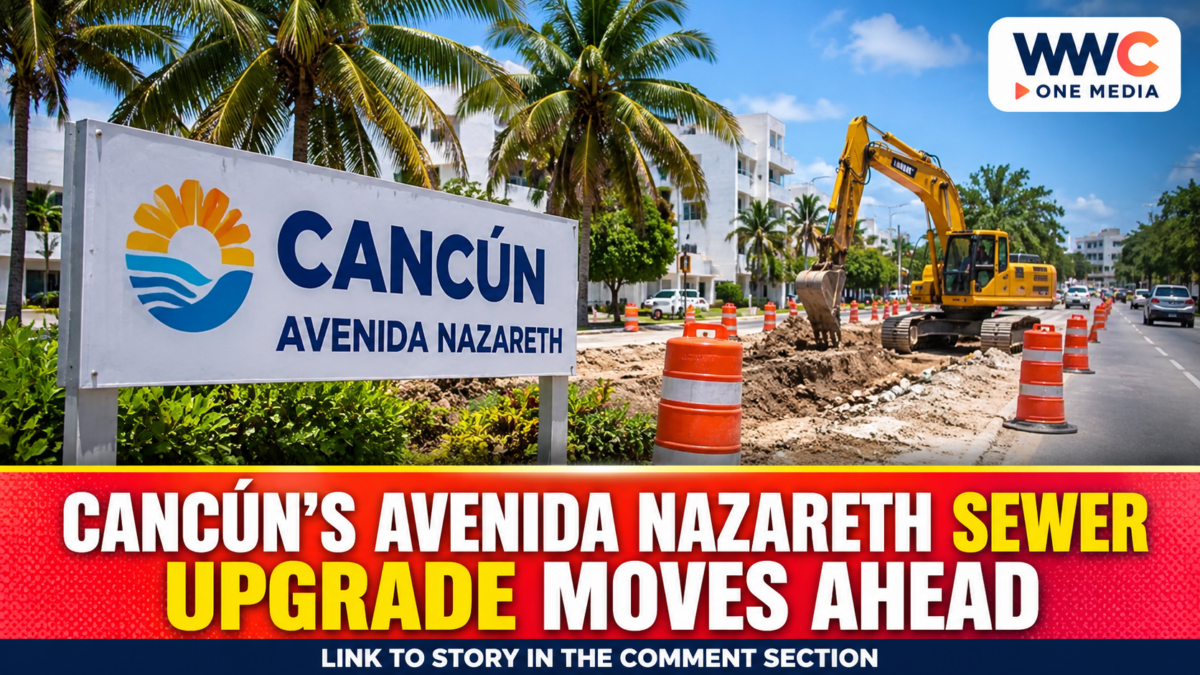
CANCÚN, Mexico — November 26, 2026. The municipal government of Benito Juárez has linked the expansion of water and sewer infrastructure along Avenida Nazareth with a wider programme to rebuild one of Cancún’s important connecting roads, following utility work carried out before the road reconstruction began.
The project highlights a practical challenge facing a growing city: underground services must be installed and coordinated before public authorities can complete major road improvements. The sequence matters because reopening a newly paved street to install water or sewer lines later could mean additional excavation, expense and disruption.
Municipal announcements published during 2026 provide a timeline of the work, from the initial utility installation to the later reconstruction of the avenue. They also show why the project should be viewed as part of a broader infrastructure programme rather than as an isolated sewer installation.
Avenida Nazareth Sewer Upgrade: What the Municipal Records Confirm
On January 28, 2026, the Benito Juárez municipal government announced an integrated improvement plan for Avenida Nazareth, between Avenida Colosio and Avenida Huayacán.
The municipality said Aguakan was then installing drainage and drinking-water lines along the avenue. The announcement described the utility work as nearing completion, with a final connection section still to be completed across to the next lane of Avenida Huayacán.
The same announcement explained that the municipality intended to undertake full road paving after the utility work. It also identified the avenue’s drainage needs, including the planned construction of absorption wells to help prevent water accumulation on streets during rainfall.
The January announcement established the project’s basic sequence: underground infrastructure first, followed by the municipal road works.
A later municipal announcement on June 17 confirmed that potable-water and drainage infrastructure was already in place before the next stage of road improvements. The city described the avenue as an approximately 1.8-kilometre road connecting Boulevard Luis Donaldo Colosio with Avenida Huayacán.
These dated municipal statements provide an important distinction. The installation of a sewer network, its connection to the wider system and the completion of road construction are related but separate milestones.
Why the Road Reconstruction Depends on Underground Work
Avenida Nazareth is part of a connection between two major roads in the southern part of Cancún. The municipality has described it as a paired traffic route intended to improve movement between Boulevard Luis Donaldo Colosio and Avenida Huayacán.
The road project involves more than laying a new asphalt surface. The June announcement listed a new hydraulic base, asphalt paving, absorption wells and road-signage improvements among the planned works.
The municipality’s October 14 update reported that reconstruction had reached nearly 60% at that point. It also said Aguakan had previously completed its work to provide water and drainage infrastructure, allowing the road project to proceed without having to reopen the avenue for those installations.
That sequencing is important for residents and businesses. A road can appear finished at the surface while important utility work remains incomplete underneath. If the work is not coordinated, newly improved roads can face repeated excavation and repairs.
The municipal approach suggests that water, sewerage and road construction are being treated as connected parts of the same urban improvement programme.
What the Project Means for Residents and Businesses
Reliable sewerage infrastructure is a basic requirement for residential and commercial development. A functioning collection network can provide a more organised way to move wastewater away from properties than relying entirely on individual on-site systems.
The January municipal announcement identified the introduction of drainage and drinking-water lines as part of the work serving the area. The later municipal updates confirmed that those utility installations preceded the road reconstruction.
However, the public records reviewed do not provide a verified count of properties already connected to the new sewer network, the number of households currently receiving service through it or the volume of wastewater it handles.
That distinction matters when measuring the project’s actual impact. Installing a main sewer line expands infrastructure availability, but the benefits to individual properties depend on the necessary connections, operational arrangements and service coverage.
For businesses, improved road access and utility infrastructure can support day-to-day operations. For residents, the practical measures will be whether the system is connected, reliable and properly maintained.
WWC has previously examined the financial and operational challenges involved in upgrading water and sanitation networks through its coverage of the <a href=”https://wwconemedia.com/afab-locks-in-1-36-billion-water-deal-for-25-years-but-one-number-shows-how-big-the-problem-really-is/“>Freeport Area of Bataan’s long-term water and sanitation modernisation programme</a>.
Although the projects operate in different countries and under different arrangements, both illustrate why infrastructure investment must be assessed through its actual service outcomes, not construction announcements alone.
Wastewater Treatment Remains a Separate Part of the Infrastructure Chain
A sewer network does not complete the wastewater process by itself.
Collection lines move wastewater away from homes and businesses, but the wider system must also transport it to an appropriate treatment facility and manage the treated output in accordance with applicable requirements.
The January 2026 municipal announcement referred to the remaining connection section toward Avenida Huayacán. The newer project reports have described a route toward the South Wastewater Treatment Plant, but the specific destination and operational connection have not been independently confirmed in a primary utility or government record available for this report.
That is an important information gap. The completion of pipes does not, by itself, establish that every part of the downstream treatment system is operating at the required capacity.
Mexico’s National Water Commission maintains a national inventory of municipal water-treatment and wastewater-treatment facilities. Its December 2022 inventory provides a historical reference for treatment infrastructure in Quintana Roo, but it predates the current Avenida Nazareth project and cannot establish the present operating condition or available capacity of a particular receiving facility.
For a complete assessment, updated treatment-plant operating data, connection records and wastewater-quality information would be valuable.
WWC has also examined how major water utilities approach long-term treatment capacity and supply reliability in its report on <a href=”https://wwconemedia.com/maynilad-invests-nearly-%E2%82%B110-billion-to-strengthen-la-mesa-water-supply-but-will-it-be-enough-to-avoid-another-el-nino-water-crisis/“>Maynilad’s investment programme for the La Mesa water-treatment facilities</a>.
Cancún’s Growth Makes Infrastructure Coordination More Important
Cancún’s road and utility projects reflect the continuing need to coordinate urban expansion with basic public services.
Roads connect residential areas, commercial establishments and other parts of the city. Water and sewer networks support the properties along those routes. Drainage infrastructure helps manage rainfall and reduce the risk of water accumulation on streets.
If these systems are planned separately, one project can interfere with another. A road may need to be excavated again after paving, or a newly installed utility line may require additional work when traffic and drainage improvements are introduced.
The Avenida Nazareth timeline shows the importance of completing underground utility work before the final road surface and related improvements.
This issue also appears in discussions about large developments and industrial infrastructure. WWC’s reporting on <a href=”https://wwconemedia.com/pax-silica-bcdas-land-offer-job-forecasts-and-water-questions-put-philippine-benefits-under-scrutiny/“>water requirements surrounding the proposed Philippine Pax Silica development</a> examined why water availability and infrastructure planning need to be considered alongside investment and construction plans.
The circumstances in Cancún are different, but the underlying planning principle is similar: development needs reliable infrastructure, and the capacity of that infrastructure must be assessed before the benefits are assumed.
What Happens Next
The next important steps are the completion and verification of the municipal road improvements, together with clear information about the sewer network’s operational status.
Residents and businesses would benefit from public confirmation of the properties covered, the number of completed connections, the destination of collected wastewater and the treatment arrangements serving the area.
The municipality’s October 14 update reported that the road reconstruction was nearly 60% complete at that time. That is a dated progress figure, not confirmation of the avenue’s completion as of November 26.
Aguakan’s detailed project documentation would also help clarify the construction scope, final investment amount, installed pipe length, number of inspection structures and the schedule for any remaining connections.
For now, the municipal record establishes the broader sequence: water and drainage infrastructure was installed before the road reconstruction, and the city has treated the avenue’s improvement as part of its wider mobility programme.
The real measure of success will be whether the new infrastructure operates reliably, whether properties can use the services intended for them and whether the road improvements can be maintained without repeated disruption.
Frequently Asked Questions
What is the Avenida Nazareth sewer project?
It is a utility infrastructure project involving the installation of drainage and drinking-water lines along Avenida Nazareth in Cancún, followed by municipal road improvements.
Who is responsible for the sewer and water installation?
The municipal government identified Aguakan as the company carrying out the water and drainage installation work.
How long is Avenida Nazareth?
The municipal government described the road improvement project as covering approximately 1.8 kilometres between Boulevard Luis Donaldo Colosio and Avenida Huayacán.
Does completion of the sewer network mean every property is connected?
Not necessarily. A completed network and individual property connections are separate milestones. The public records reviewed do not provide a verified count of connected properties.
Is the road reconstruction finished?
The municipal government reported nearly 60% progress on October 14, 2026. That dated update does not establish the final completion status as of November 26.
WWC ONE MEDIA will update this report when the municipality or Aguakan publishes additional project-completion, connection or operating information.