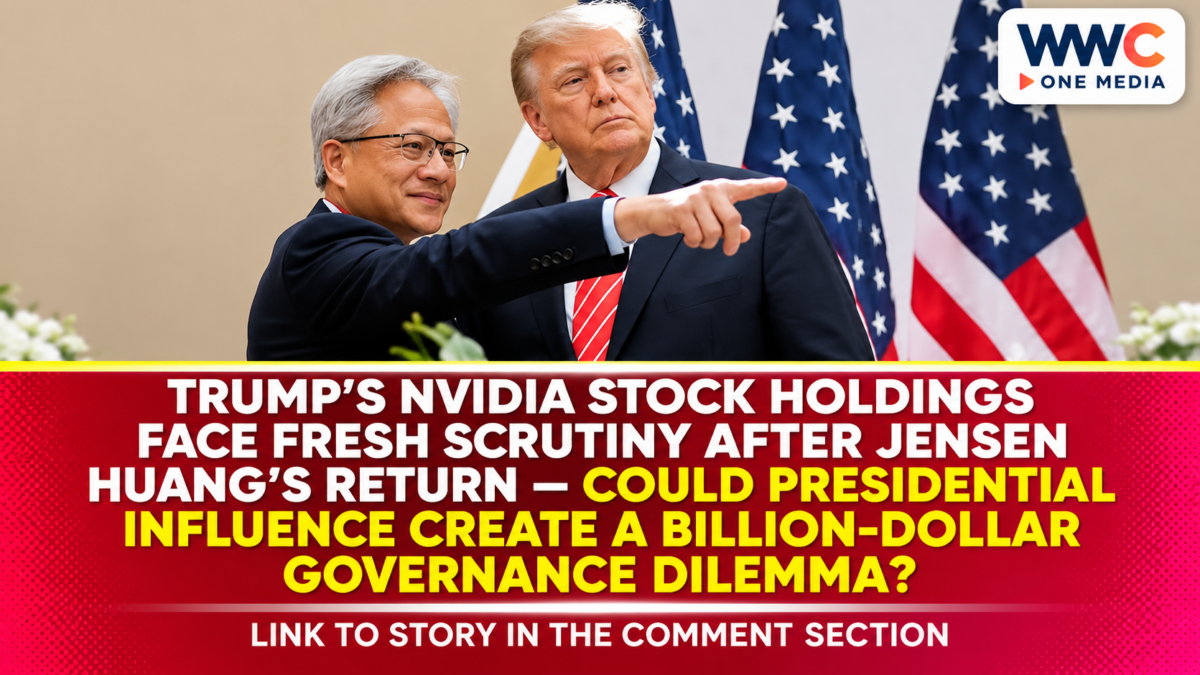
WASHINGTON, UNITED STATES — The intersection of American political power, artificial intelligence and private wealth is facing renewed scrutiny after Nvidia reinstated co-founder Jensen Huang as chief executive officer while US President Donald Trump’s financial disclosures revealed previous transactions involving the semiconductor company’s shares.
Nvidia’s board reinstated Huang as president, chief executive officer and director on Nov. 22, 2026, announcing its decision publicly the following day.
The company confirmed that senior US government officials provided input before directors reached their decision.
Meanwhile, Trump’s periodic financial disclosure, signed on Nov. 1 and received by the US Office of Government Ethics on Nov. 5, documents Nvidia stock transactions conducted in September.
The overlap between Trump’s Nvidia stock holdings and the government’s involvement in a major corporate leadership decision raises important questions about financial transparency, institutional independence and public accountability.
However, the available disclosures do not establish the president’s exact financial gain from Huang’s reinstatement, nor do they independently establish insider trading or unlawful conduct.
Trump Nvidia stock holdings: What the financial disclosures reveal
Trump’s November periodic transaction report contains multiple entries involving Nvidia shares.
Among the documented transactions are purchases conducted on Sept. 2, Sept. 9 and Sept. 10.
| Transaction date | Transaction | Disclosed value range |
|---|---|---|
| September 2, 2026 | Purchase | US$50,001–100,000 |
| September 9, 2026 | Purchase | US$1,001–15,000 |
| September 10, 2026 | Purchase | US$1,001–15,000 |
These are selected verified transactions rather than a complete accounting of Trump’s Nvidia investments.
The disclosure reports transaction values within financial bands instead of identifying exact purchase amounts or share quantities.
Consequently, determining the president’s precise exposure to Nvidia requires additional information about his existing holdings, acquisition prices, subsequent sales and any transactions completed after the reporting period.
A rise in Nvidia’s share price could increase the value of an existing investment, but establishing the amount of that increase requires an accurate share count at the relevant time.
Without that information, precise estimates of Trump’s financial gains remain uncertain.
Jensen Huang’s return reverses Nvidia’s leadership transition
Nvidia’s corporate filings establish a remarkably short period between Huang’s departure and reinstatement.
On Nov. 11, the company’s board accepted his resignation from his executive and director positions.
Colette Kress, Nvidia’s executive vice president and chief financial officer, was appointed interim CEO while directors searched for a permanent replacement.
Harvey C. Jones was also appointed chair of the board.
The initial leadership transition was examined in WWC ONE MEDIA’s profile of Colette Kress and her appointment as Nvidia’s interim chief executive.
Eleven days after accepting Huang’s resignation, directors reversed their decision and unanimously approved his reinstatement.
Kress returned to her continuing responsibilities as chief financial officer, while Jones retained the board chairmanship.
The company explained that directors had held discussions with Huang and received input from senior US government officials before determining that his reinstatement did not present a national security risk.
That assessment represents the board’s stated position rather than an independent public finding establishing the outcome of every related investigation.
Why government involvement raises corporate governance questions
Governments have legitimate interests in companies operating within industries considered strategically important to national security and economic development.
Advanced semiconductor technology presents particularly complex policy considerations because its commercial applications intersect with sensitive computing capabilities and international export restrictions.
Government consultation with technology companies is therefore not inherently improper.
Nevertheless, when public officials have financial exposure to businesses affected by government decisions, additional transparency can help maintain confidence in those decisions.
Three questions become particularly relevant: whether corporate directors exercised independent judgment, whether public officials had financial interests affected by their actions, and whether appropriate safeguards were in place.
The existence of these questions does not establish that Nvidia’s board acted improperly or that Trump personally directed investment transactions.
It does, however, illustrate why financial disclosure and corporate accountability are important when government policy and shareholder interests overlap.
Nvidia’s broader regulatory challenges are examined in WWC ONE MEDIA’s coverage of congressional scrutiny surrounding semiconductor exports.
Paper gains are not the same as realised profits
One of the most important distinctions in the Nvidia controversy concerns the difference between an increase in investment value and an actual trading profit.
An unrealised gain occurs when an investment increases in market value while its owner continues holding it.
A realised gain generally arises when an investment is sold for more than its acquisition cost, before applicable expenses and taxes.
For example, an investor holding 100,000 shares would experience a US$4 million increase in portfolio value if each share appreciated by US$40.
That hypothetical calculation does not establish a US$4 million realised profit, and it does not represent Trump’s authenticated shareholding.
The same principle applies to estimates of presidential investment gains following major corporate announcements.
Without a verified share count and relevant transaction records, the financial impact cannot be calculated precisely.
This distinction matters because inaccurate descriptions of investment gains can create misleading impressions about the amount of money an individual has actually received.
Nvidia’s investigation remains unfinished
Huang’s reinstatement has not terminated the company’s internal investigation.
Nvidia confirmed that an independent board committee, supported by independent legal counsel, would continue its work.
Huang has committed to cooperating with the inquiry.
The company also announced a search for a chief compliance officer who would oversee compliance activities and report to the Nominating and Corporate Governance Committee.
Nvidia’s announced governance reforms are examined in greater detail in WWC ONE MEDIA’s coverage of Huang’s reinstatement and continuing compliance changes.
These measures provide a framework for further oversight, but they should not be interpreted as completed investigations or proof that every outstanding concern has been resolved.
For shareholders and commercial partners, future disclosures concerning compliance, export controls and board oversight could provide greater clarity about the company’s management of regulatory risk.
What the controversy means for global semiconductor markets
Nvidia’s leadership decisions carry implications beyond the United States because the semiconductor industry operates through internationally connected manufacturing, technology and investment relationships.
Uncertainty involving senior executives, regulatory requirements or access to international markets could influence how investors evaluate technology companies across the Asia-Pacific region.
The broader regional market response is explored in WWC ONE MEDIA’s coverage of Taiwan’s stock market rebound and AI financing risks.
For institutional investors, the challenge is separating enthusiasm about technological growth from an assessment of corporate governance and regulatory exposure.
A company’s commercial prospects may remain attractive even while questions about oversight and compliance remain unresolved.
Conversely, a positive leadership announcement cannot eliminate every business or regulatory risk.
What happens next?
Future presidential financial disclosures may provide additional information about Nvidia transactions conducted after September.
Nvidia’s continuing independent investigation and subsequent corporate filings could also clarify the circumstances surrounding its leadership decisions and compliance arrangements.
Until that evidence becomes available, the exact financial impact of Huang’s reinstatement on Trump’s investments remains uncertain.
The broader issue is whether transparency safeguards can maintain public confidence when government influence intersects with private financial interests in strategically important industries.
Nvidia has restored its founding chief executive. The next challenge is demonstrating that commercial leadership, independent corporate oversight and public accountability can coexist.
Frequently Asked Questions
Has Donald Trump disclosed investments in Nvidia?
Yes. His November 2026 periodic financial disclosure includes Nvidia stock transactions conducted during September.
Did Donald Trump make US$15 million from Jensen Huang’s return?
That amount has not been established by the official financial disclosure. Trump’s exact shareholding at the time of Huang’s return and any resulting realised profit remain unverified.
When did Jensen Huang return as Nvidia CEO?
Nvidia’s SEC filing identifies Nov. 22, 2026, as the effective date of his reinstatement. The company publicly announced the decision on Nov. 23.
Was the US government involved in Nvidia’s leadership decision?
Nvidia confirmed that its board received input from senior US government officials before reinstating Huang.
Has Nvidia completed its independent investigation?
No. Nvidia’s November 23 announcement confirmed that the independent investigation would continue despite Huang’s reinstatement.