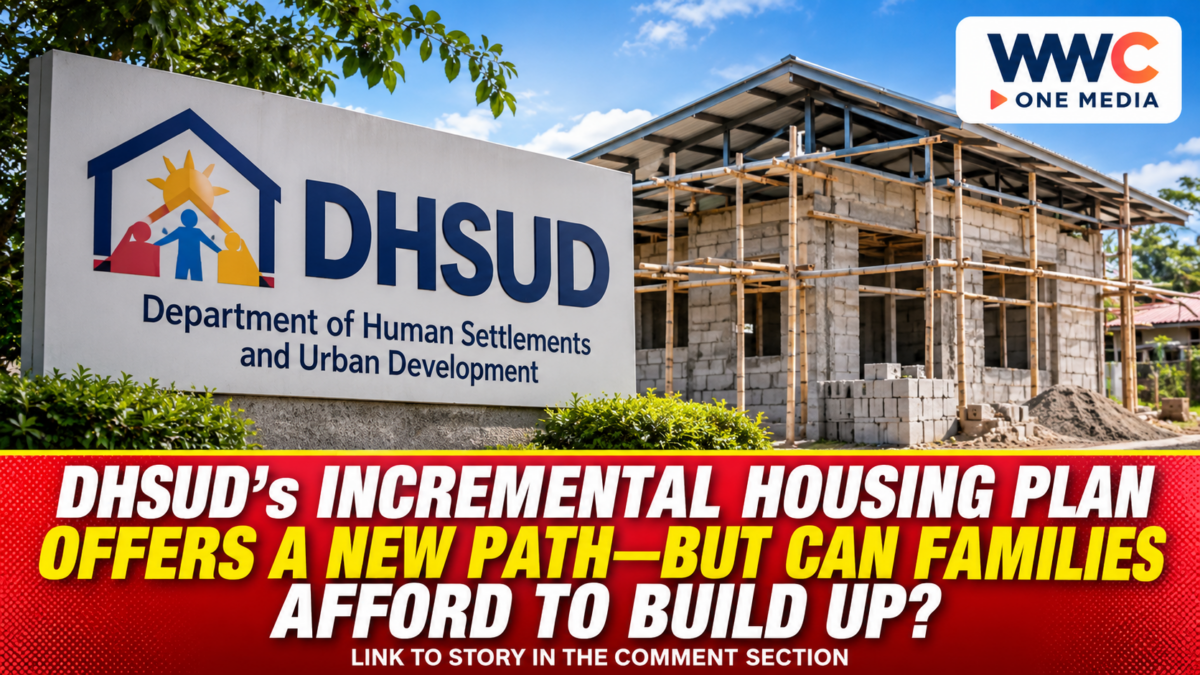
The Department of Human Settlements and Urban Development, through the Social Housing Finance Corporation, has partnered with Advocates of Housing for All and other civil society groups to advance vertical incremental housing under the Expanded Pambansang Pabahay para sa Pilipino (4PH) Program. The memorandum of understanding was signed on November 23, 2026, setting a framework for a pilot approach in which families begin with basic housing units and improve or expand them as their needs and financial capacity allow.
The concept could give low-income urban households a route to a home without requiring every family to complete a fully developed unit at the outset. But the agreement is a starting point, not proof that homes are already being built or that families have been selected. The practical questions are where the pilot will operate, who qualifies, how much each household must pay and what standards will ensure that later construction remains safe.
Incremental housing moves into the Expanded 4PH framework
The November agreement brings together the SHFC and Advocates of Housing for All, with participating nongovernment organizations involved in the initiative. SHFC President and Chief Executive Officer Federico Laxa and AHA Convener Dr. Nathaniel von Einsiedel led the signing.
The participating organizations named in the announcement include Pagtambayayong Foundation – A Foundation for Mutual Aid, Inc.; Joly Homes Foundation; Linkbuild, Inc.; Community Organizers Multiversity; Associates of the Urban Poor, Inc.; and the Foundation for the Development of the Urban Poor, Inc.
The proposed model is vertical incremental housing. Rather than requiring a family to begin with a fully finished home, the approach allows an initial basic unit to be improved or expanded in stages. The stated idea is to align the development of the home with the household’s changing needs and financial capacity.
This is not the first time the department has considered the approach. In December 2025, DHSUD said it was studying how incremental housing could be integrated into selected community mortgage sites under the Expanded 4PH Program. At that stage, Secretary Jose Ramon Aliling asked AHA to identify at least two sites under the Enhanced Community Mortgage Program where the model could be piloted.
The November 2026 agreement therefore marks a move from earlier exploration toward a partnership framework. It does not, by itself, confirm that the proposed pilot sites have been selected or that construction has started.
Why the Community Mortgage Program matters
The partnership builds on the government’s existing community-based housing structure.
The SHFC describes the Community Mortgage Program as a financing mechanism intended to help organised associations of residents in blighted or depressed areas acquire the land they occupy. Its stated purpose includes improving security of tenure and allowing communities to improve their neighbourhoods and homes within their means.
That model is relevant because housing insecurity is not only about the absence of a completed building. Families may also face uncertainty over the land beneath their homes, limited access to infrastructure and difficulty obtaining financing for improvements.
The incremental approach adds another dimension: it considers how a household can develop its living space over time. In principle, that may reduce the need to complete every improvement before a family can occupy a basic unit. However, the affordability of the later stages will depend on the actual design, financing arrangements, construction requirements and household resources.
WWC has previously examined how Davao City is considering collective land ownership for urban poor communities. That proposal is different from the DHSUD initiative, but both raise a central housing question: how can a government programme give families lasting security rather than merely a temporary place to stay?
The government’s role must extend beyond providing a site
The DHSUD announcement describes a model in which the government provides land and basic infrastructure while beneficiaries gradually develop their homes. That division of responsibility makes the condition of the land and the quality of the initial infrastructure especially important.
A site must be suitable for residential use, accessible and supported by essential services. Roads, drainage, water, sanitation, electricity and safe access are not optional extras that can simply be postponed until a family has more money.
The DHSUD’s 4PH Operations Manual sets out a broader project framework involving local government participation, site identification, housing design, beneficiary selection, financing and property management. It also recognises different project delivery arrangements, including community-based initiatives and the Community Mortgage Program.
The legal direction is consistent with that framework. Republic Act No. 12216, which strengthened the National Housing Authority, states that government housing policy should expand access to affordable, adequate, safe and secure shelter in well-planned and sustainable communities. It also identifies innovative and alternative solutions for informal settler families and lower-income households as policy objectives.
For incremental housing, this means the first unit cannot be treated as a bare structure with no plan for what happens next. The initial design must allow safe expansion, and the supporting infrastructure must be able to accommodate the development of the community.
The affordability question does not end with the first unit
A basic unit may lower the initial construction requirement, but the total cost of a home does not disappear. Families may still need to pay for additional materials, labour, permits, utilities, repairs and structural improvements as their households grow or their needs change.
That creates a risk if the programme’s affordability is measured only by the price or cost of the first stage. A household that can afford a basic unit may not necessarily have enough income to complete a second floor, add a room or carry out required structural work later.
The pilot should therefore make clear which improvements are included in the initial design, which are optional, and which require professional approval. It should also explain whether beneficiaries will receive technical guidance, construction standards or access to financing for later stages.
The question is particularly relevant to families comparing different routes into the Expanded 4PH programme. WWC’s report on DHSUD and Pag-IBIG housing access under Expanded 4PH examined how programme availability and eligibility affect prospective homeowners. Incremental housing adds another consideration: whether a household can sustain the costs of improving the home after moving in.
Civil society participation can help—but accountability must be clear
The involvement of community organisations may help government agencies understand local needs, organise prospective beneficiaries and communicate the requirements of the programme. The SHFC’s existing Community Mortgage Program framework already recognises the role of community mobilisers, including nongovernment and people’s organisations, in helping residents organise and prepare for participation.
However, partnership does not remove the need for clear public accountability. Beneficiaries should know which agency is responsible for land, infrastructure, financing, technical standards, construction oversight and complaints. They should also be able to understand how beneficiaries are selected and what happens if a household cannot afford later improvements.
The announcement does not yet provide the pilot’s location, number of participating families, detailed financing terms or implementation timetable. Those details will be essential before the public can assess the programme’s reach or determine whether the model is financially realistic.
WWC’s earlier coverage of the proposal to use unsold condominium units for affordable housing examined another route for expanding housing access. The approaches differ, but both show why the country needs more than one housing model—and why each model must be assessed by the costs and conditions faced by actual beneficiaries.
What happens next
The immediate task is to identify and disclose the pilot sites, establish the number and eligibility of participating households, and publish the operational details of the arrangement.
The government and its partners will also need to explain the standards for the initial units, the process for approving later improvements, the support available to beneficiaries and the division of responsibilities among the agencies and organisations involved.
Until those details are available, the November 23 agreement should be viewed as a partnership framework rather than a completed housing rollout.
Analysis: Incremental housing could make home development more flexible for families who cannot afford a fully completed home at once. Its success, however, will depend on whether the first stage is safe and liveable, whether future expansion is technically sound and whether households can realistically afford the full journey to a decent home.
Frequently Asked Questions
What is incremental housing?
Incremental housing is an approach in which families begin with a basic home or housing unit and gradually improve or expand it as their needs and financial resources allow.
Who signed the incremental housing agreement?
The Social Housing Finance Corporation and Advocates of Housing for All signed the memorandum of understanding on November 23, 2026, with participating nongovernment organisations represented.
Is the incremental housing pilot already under construction?
The agreement establishes a framework for the initiative, but the public announcement reviewed does not identify a confirmed construction start date, pilot location or number of participating families.
How does incremental housing relate to the Expanded 4PH Program?
The initiative is intended to advance vertical incremental housing under the Expanded 4PH Program and builds on earlier DHSUD discussions about integrating the approach into selected Enhanced Community Mortgage Program sites.
Will beneficiaries receive free homes?
The available announcement does not establish that the homes will be free. It describes a model in which families improve or expand their homes according to their financial capacity. The detailed costs and financing arrangements for the pilot have not yet been disclosed.