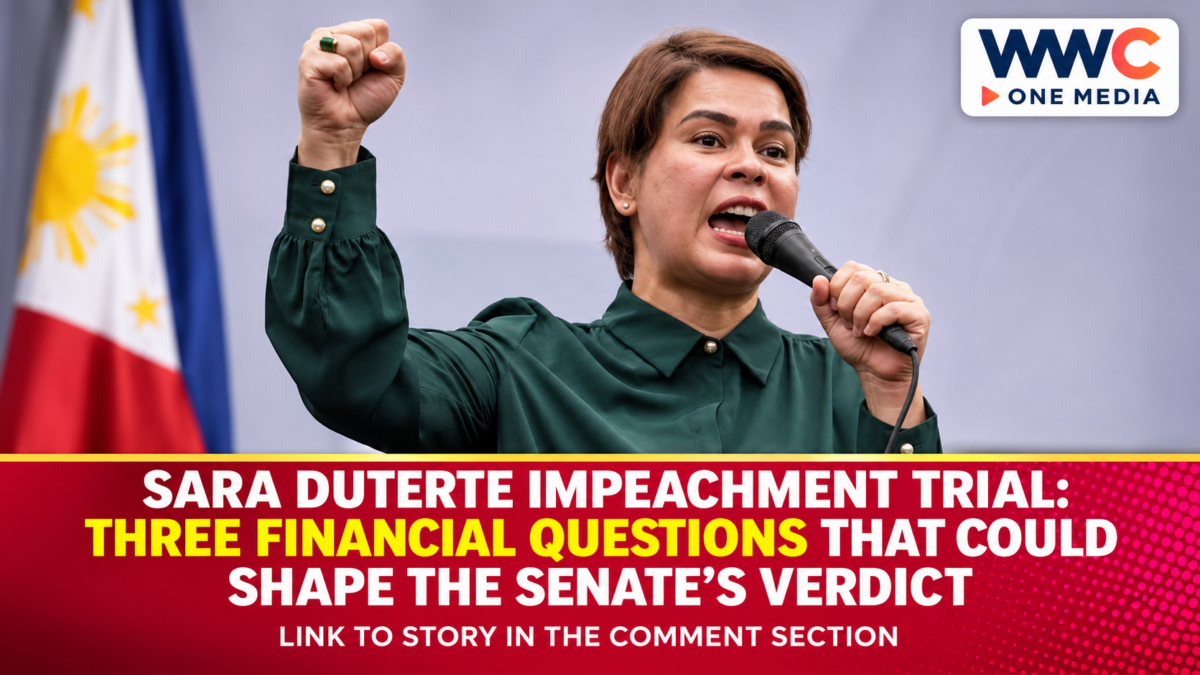
MANILA, Philippines — The Sara Duterte impeachment trial is approaching another critical stage as questions surrounding the Vice President’s financial declarations, business interests and alleged unexplained wealth place constitutional accountability at the centre of the proceedings.
Senator-Judge Panfilo “Ping” Lacson indicated on November 23, 2026, that the impeachment court expects proceedings to resume on December 1, barring unforeseen circumstances.
The defence has indicated that it has approximately three to four more witnesses to present, while senators are working towards completing the proceedings before their December recess.
Beyond the political controversy, three fundamental financial and legal questions deserve examination: whether required assets were properly declared, whether prohibited business participation occurred and whether accumulated wealth was consistent with lawful financial resources.
None of these questions establishes wrongdoing by itself. The Senate impeachment court must evaluate the evidence, consider the defence’s explanations and determine whether the allegations justify conviction.
Sara Duterte Impeachment Trial: Were Financial Assets Properly Declared?
The first question involves the constitutional and statutory requirements governing the financial disclosures of public officials.
Under Article XI, Section 17 of the 1987 Philippine Constitution, public officers and employees are required to submit sworn declarations of their assets, liabilities and net worth.
Republic Act No. 6713, otherwise known as the Code of Conduct and Ethical Standards for Public Officials and Employees, establishes more detailed disclosure obligations.
These include real property, personal property, investments, financial liabilities and business interests.
The law also requires applicable disclosures concerning spouses and unmarried children below 18 years of age living in the household.
Public officials must generally submit their Statement of Assets, Liabilities and Net Worth (SALN) within 30 days of assuming office, by April 30 of each succeeding year and within 30 days of leaving government service.
The importance of these documents has previously been examined in WWC ONE MEDIA’s coverage of the prosecution’s scrutiny of Sara Duterte’s SALN declarations.
A financial discrepancy may justify further investigation, but its legal significance depends on the underlying circumstances.
Determining whether an omission resulted from inaccurate reporting, misunderstanding, deliberate concealment or another explanation requires an examination of the relevant documents and testimony.
Did the Vice President Participate in Prohibited Business Activities?
The second question concerns the constitutional restrictions applicable to senior executive officials.
Article VII, Section 13 of the Constitution prohibits the President, Vice President and certain other executive officials from directly or indirectly participating in business during their tenure.
The provision also requires these officials to avoid conflicts of interest in performing their public responsibilities.
However, applying this constitutional restriction to an individual financial arrangement requires careful examination of the facts.
A payment received from a company could represent several different types of transactions, including repayment of an earlier investment, income from commercial activities or another contractual obligation.
These distinctions matter in determining the nature of an individual’s participation in a business.
During the impeachment proceedings, GenCorp Industries Inc. counsel Suzette Punay testified that Duterte received ₱2.14 million between 2022 and 2025.
Senator Lacson’s November 12 official statement recounts the witness’s explanation that the payments represented a return of capital associated with an investment made in 2007.
The witness also maintained that Duterte held neither shares nor a corporate position in GenCorp during the 2022–2025 period.
The testimony provides an explanation that must be evaluated alongside other relevant evidence. It does not independently establish either a constitutional violation or complete legal compliance.
Earlier disputes surrounding the interpretation of financial records and legal testimony in Duterte’s impeachment proceedings illustrate the importance of distinguishing legal arguments from proven facts.
Was Accumulated Wealth Consistent With Lawful Income?
The third question concerns the financial relationship between a public official’s assets and legitimate sources of income.
Republic Act No. 1379 establishes a legal framework for forfeiting property unlawfully acquired by public officials and employees.
Under Section 2, property acquired during public service that is substantially disproportionate to an official’s salary and other legitimate financial resources may give rise to a rebuttable presumption of unlawful acquisition in proceedings under that law.
However, this framework requires more than identifying unusually large financial transactions.
Investigators must establish the relevant ownership, acquisition dates, financial amounts and legitimate income sources.
For example, money transferred between accounts belonging to the same person should not automatically be counted as newly acquired wealth.
Similarly, gross business receipts do not necessarily represent personal earnings, while loan proceeds and legitimate asset sales may require separate accounting treatment.
Previous coverage of the prosecution’s submission of financial evidence in Sara Duterte’s impeachment trial provides context for the broader dispute over financial documentation.
Importantly, the rules governing civil forfeiture under Republic Act No. 1379 should not automatically be treated as identical to the evidentiary requirements of an impeachment trial.
The Senate must determine the relevance and weight of the evidence under the applicable constitutional framework and impeachment procedures.
Three Financial Questions Explained
| Issue | Relevant legal framework | Central question |
|---|---|---|
| Asset disclosure | Constitution and Republic Act No. 6713 | Were required financial interests and assets accurately declared? |
| Business participation | Article VII, Section 13 | Did any financial arrangement constitute prohibited business participation during the official’s tenure? |
| Unexplained wealth | Republic Act No. 1379 and relevant constitutional provisions | Can the questioned assets be reconciled with legitimate financial resources? |
These questions are connected, but they are not legally interchangeable.
An inaccurate financial declaration does not automatically establish unlawful acquisition. Receiving money from a company does not, by itself, prove active business participation.
Each allegation must be evaluated against the evidence and the relevant legal requirements.
Why Bank Records and Defence Testimony Matter
Financial documents may provide important evidence concerning account ownership, transaction histories, investment arrangements and the timing of asset acquisitions.
Nevertheless, interpreting these records requires appropriate context.
A witness may explain the commercial purpose of a transaction, while supporting documents may establish whether that explanation is consistent with the recorded financial activity.
The relationship between documentary evidence and witness testimony has become increasingly important, particularly following earlier developments involving changes to Sara Duterte’s proposed bank witness lineup.
A decision not to call a particular witness should not automatically be interpreted as an admission of wrongdoing.
The prosecution remains responsible for establishing its allegations, while the defence is entitled to challenge the evidence and present relevant explanations.
What Happens Next in Sara Duterte’s Impeachment Trial?
Proceedings are expected to resume on December 1, 2026, following a temporary suspension to accommodate Senate deliberations on the proposed 2027 national budget.
The Senate’s scheduled December adjournment begins on December 19.
Although Senator Lacson expressed confidence that the trial could conclude before the recess, this remains an expectation rather than a guaranteed verdict date.
Article XI of the Constitution gives the Senate exclusive authority to conduct impeachment trials and decide their outcomes.
An impeachment conviction may result in removal from office and disqualification from holding public office, subject to the applicable constitutional provisions and judgment.
Impeachment proceedings are distinct from criminal prosecutions, which must follow their own legal processes.
For Duterte, the outcome could carry substantial political and institutional consequences.
Ultimately, the significance of the three financial questions will depend not on the intensity of public accusations but on whether the evidence satisfies the applicable legal requirements.
The Senate’s responsibility is to reach a verdict based on the proceedings rather than public speculation or political pressure.
Frequently Asked Questions
What are the three financial issues in Sara Duterte’s impeachment trial?
They concern asset disclosures, alleged prohibited business participation and whether questioned wealth is consistent with lawful income.
What is a SALN?
A Statement of Assets, Liabilities and Net Worth is a sworn financial disclosure required of covered Philippine public officials and employees.
Can a Philippine vice president participate in business while in office?
Article VII, Section 13 of the Constitution prohibits direct or indirect business participation during the official’s tenure. Whether a particular financial arrangement violates that provision depends on its circumstances.
Does an allegation of unexplained wealth establish guilt?
No. Allegations must be supported by evidence and evaluated through the applicable legal proceedings.
When is Sara Duterte’s impeachment trial expected to resume?
Senator-Judge Panfilo Lacson indicated that proceedings are expected to resume on December 1, 2026, barring unforeseen circumstances.