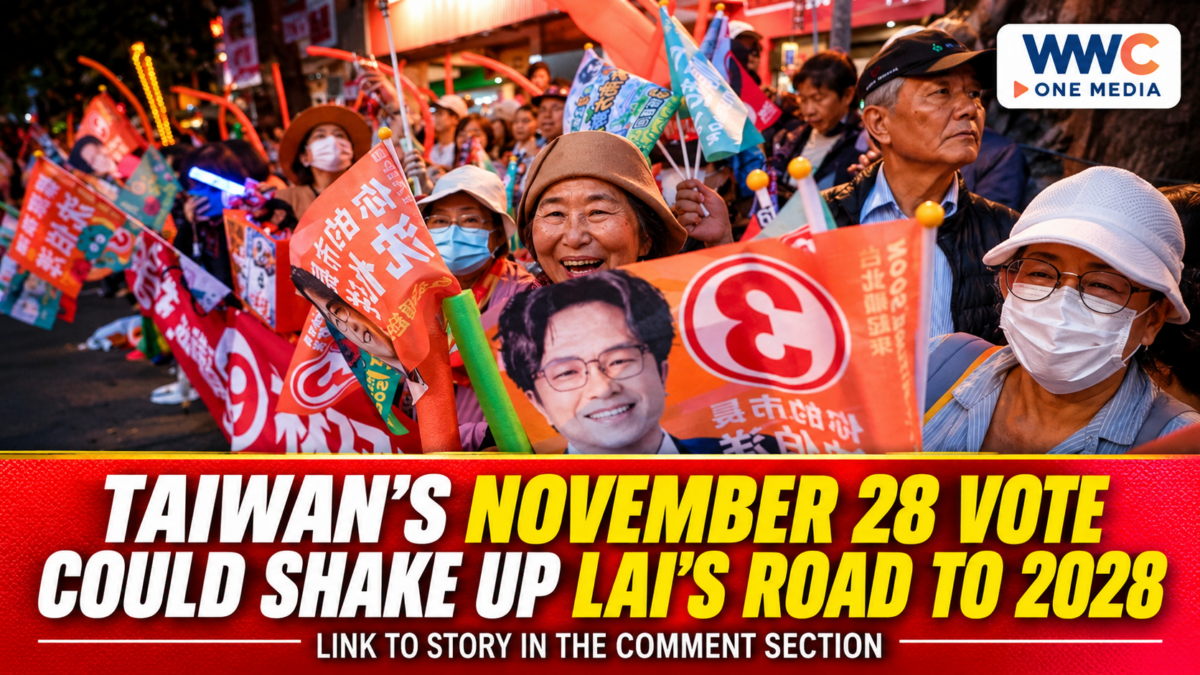
TAIPEI, Taiwan — November 25, 2026 — Taiwan is heading into a consequential election weekend, with voters preparing to choose thousands of local officials in contests that could reshape the political balance ahead of the island’s 2028 presidential election.
The November 28 vote will determine who leads Taiwan’s major cities, counties and local councils. Although President Lai Ching-te is not on the ballot, the results will provide an important measure of the ruling Democratic Progressive Party’s (DPP) political strength midway through his four-year term.
The opposition Kuomintang (KMT) is seeking to strengthen its position across local governments, while the DPP is defending its political influence and trying to demonstrate that its national governing mandate remains supported at the community level.
The stakes extend beyond party competition. Voters will also decide a nationwide referendum on whether Taiwan should use nuclear power as part of a change to its nuclear-free energy policy.
With Taiwan playing a central role in global semiconductor production and the artificial intelligence supply chain, the election is drawing attention beyond domestic politics. Local government decisions on transport, infrastructure, urban development and public services can affect the environment in which companies operate.
But one distinction is essential: the November 28 elections will not choose Taiwan’s president or directly determine its policy toward Beijing. Their significance lies in the political signals they send before the next national election.
Taiwan’s 2026 local elections: What voters will decide
The Central Election Commission has scheduled voting for Saturday, November 28, from 8 a.m. to 4 p.m.
The election covers nine categories of local public offices, including mayors of special municipalities, county and city chiefs, council members, township and district leaders, representatives and village or neighborhood chiefs.
The commission has confirmed that the elections will fill 11,051 positions. It recorded 19,695 applications for candidacy, with 19,100 candidates qualifying after the eligibility review.
The six special municipalities holding mayoral elections are:
- Taipei
- New Taipei
- Taoyuan
- Taichung
- Tainan
- Kaohsiung
These cities are important centres of population, industry, commerce and public administration. Their elected leaders will have responsibilities involving local development, transport, urban planning and the delivery of municipal services.
The Central Election Commission reported 19,576,028 eligible voters for mayoral and county-chief elections. The electorate for the accompanying national referendum is larger, at 20,003,835.
The scale of the vote makes it one of Taiwan’s most important nationwide exercises in local democratic representation.
WWC ONE MEDIA has previously examined the final campaign stretch and the local issues shaping Taiwan’s DPP–KMT contests.
Taipei becomes a closely watched political battleground
The Taipei mayoral contest is among the races attracting national attention.
The official candidate registration records list six candidates, including Puma Shen of the Democratic Progressive Party and Chiang Wan-an of the Kuomintang.
The contest carries political significance because Taipei is Taiwan’s capital and one of its most influential centres of government, business and media.
For the DPP, a strong result in the capital would strengthen its position in a city where opposition parties are seeking to retain or expand their influence. For the KMT, defending its position would reinforce its argument that it remains competitive in Taiwan’s major urban centres.
However, the mayoral race should not be treated as a direct referendum on Lai’s presidency. Taipei voters are choosing a city government, and the result will reflect local candidate performance as well as wider party sentiment.
The broader election also includes contests in New Taipei, Taoyuan, Taichung, Tainan and Kaohsiung. Results across these municipalities and the counties will provide a more complete picture of the parties’ national political standing than any single mayoral contest.
Why the election matters for Lai Ching-te’s 2028 prospects
Lai took office on May 20, 2024, as Taiwan’s 16th-term president. His current term is scheduled to run for four years, placing the next presidential election in 2028.
The November local elections therefore arrive at a politically important midpoint.
A strong showing by the DPP could help the president’s party maintain momentum, strengthen its local political network and improve its position as parties begin preparing for the next national campaign.
A weaker result could intensify internal debate about candidate selection, campaign strategy and the government’s performance.
The KMT and other opposition forces will also be watching the outcome closely. Gains in mayoral and county-level offices could improve their organisational reach and give them a stronger platform for the 2028 presidential and legislative contests.
Still, local election results are not a reliable one-to-one prediction of a presidential outcome. Voters may evaluate local candidates on municipal performance, personality and service delivery, while presidential elections involve a different set of national questions.
The results will be a political signal, not a predetermined result for 2028.
Nuclear power referendum adds a major energy question
The local elections will take place alongside National Referendum Case No. 22, which asks voters whether they support the government using nuclear power to revitalise the economy and abolish the nuclear-free homeland energy policy.
The official question is separate from the local candidate ballots.
The referendum is particularly significant because Taiwan’s energy policy is closely connected to its industrial competitiveness. Semiconductor manufacturing, artificial intelligence infrastructure and other advanced industries require reliable electricity supplies.
A nuclear power debate therefore reaches beyond party identity. It involves questions about energy security, electricity costs, environmental protection, nuclear safety, waste management and the long-term needs of high-technology manufacturing.
The referendum does not itself restart a nuclear power plant. It asks voters to express support or opposition to a change in the government’s energy-policy direction. Any subsequent action would still require the relevant legal, regulatory and technical processes.
The issue also reflects a wider regional debate over how economies can meet rising electricity demand while pursuing decarbonisation.
For Taiwan, the outcome could influence the political environment surrounding future energy decisions, but it should not be confused with an immediate operational change in the power system.
China remains part of the wider political backdrop
Taiwan’s relationship with mainland China remains an important national political issue, even though the November 28 contests are local elections.
Beijing claims Taiwan as part of its territory, while Taiwan’s government maintains that its future should be determined by its people. Cross-strait relations have remained a major factor in Taiwan’s security and diplomatic environment.
But local officials do not control the central government’s foreign or defence policy. The election is therefore not a direct vote on whether Taiwan should change its national position toward Beijing.
The political implications are nevertheless difficult to separate completely from the wider environment. Party performance at the local level can influence the strength and strategy of political forces that will later debate national security, defence spending and cross-strait engagement.
Taiwan’s participation in regional institutions also remains important. Its recent ministerial-level engagement in China through the Asia-Pacific Economic Cooperation framework illustrated how economic cooperation can continue even amid political differences. WWC ONE MEDIA examined the significance of Taiwan’s rare ministerial visit to China for an APEC meeting.
The episode highlights the difference between practical regional engagement and the unresolved political questions across the Taiwan Strait.
Taiwan’s election security and information environment
Election integrity is another important part of the national discussion.
Taiwan’s National Security Bureau has previously documented methods it says were used to spread misleading information during earlier election periods, including coordinated social-media activity, manipulated content and the use of compromised or impersonated accounts.
Such concerns are particularly relevant during a campaign in which candidates, political parties and public institutions are competing for voters’ attention.
The existence of documented disinformation methods does not mean that every disputed online post is foreign-directed or that a particular candidate has benefited from unlawful interference. Claims about specific incidents require evidence and appropriate investigation.
For voters, the practical challenge is to distinguish official election information, campaign claims and independently verified reporting from manipulated or misleading material.
The issue also reinforces the importance of Taiwan’s election administration as the island approaches another major national political cycle.
What the results could mean for Taiwan’s economy
The election does not directly determine Taiwan’s national economic policy, but local governments influence many of the conditions that businesses and households experience.
Transport systems, land-use decisions, public infrastructure, urban redevelopment, local investment promotion and municipal services all fall within the broader responsibilities of local authorities.
For companies operating in Taiwan, the results may therefore matter through changes in local priorities and the implementation of development projects.
The nuclear referendum adds another economic dimension. Taiwan’s ability to provide reliable and competitively priced electricity is an important consideration for energy-intensive industries, particularly semiconductor manufacturing and the growing AI-related technology ecosystem.
However, the referendum’s result alone will not settle every question about electricity supply. The future of nuclear power will also depend on safety requirements, plant conditions, regulatory approval, waste-management arrangements and government decisions.
The outcome should be read as one part of a wider debate over how Taiwan intends to support industrial growth while managing energy and environmental risks.
The next test begins after the ballots are counted
Voting is scheduled for November 28, with the Central Election Commission setting December 4 as the deadline for reviewing and announcing the elected candidates under the published election timetable.
The immediate result will determine the distribution of local political power across Taiwan’s municipalities and counties. The referendum will provide a separate measure of public support for changing the island’s nuclear-free energy policy.
For Lai and the DPP, the election will offer an important opportunity to assess their political position before the 2028 presidential race. For the KMT and other opposition parties, it will test whether they can translate local campaigning into broader political gains.
But the most consequential question may be what the winning candidates do after taking office.
Campaign promises on transport, public safety, infrastructure, energy and local economic development will eventually be measured against budgets, implementation and public services.
Taiwan’s November 28 vote is not a presidential election and will not settle the island’s future relationship with China. It will, however, help shape the political landscape in which those national questions will be debated as the 2028 election approaches.