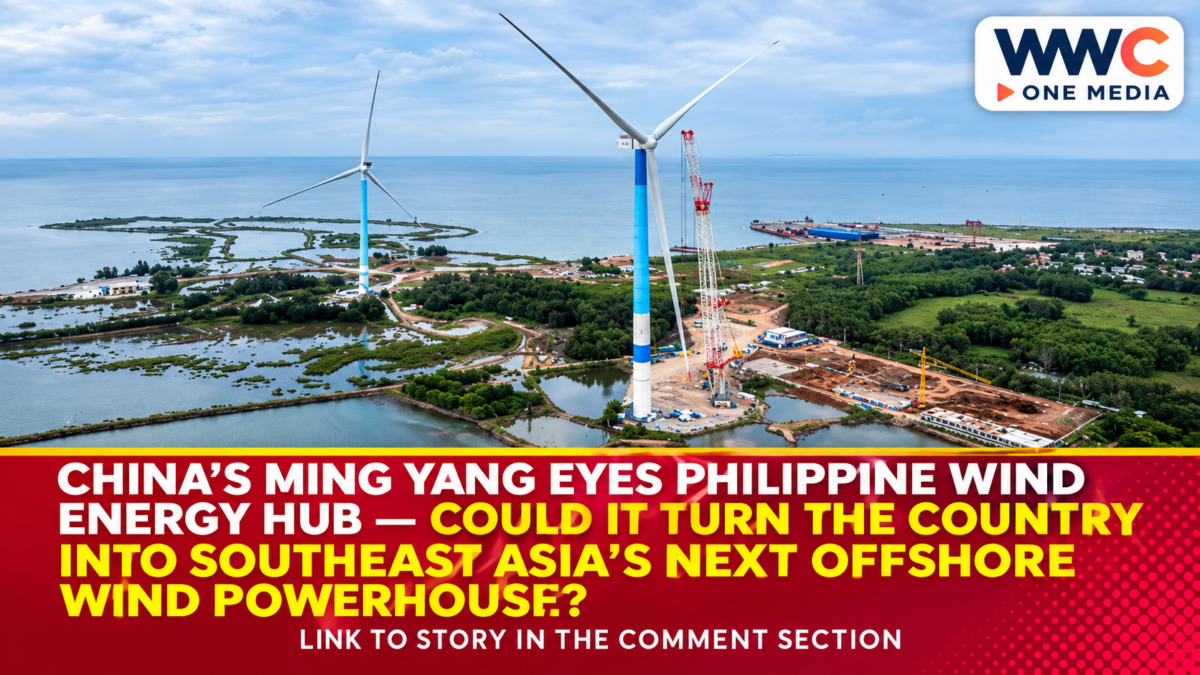
MANILA, PHILIPPINES — Chinese renewable energy manufacturer Ming Yang Smart Energy Group is pursuing plans to establish a Philippine wind energy hub, potentially creating new employment opportunities and strengthening the country’s industrial capabilities as it prepares for large-scale offshore wind development.
The Department of Energy (DOE) confirmed on Nov. 24, 2026, that the Chinese company intends to establish a service and maintenance centre while recruiting and training Filipino workers.
The development follows President Ferdinand Marcos Jr.’s discussions with Ming Yang executives during the Asia-Pacific Economic Cooperation (APEC) meetings in Shenzhen, China.
With an estimated 178 gigawatts of technical offshore wind potential, the Philippines offers substantial opportunities for renewable energy development.
However, transforming that potential into commercially viable electricity generation will require more than installing turbines. It will also require skilled workers, reliable maintenance services, suitable ports, transmission infrastructure and substantial long-term investment.
Ming Yang’s Philippine wind energy hub could create new industrial opportunities
Ming Yang’s proposed facility would provide technical support for wind turbines operating in the Philippines.
Establishing domestic maintenance capabilities could allow renewable energy developers to address equipment problems without relying exclusively on technical personnel travelling from overseas.
A locally based service operation could also improve access to replacement components and specialised engineering expertise.
For wind farm operators, reducing equipment downtime could improve operational efficiency and help protect electricity generation revenue.
The proposed investment builds on discussions between Energy Secretary Sharon S. Garin and Ming Yang representatives during the 49th ASEAN Ministers on Energy Meeting in October 2026.
The engagement continued during Marcos’ subsequent meeting with company executives in China.
However, the investment remains at the planning stage. The government announcements have not established a final capital commitment, facility location, construction schedule or confirmed number of employees.
The proposed centre should also not be confused with a confirmed turbine manufacturing plant.
Its immediate commercial purpose involves developing domestic technical services rather than establishing a complete manufacturing supply chain.
Ming Yang already has a major offshore wind partnership in Ilocos Norte
The proposed maintenance hub follows another significant development involving the Chinese manufacturer and a Philippine renewable energy company.
On Nov. 6, 2026, Yuchengco-led PetroGreen Energy Corporation entered into a strategic cooperation agreement with Ming Yang in Zhongshan, China.
The collaboration initially focuses on the proposed 2-gigawatt Northern Luzon Offshore Wind Project in Ilocos Norte, being developed by Buhawind Energy Northern Luzon Corporation.
The companies intend to evaluate turbine selection, prospective electricity production, project economics and construction requirements.
Ming Yang will also support specialised training involving engineering students, faculty members and professionals in the Ilocos region.
WWC ONE MEDIA previously examined the commercial significance of the 2-GW Ilocos offshore wind partnership between PetroGreen and Ming Yang.
The agreement establishes a framework for evaluating offshore wind opportunities, but specific investment and commercial arrangements remain subject to further negotiations.
It does not independently establish that construction financing has been secured or that Ming Yang has received a definitive turbine supply contract.
The Philippines has 178 GW of offshore wind potential
The Philippine offshore wind roadmap, developed jointly by the DOE and the World Bank Group and released in April 2022, identified approximately 178 gigawatts of technical offshore wind potential.
The figure illustrates the considerable scale of the country’s wind resources.
However, technical potential is not the same as economically viable generation capacity.
Developers must consider electricity demand, construction expenditure, environmental conditions, financing availability and the cost of connecting projects to the national grid.
The government’s renewable energy strategy targets a 35% share of electricity generation from renewable sources by 2030, increasing to 50% by 2040.
Offshore wind could contribute to achieving these objectives if projects successfully advance through development, financing and construction.
Nevertheless, the size of the available wind resource does not guarantee that every technically suitable location will eventually accommodate a commercial wind farm.
The 3,300-MW offshore wind auction faces an infrastructure test
The Philippine government’s Fifth Green Energy Auction, commonly known as GEA-5, was originally designed to procure 3,300 megawatts of fixed-bottom offshore wind capacity, with delivery targeted between 2028 and 2030.
Fixed-bottom offshore wind turbines are supported by foundations attached to the seabed.
However, the auction process has faced implementation challenges.
In July 2026, the DOE announced a recalibration of the programme following the suspension of auction activities.
The review identified several important considerations, including port infrastructure, environmental requirements, grid readiness and international supply-chain conditions.
These challenges demonstrate why developing a competitive offshore wind industry involves much more than awarding electricity generation contracts.
Specialised vessels and suitable port facilities are necessary to transport and install large turbine components. Transmission facilities must also be capable of receiving and distributing electricity.
The commercial difficulties associated with renewable energy development were previously examined in WWC ONE MEDIA’s coverage of ACEN’s withdrawal from several renewable energy contracts, including proposed offshore wind projects.
For Ming Yang, the long-term commercial opportunity associated with its proposed service hub will depend partly on how successfully Philippine developers advance their wind projects into operation.
Green jobs and technical expertise could become lasting economic benefits
One of the most important potential benefits of the proposed investment involves workforce development.
Wind turbine maintenance requires specialised capabilities involving mechanical engineering, electrical systems, industrial safety and equipment monitoring.
Developing these skills domestically could create opportunities for engineers, technicians and other trained workers.
It could also help establish a broader ecosystem of service providers supporting renewable energy infrastructure.
However, the economic significance of the investment will depend on the quality and continuity of employment, not simply the announcement of future recruitment.
Training programmes must provide relevant competencies, while businesses must generate sufficient demand to sustain employment over time.
Technology transfer could become particularly valuable if local companies develop the ability to provide specialised services independently and participate in regional renewable energy supply chains.
Can typhoon-resistant technology strengthen energy resilience?
The Philippines’ exposure to severe tropical weather creates additional engineering requirements for wind power development.
Ming Yang specialises in both land-based and offshore wind technology, including turbines designed for demanding weather conditions.
Such expertise could help developers evaluate equipment suitable for Philippine operating environments.
However, turbine specifications alone cannot guarantee uninterrupted electricity generation during extreme weather.
Project resilience also depends on foundation engineering, electrical infrastructure, operational procedures and maintenance arrangements.
Developers must assess whether equipment is appropriate for the specific environmental conditions of individual sites.
For investors, these considerations are important because severe weather damage and prolonged equipment downtime could affect operating costs and financial performance.
Southeast Asia’s renewable energy investment competition intensifies
Ming Yang’s proposed Philippine operations provide another example of cross-border cooperation in Southeast Asia’s renewable energy industry.
International partnerships could connect local development opportunities with technical expertise, equipment suppliers and investment capital.
Similar opportunities have previously been examined in WWC ONE MEDIA’s coverage of regional investment in Vena Group’s 2.8-GW renewable energy portfolio across the Philippines and Indonesia.
For APEC economies, the commercial significance of renewable energy extends beyond electricity production.
It also involves competition for industrial investment, engineering capabilities, infrastructure financing and long-term technical employment.
What happens next for Ming Yang?
The next significant milestones will involve confirmation of the proposed centre’s location, investment requirements, implementation schedule and workforce development arrangements.
Progress on offshore wind projects and supporting infrastructure will also influence demand for the company’s technical services.
Ming Yang’s proposed investment could help establish an important component of the Philippine wind energy industry.
But the ultimate test is whether these plans translate into operating facilities, sustainable employment and reliable electricity generation.
The Philippines has substantial wind resources. Turning them into a competitive regional industry remains the bigger challenge.
Frequently Asked Questions
What is Ming Yang planning to establish in the Philippines?
Ming Yang Smart Energy Group plans to establish a wind turbine service and maintenance centre and recruit and train Filipino workers.
Is Ming Yang building a wind turbine manufacturing factory in the Philippines?
A manufacturing factory has not been confirmed. The current government announcement concerns a proposed service and maintenance facility.
How much offshore wind potential does the Philippines have?
The DOE and World Bank Group identified approximately 178 GW of technical offshore wind potential in their 2022 roadmap.
What is Ming Yang’s offshore wind project in Ilocos Norte?
Ming Yang has entered into a strategic cooperation agreement with PetroGreen Energy Corporation initially focusing on the proposed 2-GW Northern Luzon Offshore Wind Project.
How much will Ming Yang invest in its Philippine wind energy hub?
The official announcements reviewed do not disclose a confirmed investment amount, facility location, opening date or employment target.