
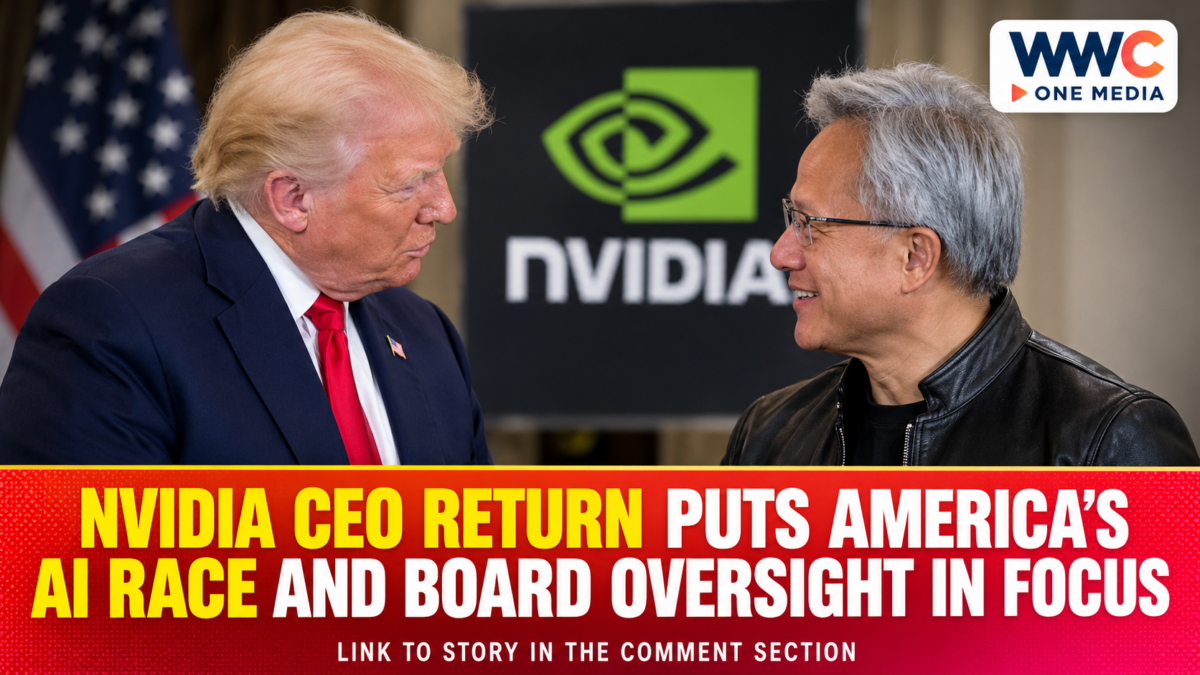
SANTA CLARA, California — November 25, 2026 — NVIDIA has reinstated co-founder Jensen Huang as president and chief executive officer, reversing a leadership change announced less than two weeks earlier. The board’s decision restores the executive who has led the chipmaker through the expansion of the global artificial-intelligence market, while leaving a separate independent investigation and newly established compliance oversight measures in place.
The return matters beyond a corporate title change. NVIDIA’s processors and computing platforms are central to the infrastructure used by major AI developers and cloud providers. Its latest quarterly results show the scale of that business, while its recent governance announcements show that national-security and export-control oversight remain significant issues for the company.
NVIDIA CEO return reverses November’s leadership transition
NVIDIA announced on November 23 that its board had unanimously reinstated Huang as president and CEO and restored him as a member of the board. The company said the decision followed discussions and meetings with Huang. It also said the board had received input from senior levels of the US government and was confident the reinstatement posed no national-security risk.
A Form 8-K filed with the US Securities and Exchange Commission records November 22 as the date of the reinstatement, effective immediately. The filing also states that Colette Kress would continue as NVIDIA’s executive vice president and chief financial officer following the change.
The sequence began on November 12, when NVIDIA announced that Huang had resigned as president, CEO and a board member. Kress, who already held the finance leadership role, was appointed interim CEO while the board began a search for a permanent successor and said it would consider internal and external candidates.
The November 23 announcement ended that interim arrangement by restoring Huang to the top executive position. It did not, however, announce that every matter considered by the board had been concluded.
The scale of NVIDIA’s AI business explains the wider stakes
The leadership decision comes as NVIDIA reports rapid growth in its data-center business, the segment most directly associated with large-scale AI computing infrastructure.
For the third quarter of fiscal 2027, ended October 25, NVIDIA reported revenue of US$115.8 billion, up 103% from a year earlier. Data Center revenue reached US$107.6 billion, an increase of 110% year over year.
Those figures help explain why NVIDIA’s leadership attracts attention from technology companies, investors and policymakers. Its products are used in computing systems that support AI model development, cloud services and other data-intensive workloads.
The company’s own results also show that the business is connected to a broad ecosystem rather than a single product or customer. Its third-quarter announcement identified cloud providers, AI developers and technology partners building infrastructure around its platforms.
For the United States, the strategic question is how to sustain domestic leadership in advanced computing while managing the security and trade rules governing where powerful chips can be sold and used. Huang’s return may restore executive continuity at a company central to that debate, but it does not by itself settle the country’s broader AI policy or guarantee continued technological leadership.
The infrastructure race also has consequences for businesses outside the United States. In the Philippines, for example, Converge’s exploration of AI computing and data-center services illustrates how demand for advanced processors can influence local digital infrastructure plans.
Export controls remain a board-level responsibility
NVIDIA’s governance changes began before Huang’s reinstatement. On November 17, the company announced that its board had established a standing National Security and Export Control Oversight Committee.
The committee is responsible for board-level oversight of national-security policies, export-control compliance and global trade risk management. NVIDIA named director Suzanne Nora Johnson as chair, with directors Stephen C. Neal and John O. Dabiri as members.
The company said the committee would meet at least quarterly and work with independent outside experts in law, national security and global trade compliance. NVIDIA’s National Security Team and Global Trade Compliance Team would report directly to the committee and to the interim CEO on day-to-day operations.
The November 23 reinstatement announcement added another planned measure: a search for a Chief Compliance Officer. The new officer is expected to oversee compliance across NVIDIA and report to the board’s Nominating and Corporate Governance Committee.
These are governance steps, not proof that NVIDIA has committed an export-control violation. They show that the company is placing formal board attention on national-security and trade-compliance risks as its technology becomes increasingly important to global computing infrastructure.
The issue also has a financial dimension. AI data centers require large investments in processors, power, cooling and facilities. WWC has examined the financing pressures surrounding large AI infrastructure projects, while its report on higher-capacity power systems for AI data centers examines another constraint on the industry’s expansion.
Reinstatement does not close the independent investigation
NVIDIA’s November 23 announcement explicitly stated that the independent directors’ investigation would continue to its conclusion. The board had formed a committee made up solely of independent directors and retained independent counsel to assist with the inquiry.
Huang, the company said, supports the investigation and is committed to cooperating with it.
That distinction is important. The board’s decision to restore Huang to his executive and director positions is separate from the work of the independent committee. Reinstatement is a leadership decision; the investigation is a process that has not been declared complete.
The company’s statement that it received US government input and was confident the reinstatement posed no national-security risk describes the board’s position when it made the decision. It should not be treated as a published investigative finding or as a substitute for the committee’s final conclusions.
For shareholders and business partners, the remaining questions concern the investigation’s findings, the operation of the new oversight committee and the implementation of the compliance officer role.
What happens next
NVIDIA has restored Huang as CEO, but several governance milestones remain outstanding. The independent committee is expected to continue its work, the National Security and Export Control Oversight Committee is responsible for ongoing board-level supervision, and the company has announced a search for a Chief Compliance Officer.
The company’s operating performance will also remain under scrutiny. Its latest results demonstrate the scale of demand for AI computing, but continued growth depends on customers, supply-chain capacity, infrastructure investment and the regulatory environment in which advanced chips are sold and deployed.
Huang’s return restores a familiar leader to NVIDIA at a consequential moment for the AI industry. Whether the company can pair that leadership continuity with credible oversight will be measured not by the announcement itself, but by the results of the investigation and the effectiveness of the controls it has promised to strengthen.
Frequently asked questions
1. Is Jensen Huang back as NVIDIA CEO?
Yes. NVIDIA announced on November 23, 2026, that its board had reinstated Huang as president and CEO and as a member of the board, effective immediately.
2. When did Jensen Huang’s reinstatement take effect?
NVIDIA’s Form 8-K records the reinstatement as effective November 22, 2026.
3. Who served as NVIDIA’s interim CEO?
Colette Kress, NVIDIA’s executive vice president and chief financial officer, served as interim CEO after Huang’s November 12 resignation announcement. She continues as the company’s CFO.
4. Has NVIDIA completed its independent investigation?
No completion was announced in the November 23 reinstatement statement. NVIDIA said the independent directors’ committee would continue its investigation to conclusion.
5. Why does Huang’s return matter to the AI industry?
NVIDIA supplies computing platforms used in AI development and data centers. Its third-quarter fiscal 2027 results reported US$107.6 billion in Data Center revenue, illustrating the scale of the business at the center of the AI infrastructure market.










