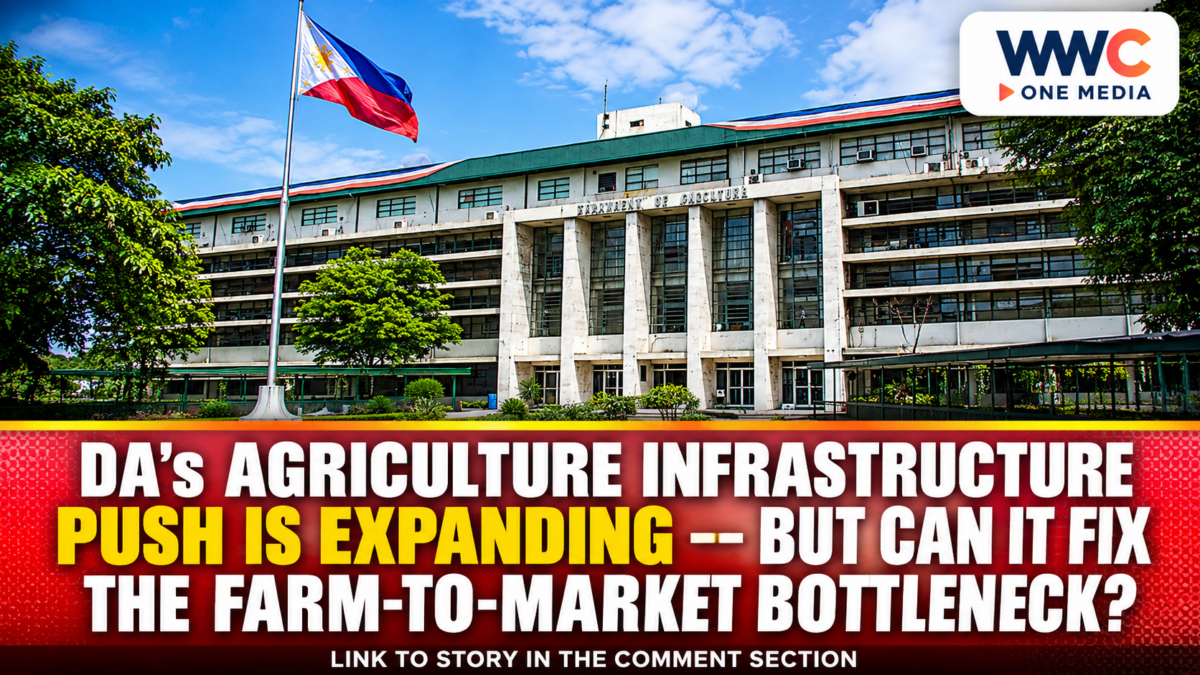
The Department of Agriculture (DA) has formalized a nationwide framework for coordinating major farm infrastructure and logistics projects, placing roads, storage, processing and market access under a single department-wide programme. The move comes as the agency advances road projects, opens new cold-storage facilities and explores private-sector participation in agricultural infrastructure.
The framework matters because producing more food does not automatically mean farmers can sell it efficiently. Poor rural connections, limited storage and expensive transport can weaken the value of a harvest before it reaches buyers, making infrastructure delivery—not just project announcements—a central test of the government’s agricultural strategy.
The DA has made GAIN its department-wide infrastructure framework
Department Order No. 29, Series of 2026, institutionalized the Growing Agri-Aquatic Industrial Network (GAIN) Program as a department-wide flagship programme. The order, dated September 21, 2026, assigns the Office of the Undersecretary for Agro-Marine Industrial Systems as the programme’s lead oversight and coordinating office. AgriPortal+1
The order describes GAIN as a framework for integrating major agriculture and fisheries infrastructure initiatives. Its coverage includes farm-to-market roads and bridges, mega agri-fish ports and hatchery centers, mega food hubs, cold storage and solar-powered ice plants, solar-powered irrigation systems, agricultural mechanization and biosafety facilities, and seed systems.
This is significant because these facilities serve different stages of the same supply chain. Roads connect farms to trading areas; storage gives producers more time to handle perishable harvests; processing can add value to raw products; and market facilities can improve connections between producers and buyers.
The order also gives the coordinating office responsibility for policy direction, inter-agency coordination, stakeholder engagement, transparency and monitoring. However, it does not transfer every technical or implementation function to that office. Those responsibilities remain with the DA offices and implementing units assigned to the projects. AgriPortal+1
A ₱9.06-billion road package covers 605 projects in Luzon
One of the clearest examples of the infrastructure programme moving into specific project commitments is the DA’s farm-to-market road agreement with the Department of Public Works and Highways (DPWH).
A memorandum of agreement signed by the two departments covers 605 farm-to-market road projects worth ₱9.06 billion across the Cordillera Administrative Region and Regions I, II, III and IV-A. The DA’s October 6 announcement said the projects would cover 26 provinces and a combined road length of 604 kilometers. AgriPortal+1
The department said the broader 2026 national budget also provides for more than 1,600 farm-to-market road projects covering about 2,200 kilometers nationwide. That wider figure should not be confused with the separate 605-project, ₱9.06-billion agreement.
For farmers, the practical value of a road is measured by whether it makes transport more reliable and reduces the difficulty of moving crops, livestock and farm inputs. A completed road can improve access to buyers, but the benefits depend on its location, condition, construction quality and connection to functioning markets.
WWC has previously examined how rural road projects can change access to markets in its report on the Cateel–Boston farm-to-market road project in Davao Oriental. That project is a separate local development, but it illustrates why road access is an important part of agricultural logistics.
New cold-storage facilities and fuel assistance target different supply-chain costs
Infrastructure is not limited to concrete roads. On November 20, the DA inaugurated three modular cold-storage facilities in Ilocos Sur, located in Sto. Domingo, Bantay and Narvacan. The facilities are intended to give farmers and other agricultural stakeholders additional capacity to preserve perishable produce before transport and sale. AgriPortal+1
The same activity also opened registration for fuel assistance for agricultural truckers. The DA said the registration caravan was held at the Farmers Productivity Center in Barangay Parada, Sto. Domingo, while fuel subsidy intervention monitoring cards were distributed to farmers during the activity. The agency identified its Agricultural and Fisheries Logistics Office, regional marketing personnel and local government as participants in the registration process. AgriPortal
The two interventions address different points in the chain. Cold storage can give producers more time to consolidate goods and arrange sales, while fuel assistance is intended to help transport operators manage operating expenses. Neither measure, by itself, guarantees lower retail prices or higher farm income.
The wider challenge is making these facilities accessible and useful beyond their opening ceremonies. Storage capacity must match the crops produced in an area, operating arrangements must be sustainable, and farmers need transport and buyers to move stored products onward.
WWC has also covered the role of cold storage in the Cordillera’s vegetable supply chain, where weather-related disruptions have highlighted the limits of relying on roads and trading posts alone.
Private investment is being explored, but projects are not all at the same stage
The DA has also discussed bringing private-sector capital into selected agricultural infrastructure projects through public-private partnerships (PPPs).
In a July 5, 2026 release, the department said Agriculture Secretary Francisco P. Tiu Laurel Jr. met with Public-Private Partnership Center officials on June 30 to discuss a pipeline of possible projects. These included farm-to-market roads, mega food hubs, agri-fish ports, hatchery centers, mechanization and biosafety facilities, cold storage, solar-powered ice plants and irrigation systems. AgriPortal
The same release cited PPP Center dashboard figures of ₱33.25 billion for agriculture PPP projects under development and ₱4.7 billion for projects already under implementation. These figures describe the dashboard’s project pipeline at the time of the DA announcement; they should not be treated as the total budget of GAIN or as proof that all proposed projects have reached construction. AgriPortal
For government, PPPs can provide another route to develop facilities that may require substantial capital and technical expertise. For private investors, project readiness, revenue arrangements, land access, demand and risk allocation will influence whether proposals become actual investments.
The DA’s earlier announcement therefore establishes that private-sector participation is being explored. It does not mean every project named in the pipeline has been approved, awarded or financed.
A separate example of market-access infrastructure is the Samal Trading Post in Bataan, which shows how trading facilities can complement transport and storage investments by giving producers another place to bring their goods.
Project verification is part of the infrastructure challenge
The DA’s infrastructure programme also faces a basic public-accountability requirement: project information must be accurate enough for government agencies and communities to verify where public funds are intended to go.
In a November 3 release, the department said its review of farm-to-market road entries identified eight coordinate discrepancies among 1,669 entries. The DA described the errors as involving one or two mistyped numbers that placed the affected entries away from their intended locations. It said the review was administrative and that it was working with civil society groups on further checks. AgriPortal+1
The department also said it would strengthen geotagging, internal review, third-party validation and citizen monitoring through the FMR Watch portal.
Separately, Department Order No. 30, Series of 2026, issued guidelines for preparing the Program of Works and Approved Budget for the Contract for farm-to-market road projects for fiscal year 2026 and beyond. The order requires technical review of detailed engineering designs and programmes of work, while contract budgets are subject to cost validation by the DA’s Bureau of Agriculture and Fisheries Engineering before procurement. AgriPortal+1
These controls matter because a road project’s value depends on more than its announced price or length. Accurate location data, defensible cost estimates, appropriate engineering and transparent implementation all affect whether the finished project serves the intended community.
What happens next
The next measure of the GAIN framework will be how effectively the DA coordinates projects already announced and those still being developed. That includes tracking road procurement and construction, monitoring the use of new storage facilities, and clarifying which proposed infrastructure projects move forward through public funding or PPP arrangements.
The DA’s own orders provide for coordination and monitoring, while the separate road guidelines establish technical and cost checks before procurement. Those rules create a structure for oversight, but they do not by themselves establish that every project will be completed on time or deliver the expected benefits.
For farmers, the outcome will be more tangible: roads that remain passable, storage facilities that are accessible and operational, transport support that reaches eligible users, and reliable links to buyers. The infrastructure push will be judged less by the number of announcements than by whether these pieces work together across the supply chain.
Frequently asked questions
What is the DA’s GAIN Program?
GAIN stands for the Growing Agri-Aquatic Industrial Network. Department Order No. 29, Series of 2026, institutionalized it as a department-wide flagship programme for coordinating agriculture and fisheries infrastructure initiatives.
What infrastructure projects are included in GAIN?
The order covers farm-to-market roads and bridges, agri-fish ports, hatchery centers, food hubs, cold storage, solar-powered ice plants, irrigation systems, mechanization and biosafety facilities, and seed systems.
How much is the DA’s farm-to-market road agreement with DPWH worth?
The DA announced a ₱9.06-billion agreement covering 605 farm-to-market road projects across five Luzon regions, with a combined length of 604 kilometers.
Where did the DA open new cold-storage facilities in November 2026?
The three modular facilities were inaugurated in Sto. Domingo, Bantay and Narvacan in Ilocos Sur on November 20, 2026.
Does the GAIN framework mean all proposed projects are already funded?
No. The framework coordinates infrastructure initiatives, but individual projects may be at different stages of planning, preparation, financing, procurement or implementation. The DA’s PPP announcement, for example, distinguished projects under development from those already under implementation.