
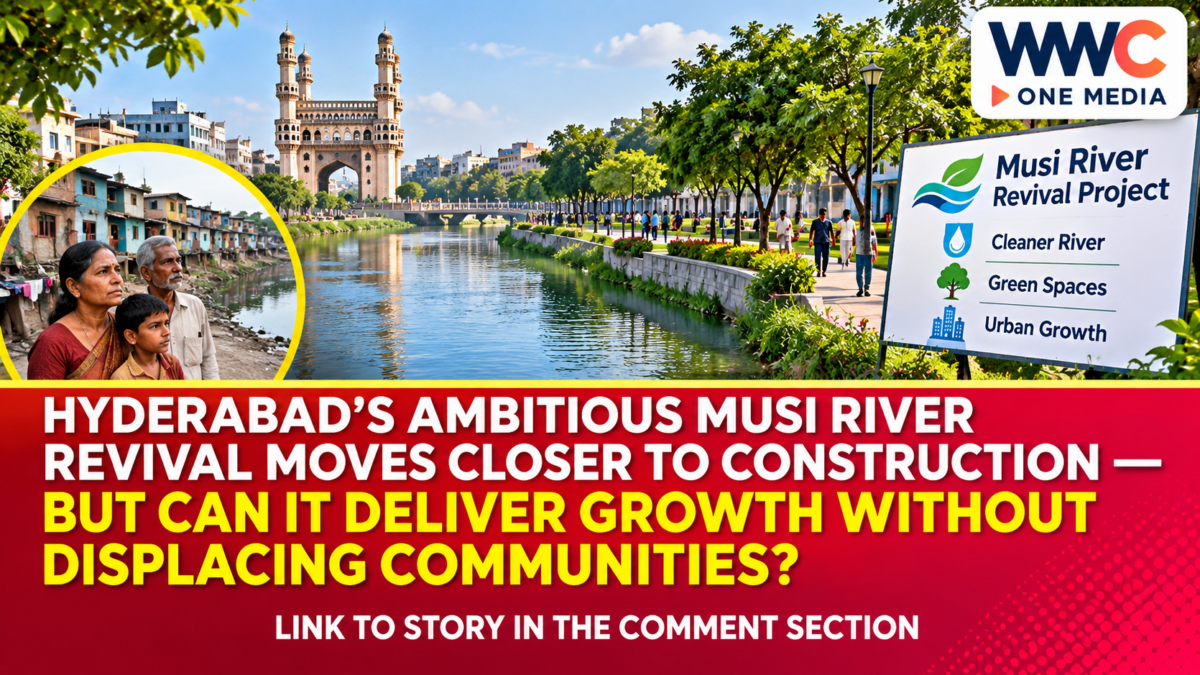
HYDERABAD, TELANGANA, INDIA — Hyderabad’s ambitious Musi River rejuvenation project is moving through a critical procurement stage as the Telangana government prepares to transform a 21-kilometre stretch of the river into a cleaner, better-connected and more flood-resilient urban corridor.
The Musi Riverfront Development Corporation Limited (MRDCL) has invited construction bids for two major development packages, with its published procurement schedule setting Nov. 26, 2026, as the submission deadline and Nov. 27 for the opening of technical bids.
The initiative forms part of a wider plan to revitalise a 55-kilometre riverfront corridor, integrating environmental restoration with infrastructure development and economic opportunities.
But beyond the ambitious designs lies a more complicated challenge: whether Hyderabad can restore its historic river while protecting the livelihoods, housing and financial security of affected communities.
Musi River rejuvenation moves closer to construction
Telangana Chief Minister A. Revanth Reddy announced on Nov. 11, 2026, that the government had secured the necessary project approvals and that the initiative would cover 21 kilometres during its first phase.
The announcement came during the inauguration of the restored Thammidikunta Lake in Hyderabad’s Hitec City.
Reddy emphasised that restoring the Musi should address pollution and environmental degradation rather than concentrate exclusively on improving the appearance of the riverfront.
Official construction documents identify two major development zones connecting Himayat Sagar and Osman Sagar to Bapughat.
Both packages include river cleaning, flood-mitigation infrastructure, embankments, stormwater drainage, major sewer lines, roads, bridges and utility corridors.
The Osman Sagar package also includes a proposed cable-stayed bridge crossing the Outer Ring Road.
The contracts incorporate five years of operation and maintenance, extending the contractors’ responsibilities beyond initial construction.
However, an invitation for bids does not establish that construction contracts have already been awarded or that physical work has been completed.
The next milestones involve procurement evaluation, contract finalisation and preparations for construction.
Telangana’s ₹7,000-crore infrastructure ambition
During a project presentation on March 13, 2026, Reddy identified an estimated project cost ranging from ₹6,500 crore to ₹7,000 crore, equivalent to INR 65 billion to INR 70 billion.
The estimate illustrates the financial scale of the government’s development ambitions.
However, it should not be interpreted as a final awarded contract value or the confirmed cost of redeveloping every section of the wider 55-kilometre corridor.
Large infrastructure projects can experience changes in expenditure as designs are refined, construction requirements become clearer and land acquisition arrangements progress.
The financial challenge extends beyond building physical infrastructure.
River cleaning, sewage treatment, drainage maintenance and environmental monitoring can require continuing expenditure after construction is completed.
For Telangana, the long-term value of the Musi project will therefore depend on whether the infrastructure remains effective throughout its operational life.
The wider importance of water infrastructure investment has previously been examined in WWC ONE MEDIA’s coverage of Telangana’s Krishna River water allocation dispute and the challenges surrounding interstate irrigation.
Why sewage treatment could determine the project’s success
The Musi redevelopment is not simply a waterfront construction programme.
MRDCL’s development strategy integrates ecological restoration with wastewater treatment, underground drainage, lake restoration and improved flood management.
The corporation also envisions connecting the Godavari River with the Musi as part of a broader water-security strategy.
These objectives highlight the relationship between urban growth and environmental infrastructure.
A newly developed riverfront may improve public access and create attractive commercial spaces. However, its environmental benefits could be limited if untreated wastewater continues entering the river.
Effective restoration requires attention to pollution sources, sewage collection, treatment capacity and the maintenance of drainage systems.
The project’s success should therefore be evaluated through measurable environmental outcomes alongside physical construction milestones.
The relationship between drainage infrastructure, river conditions and urban flooding has also been examined in WWC ONE MEDIA’s coverage of watershed management and the engineering challenges behind severe urban flooding.
For Hyderabad, cleaner water and functioning flood-control infrastructure could provide benefits extending well beyond the immediate riverfront.
Could the Musi become a new economic corridor?
The government’s wider vision for the 55-kilometre riverfront includes public walkways, cultural venues, improved transport connections, mixed-use development and recreational facilities.
Such infrastructure could potentially create opportunities for hospitality businesses, tourism operators, retailers and other commercial activities.
Improved transport connectivity could also make previously neglected areas more accessible.
However, anticipated economic benefits should not be confused with confirmed investment commitments or guaranteed property appreciation.
Commercial opportunities will depend on the final development regulations, accessibility, infrastructure quality and actual demand.
Integrating new infrastructure into an established city also requires careful coordination with existing water, electricity, transportation and sewerage networks.
These engineering complexities were previously explored in WWC ONE MEDIA’s reporting on major infrastructure construction and the relocation of existing underground utilities.
The Musi project’s economic potential will ultimately depend on whether its different infrastructure components function together rather than operate as isolated developments.
Land acquisition and community concerns remain unresolved
The social implications of the redevelopment deserve equal attention.
The Asian Development Bank’s accountability mechanism records a complaint received on March 31, 2026, concerning land acquisition, potential displacement, compensation arrangements and concerns regarding social impact assessment.
The complaint was determined ineligible on April 30 because the complainants had not yet raised their concerns with the relevant ADB project team.
That procedural outcome does not establish that the underlying concerns were unfounded.
A separate complaint concerning the Musi Riverfront Development Project, received on Aug. 19, was forwarded to the bank’s Special Project Facilitator on Nov. 12.
These records establish that formal concerns have been raised, but they do not constitute findings that project authorities have violated applicable safeguards.
The Telangana government has publicly committed to supporting people affected by the redevelopment.
Delivering that commitment will require transparent eligibility assessments, appropriate compensation arrangements, meaningful consultation and accessible grievance procedures.
A river restoration programme should not be assessed solely through the physical appearance of its completed infrastructure.
Its social consequences also matter, particularly for households whose employment, housing or access to essential services could be affected.
Flood protection must work beyond the riverfront
Flood mitigation represents another central objective of the Musi redevelopment.
The construction tenders include river engineering, protective embankments, retaining structures and stormwater drainage facilities.
These measures could help manage water flows and reduce particular flood risks when supported by appropriate engineering design and maintenance.
However, no individual construction package can guarantee complete protection against every future extreme rainfall event.
Effective urban flood management requires coordination across river channels, drainage networks, reservoirs and surrounding watersheds.
WWC ONE MEDIA previously examined this distinction through its coverage of large-scale floodwater retention infrastructure and the importance of maintaining wider drainage systems.
For Hyderabad, the practical test will be how effectively the completed infrastructure performs under demanding weather conditions.
What happens next for Hyderabad’s Musi River?
The immediate published procurement milestones involve the submission and evaluation of bids for the two riverfront construction packages.
Subsequent contract awards and official construction notices should provide greater clarity regarding implementation schedules, project expenditure and the responsibilities of selected contractors.
The government will also need to demonstrate progress in pollution control, environmental protection and arrangements for affected communities.
The Musi River rejuvenation project offers Hyderabad an opportunity to connect environmental restoration with broader urban development.
Its ultimate success, however, will not be determined simply by the number of bridges, public walkways or kilometres of riverfront constructed.
It will depend on whether the river becomes cleaner, flood risks are better managed and surrounding communities share in the benefits of development.
Frequently Asked Questions
What is the Musi River rejuvenation project?
It is a Telangana government initiative designed to restore the Musi River in Hyderabad while improving wastewater infrastructure, flood protection, public spaces and urban connectivity.
How long is Phase I of the Musi River project?
The Telangana government has identified a 21-kilometre first phase within a wider 55-kilometre riverfront development corridor.
How much will the Musi River rejuvenation project cost?
Chief Minister A. Revanth Reddy stated an estimated cost of ₹6,500 crore to ₹7,000 crore during a March 2026 project presentation. This is an official estimate rather than a final awarded contract value.
What are the main construction zones?
The official construction tenders cover two zones connecting Himayat Sagar and Osman Sagar to Bapughat.
When will Phase I of the Musi River project be completed?
The official records reviewed do not establish a January 2027 completion deadline. The published construction tender identifies November 2026 procurement milestones, with the final construction timetable requiring further confirmation.










