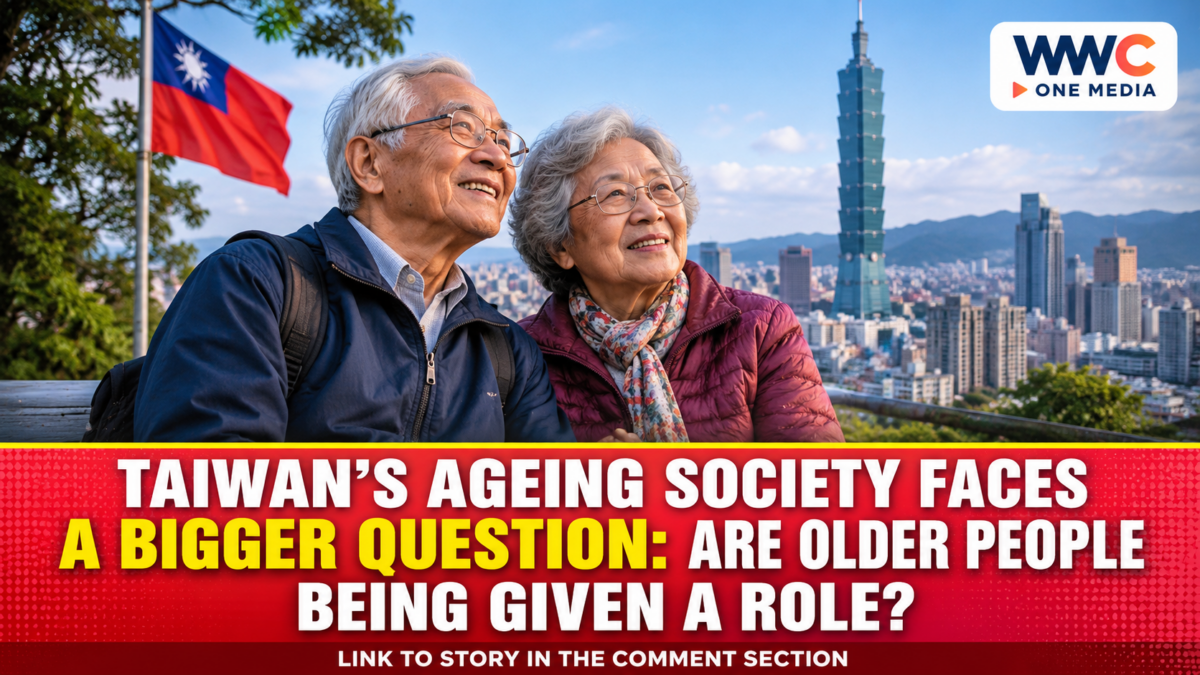
Taiwan’s population aged 65 and above reached 4,823,709 people, or 20.79% of the population, at the end of October 2026, according to the government’s latest household-registration figures. As the island adjusts to its new demographic reality, official education programmes and recent public-health research point to a policy challenge beyond care services: how to help older residents remain connected, continue learning and contribute to their communities.
The question matters because a longer life does not automatically guarantee a meaningful or socially connected one. Home assistance, medical services and financial support remain essential, particularly for people with care needs. But a system measured only by the number of services delivered may miss another dimension of ageing: whether older people have opportunities to build relationships, develop skills and take part in public life.
For governments facing rapid demographic change, the issue is increasingly practical. Social participation is not a replacement for professional care, but research in Taiwan suggests it deserves a more visible place in policies for older adults.
Taiwan’s ageing society is changing faster than its institutions
The latest figures from Taiwan’s Ministry of the Interior show that people aged 65 and older represented 20.79% of the population at the end of October. The total population was 23,204,000, while the working-age group aged 15 to 64 accounted for 68.03%. Children aged 14 and below made up 11.18%.
The 20% threshold is significant because it is the benchmark commonly used to describe a “super-aged” society. Taiwan’s Ministry of Health and Welfare has also documented the transition in its 2024 Annual Report on Aging and Long-Term Care, which says the country crossed that threshold by the end of 2025.
This demographic shift has consequences for public budgets, healthcare capacity, family caregiving and the labour market. It also changes the way communities need to be designed. More older residents mean greater demand for accessible transport, public spaces, health services and opportunities to participate in local activities.
The policy challenge is not simply to extend the number of years people live. It is to make sure that social and community systems remain accessible as the population grows older. 內政部全球資訊網-中文網+1
Research links participation with lower loneliness
A Taiwan study published in the Taiwan Journal of Public Health in February 2026 examined the relationship between social participation, social support, loneliness and depression among people aged 50 and above.
The retrospective cohort study analysed 3,967 participants using data from the Taiwan Longitudinal Study in Aging. Researchers examined activities including volunteering and participation in social groups, alongside emotional and informational support.
The study found that participants with volunteering experience had a lower likelihood of reporting loneliness than those without social participation. People who held leadership positions in social groups also showed a lower likelihood of loneliness. The researchers further reported an association between social-group participation and a lower likelihood of depression.
The findings do not prove that volunteering alone prevents loneliness or depression. The study examined associations, and individual circumstances can influence both participation and well-being. Still, the results provide evidence that social roles and relationships deserve attention alongside traditional care services.
The distinction is important for policymakers. An older person may receive meals, medical attention or regular welfare checks but still have limited opportunities to make friends, learn new skills or feel useful within a community. Those needs are related to care, but they are not identical. toaj.stpi.niar.org.tw
Lifelong learning is already part of Taiwan’s policy response
Taiwan’s Ministry of Education has built a nationwide network of senior learning centres aimed at people aged 55 and above. The programme works with local governments, schools, libraries and community organisations to bring learning opportunities closer to where older residents live.
The ministry’s third Senior Citizen Education Medium-Term Development Plan, covering 2025 to 2028, sets out a broader approach to older-adult education. Its objectives include expanding learning access, improving course quality, strengthening digital literacy and encouraging older people to contribute through community activities.
The ministry’s published plan also identifies participation gaps. Its review of earlier programme data found that overall participation among people aged 55 and above remained limited, with male participation lower than female participation. This suggests that building centres is only one part of the task; programmes must also reach people who do not currently take part.
The scale of the existing network is substantial. Taiwan’s 2024 lifelong-education reporting recorded 369 senior learning centres and 2,997 community learning locations. These centres held more than 116,000 learning activities during the year, with nearly 2.97 million attendances. Attendance figures represent participation instances, not necessarily unique individuals.
The programme demonstrates that lifelong learning is already recognised as a public-policy tool. The next question is whether participation can become more inclusive and whether its results are measured beyond enrolment and attendance. ws.moe.edu.tw+1
Care services and social connection must work together
The World Health Organization’s Commission on Social Connection has described loneliness and social isolation as significant public-health and social concerns. Its 2025 report calls for governments and other sectors to treat social connection as a policy priority, rather than viewing it only as a private or personal matter.
The WHO distinguishes social isolation from loneliness. Isolation concerns the objective lack of relationships and interactions, while loneliness describes the distress that can arise when a person’s actual relationships do not meet the connections they want or need.
That distinction matters in ageing policy. Living alone does not automatically mean someone is lonely, and a person surrounded by others may still feel disconnected. Programmes therefore need to consider the quality and meaning of relationships, not simply count visits or contacts.
This is also a relevant issue elsewhere in Asia. WWC’s report on Singapore’s support system for seniors living alone examined how community outreach can identify older residents who may need help. Meanwhile, Japan’s cooperation with the Philippines on elderly care and healthcare workers illustrates the growing regional demand for care capacity and trained personnel.
In the Philippines, local programmes also show how public support can reach older people through community services. WWC has reported on Zamboanga’s efforts to strengthen senior-pension verification, highlighting the administrative challenge of protecting assistance while ensuring eligible seniors continue receiving it.
These examples involve different systems and policy priorities, but they point to a shared lesson: ageing policy must consider both material support and the social conditions that allow older people to remain involved in their communities.
Measuring success beyond the number of services
Taiwan’s experience raises a useful question for governments: what should count as a successful ageing policy?
The number of care recipients, learning centres, programme sessions and home visits can show whether services are being delivered. They cannot, on their own, show whether older people feel included, have meaningful relationships or can continue contributing to society.
A broader evaluation could examine whether programmes are accessible to people with mobility limitations, whether rural communities have adequate learning options, whether men and women participate at comparable rates, and whether older learners have opportunities to lead activities or volunteer.
It should also recognise that not everyone wants the same kind of participation. Some older adults may prefer structured classes, while others may value neighbourhood groups, intergenerational activities, cultural programmes or flexible digital learning. Public programmes should offer choices rather than impose a single model of active ageing.
This is analysis, not a claim that learning programmes can replace medical treatment, long-term care or income support. Those services remain necessary. The stronger approach is to connect them with opportunities for social participation where appropriate.
What happens next
Taiwan’s 2025–2028 senior education plan provides an existing framework for expanding lifelong learning. The demographic figures and the 2026 public-health study give policymakers additional reasons to examine whether those programmes are reaching people who are most at risk of disconnection.
The next measure of progress should not be the number of centres alone. It should include who participates, who remains excluded, whether older people can take on meaningful roles and whether local services coordinate learning with community care.
Taiwan’s ageing population is already a statistical reality. The policy test is whether its institutions can respond not only to the needs of older residents, but also to their continuing capacity to learn, contribute and belong.
Frequently asked questions
What percentage of Taiwan’s population is aged 65 and above?
At the end of October 2026, people aged 65 and above accounted for 20.79% of Taiwan’s population, or 4,823,709 people.
What does a super-aged society mean?
It generally refers to a society in which at least 20% of the population is aged 65 or older.
Does social participation help reduce loneliness among older adults?
A 2026 Taiwan cohort study found that volunteering and participation in social groups were associated with a lower likelihood of loneliness. The findings show an association, not proof that participation alone prevents loneliness.
What are Taiwan’s senior learning centres?
They are community-based education centres supported by Taiwan’s Ministry of Education and local partners. They provide learning opportunities for people aged 55 and above, including activities intended to support active ageing.
Is living alone the same as being lonely?
No. Living alone describes a household arrangement. Loneliness is a subjective feeling of disconnection, while social isolation refers to having too few relationships or interactions.