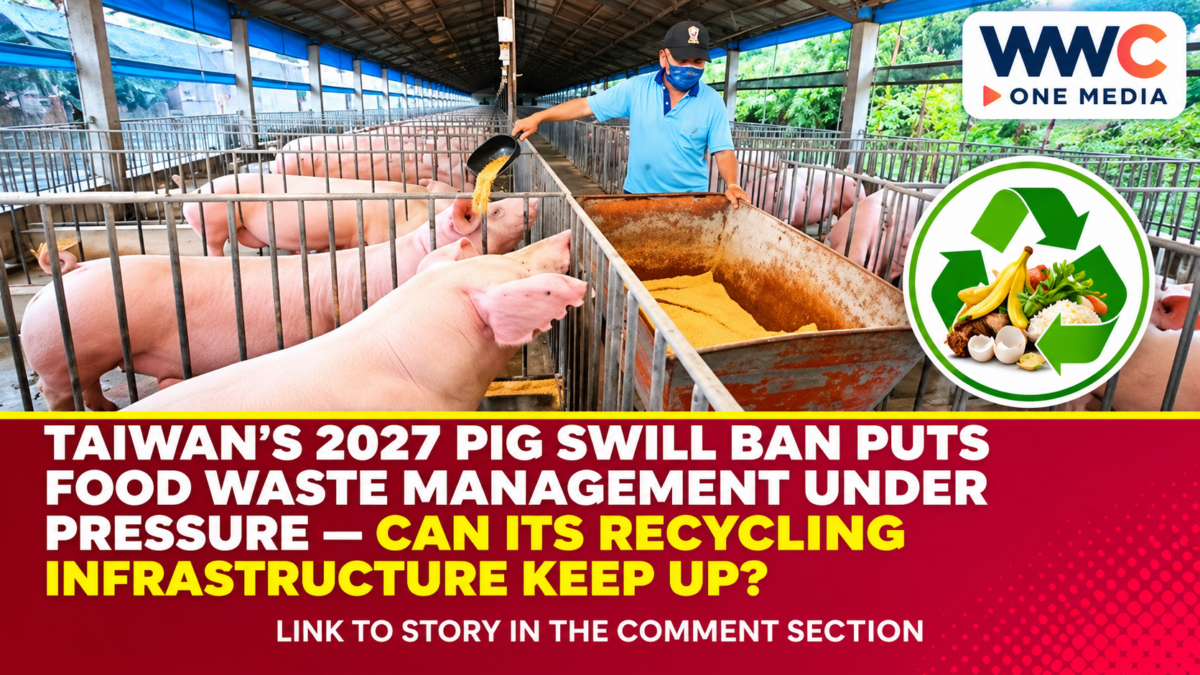
TAIPEI, TAIWAN — Taiwan is preparing for a major transformation of its agricultural and environmental policies as a comprehensive ban on traditional food waste feeding for pigs takes effect on Jan. 1, 2027, forcing businesses and local authorities to identify alternative ways of processing discarded food.
The Taiwan pig swill ban forms part of the government’s efforts to reduce African swine fever transmission risks following an outbreak in October 2025.
With approximately 197,000 tonnes of recovered household food waste previously used for pig farming in 2025, the transition presents a significant challenge for the island’s waste-management infrastructure.
Incineration and landfill disposal will remain supplementary treatment options while authorities expand alternative recycling methods.
However, the longer-term ambition extends beyond finding somewhere to dispose of unwanted food. Taiwan wants to transform organic waste into commercially useful resources without compromising agricultural biosecurity.
Taiwan pig swill ban enters its final transition period
Taiwan’s Executive Yuan established Dec. 31, 2026, as the nationwide deadline for transitioning away from traditional food waste feeding for pigs.
Household food waste has already been prohibited for pig feeding since the beginning of 2026.
During the transition period, qualifying farms have been permitted to use certain categories of commercial food waste and animal-derived materials under regulatory conditions.
Those arrangements require local government approval, monitoring equipment, transportation controls and inspections.
The comprehensive prohibition beginning in January 2027 will bring the traditional feeding practice to an end.
African swine fever prevention remains central to the policy. Discarded food containing contaminated meat products can create a potential route for transmitting the virus to pigs.
Reducing that risk requires safeguards extending beyond individual farms into waste collection, transportation and processing.
For livestock producers, the transition also introduces commercial considerations involving feed procurement, operating expenditure and investment in alternative feeding systems.
Where will Taiwan’s food waste go?
Taiwan recovered approximately 522,000 tonnes of household food waste nationwide in 2025.
Of that total, approximately 229,000 tonnes were converted into fertiliser, while 197,000 tonnes were used for pig farming.
Another 57,000 tonnes were directed towards bioenergy production, with approximately 15,000 tonnes processed through other methods.
Incineration accounted for 4.1% of recovered household food waste, while landfill disposal represented another 0.4%.
These figures demonstrate how significantly traditional pig feeding contributed to Taiwan’s food waste management system.
They do not, however, establish that the entire historical volume will automatically be redirected to incinerators in 2027.
Waste prevention, alternative processing capacity and changes in food waste generation could influence the actual quantities requiring disposal.
The government’s preferred approach is to prioritise resource recovery, using incineration and landfill facilities as supplementary options.
The broader infrastructure challenge has also been examined in WWC ONE MEDIA’s coverage of integrated waste-management systems designed to convert discarded materials into fuel and reusable resources.
For Taiwan, developing alternative processing capacity before existing disposal channels become strained will be an important operational test.
Can incinerators handle the transition?
Taiwan’s Ministry of Environment has identified incineration as one of the temporary mechanisms available for managing food waste during the transition.
Nevertheless, the ability of waste-treatment facilities to accommodate additional material depends on operating conditions, available capacity and the composition of the waste being processed.
Food waste contains moisture that can complicate thermal treatment.
The government encourages households and businesses to drain excess liquid from discarded food before collection, reducing the weight of material entering the waste-management system.
Appropriate waste segregation also remains important because contamination can reduce the effectiveness of recycling and resource recovery.
Incineration provides a disposal option, but it should not be confused with every other form of waste-to-energy technology.
Different treatment processes involve different operating requirements and environmental considerations.
WWC ONE MEDIA previously explored these infrastructure challenges through its coverage of waste-to-energy development and the environmental safeguards required before facilities become operational.
The practical question for Taiwan is whether temporary disposal arrangements can remain dependable while longer-term recycling infrastructure expands.
Taiwan invests NT$1.3 billion in alternative waste treatment
Taiwan’s Ministry of Environment has allocated NT$1.3 billion in subsidies since February 2019 to support the development of regional food waste treatment facilities.
The Environmental Management Administration identifies completed infrastructure including two biomass energy plants, 11 black soldier fly larvae facilities and 14 high-efficiency composting facilities.
Another 45 existing traditional composting sites have received improvements supported by technical expertise.
Each approach offers a different potential use for organic waste.
Composting can produce fertiliser, while anaerobic digestion converts organic material into biogas that can support energy generation.
Black soldier fly larvae can process suitable organic materials, producing resources that may be further developed into feed or fertiliser ingredients under applicable regulations.
These technologies provide opportunities for businesses operating across agricultural services, renewable energy and environmental engineering.
Similar commercial opportunities have previously been examined in WWC ONE MEDIA’s coverage of Malaysia’s interest in agricultural residues as potential biomass energy feedstock.
However, establishing a treatment facility does not automatically guarantee profitable operations.
Commercial viability depends on reliable supplies of suitable waste, processing expenditure, regulatory compliance and demand for the resulting products.
Recycled animal feed remains a separate opportunity
Taiwan’s prohibition on traditional pig swill feeding does not eliminate every potential use of recycled organic materials in animal nutrition.
On Oct. 20, 2026, the Ministry of Agriculture issued establishment standards for factories manufacturing circular raw-material feed.
The framework allows qualifying materials to undergo industrial processing before being converted into products that comply with animal feed safety requirements.
Manufacturers must satisfy applicable registration, facility and waste-reuse requirements.
The policy distinguishes regulated feed manufacturing from the traditional practice of transporting and preparing food scraps directly for pigs.
Not every category of discarded food qualifies for these industrial processes.
Restrictions concerning material origins, reporting requirements and approved processing arrangements remain applicable.
For feed manufacturers, the transition could create opportunities to develop alternative agricultural products.
For pig farmers, it could provide additional procurement options as traditional food waste feeding is phased out.
Nevertheless, the availability of regulated circular feed does not establish that it will necessarily be cheaper than conventional alternatives.
Food businesses face pressure to reduce waste at its source
Expanding treatment infrastructure represents only one component of Taiwan’s strategy.
Reducing the quantity of discarded food before it enters the collection system could also ease pressure on processing facilities.
Restaurants, hotels, retailers and food manufacturers have opportunities to examine inventory management, purchasing practices and the disposal of unsold products.
Households can contribute through more effective meal planning and compliance with local waste separation requirements.
For commercial operators, reducing avoidable waste could potentially lower procurement and disposal expenses.
However, the financial benefits will vary according to individual business operations.
The broader economics of converting waste into commercially valuable resources has also featured in WWC ONE MEDIA’s coverage of Indonesia’s proposed US$400 million waste-to-energy project and its infrastructure financing challenges.
Across Asia-Pacific, the commercial opportunity associated with circular waste management depends on more than constructing new facilities. It also requires reliable collection systems and appropriate environmental safeguards.
What happens next for Taiwan?
The Jan. 1, 2027, deadline represents an important milestone for Taiwan’s livestock industry and environmental authorities.
Government agencies will need to monitor waste volumes, treatment capacity and compliance with the new agricultural restrictions.
Businesses must also evaluate alternative disposal arrangements and determine whether their organic materials qualify for regulated recycling processes.
For farmers, the immediate priority is maintaining reliable and safe animal nutrition.
For waste-management operators, the challenge is handling changing material flows without creating additional environmental problems.
Taiwan’s transition presents an opportunity to connect agricultural biosecurity with circular economic development.
But its success will ultimately depend on whether alternative infrastructure can process discarded food safely, consistently and at a sustainable cost.
Frequently Asked Questions
When does Taiwan’s pig swill ban take effect?
Taiwan’s comprehensive prohibition on traditional food waste feeding for pigs begins on Jan. 1, 2027, following the end of the nationwide transition period on Dec. 31, 2026.
Why is Taiwan banning food waste feeding for pigs?
The policy aims to reduce African swine fever transmission risks associated with potentially contaminated food waste.
How much household food waste does Taiwan recover?
Taiwan recovered approximately 522,000 tonnes of household food waste in 2025. Around 197,000 tonnes were used for pig farming.
Will Taiwan burn all its food waste after the ban?
No. Government policy prioritises resource recovery through composting, bioenergy and other approved methods, with incineration and landfill disposal serving as supplementary options.
Can recycled food materials still be used in animal feed?
Yes, qualifying materials may be processed into regulated circular feed products through approved industrial facilities, subject to applicable animal nutrition, waste-management and safety requirements.