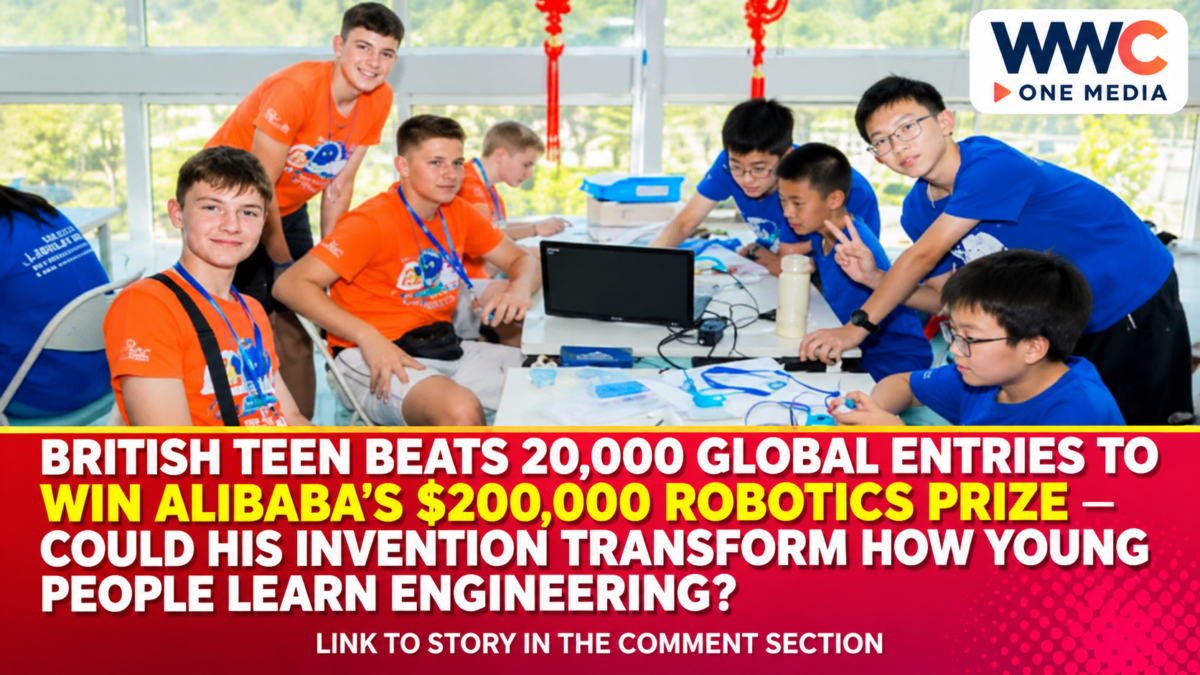
LONDON, UNITED KINGDOM — British teenage entrepreneur Suleymaan Khan has secured a US$200,000 prize package from Alibaba.com after his educational technology business, SuleyNova Robotics, emerged as the grand winner of the 2026 CoCreate Pitch competition in London.
Selected from a global pool of 20,000 applications, the self-taught robotics engineer turned his passion for building machines into a commercial venture designed to make coding and engineering more accessible to young learners.
His victory highlights an entrepreneurial opportunity at the intersection of education, robotics and technology-enabled commerce.
But winning an international competition is only the beginning. Khan now faces the challenge of transforming his award-winning invention into a sustainable and scalable business.
SuleyNova Robotics turns engineering curiosity into a business
Rather than developing sophisticated machines exclusively for industrial customers, Khan has focused on creating an educational product that introduces beginners to the fundamental principles of robotics.
SuleyNova Robotics offers a programmable mechanical hand that users assemble themselves, providing an introduction to electronics, mechanical design and software development.
The product brings together three-dimensional printed components, electronic circuitry and an Arduino controller.
Users can experiment with programming instructions and observe how software affects physical movement, creating a direct connection between digital commands and mechanical behaviour.
The concept addresses a practical educational challenge: understanding engineering can become easier when learners can interact with the technology they are studying.
A programmable hand offers opportunities to experiment with movement, coordination and electronic control without requiring access to an industrial robotics laboratory.
The broader potential of robotics in education has also been explored in the development of a Kenyan startup using robotic hands to improve classroom accessibility.
Although the two businesses serve different purposes, both illustrate how mechanical engineering can be applied to educational challenges.
What Alibaba’s $200,000 prize actually means
Khan secured the top award during the CoCreate Pitch final on November 20, 2026.
The competition brought together 20 shortlisted finalists, each given 90 seconds to introduce their business before answering questions from the judging panel.
However, the US$200,000 grand prize should not be mistaken for an entirely cash-based investment.
The competition’s award structure provides US$100,000 in non-dilutive cash funding, with the remaining US$100,000 represented by Alibaba.com credits and support.
Non-dilutive funding allows entrepreneurs to access financial resources without surrendering an ownership stake in their companies in exchange for the award.
For an early-stage business, this distinction can be particularly important.
Cash funding can help address immediate operating requirements, while platform-based credits could support eligible commercial and sourcing activities.
The combination could provide SuleyNova Robotics with opportunities to improve its products, develop supplier relationships and reach additional customers.
Nevertheless, the prize does not establish the company’s valuation, profitability or future sales.
Its commercial success will ultimately depend on how effectively the resources are deployed.
From self-taught engineer to international competition winner
Khan’s latest achievement builds on an existing history of engineering experimentation.
In 2023, he received the Network Rail Innovation Award for developing a robot named Pepper.
His progression from personal engineering projects to a commercial educational technology business demonstrates one possible pathway for turning technical skills into entrepreneurship.
SuleyNova Robotics Ltd is registered as an active private company in the United Kingdom.
Its business model centres on providing practical robotics experiences to learners through commercially available educational kits.
The company intends to pursue growth through direct consumer sales and relationships with educational organisations.
These distribution channels could serve different customer needs.
Individual consumers may purchase robotics kits for personal learning, while educational institutions could potentially incorporate similar products into structured lessons, workshops or engineering programmes.
However, establishing institutional partnerships requires more than demonstrating an impressive invention.
Product reliability, instructional quality, pricing, safety and customer support will all be important considerations as the business develops.
Why practical robotics education matters
The development of automation has raised important questions about how education systems prepare students for technology-intensive careers.
Learning how to interact with software is one aspect of digital education. Understanding the relationship between software, electronics and mechanical systems introduces an additional dimension.
A robotics kit can provide opportunities to experiment with these interconnected disciplines through practical projects.
This approach is particularly relevant as educational institutions consider how to prepare students for emerging technical occupations.
WWC ONE MEDIA previously examined this changing educational landscape through Singapore’s development of technical training for autonomous vehicles and future transport careers.
The growing sophistication of industrial automation also provides context for the technical capabilities that future engineers may need to develop.
Recent developments involving Japanese humanoid robotics startups and factory automation illustrate the broader commercial applications of mechanical engineering and programmable machines.
Educational robotics products cannot independently replace formal engineering qualifications or professional training.
However, they could provide an accessible starting point for learners interested in developing more advanced technical capabilities.
Alibaba’s wider strategy for supporting entrepreneurs
The CoCreate competition also forms part of Alibaba.com’s broader efforts to connect product developers with commercial resources.
Its entrepreneurship initiatives bring together business owners, manufacturers and industry specialists, creating opportunities for entrepreneurs to explore product development and international sourcing.
Artificial intelligence is another component of this strategy.
Alibaba.com has developed Accio to support business activities through AI-powered tools, covering areas such as product development, supplier discovery and commercial operations.
The initiative reflects the company’s wider ambition to integrate artificial intelligence into business-to-business commerce.
WWC ONE MEDIA previously examined this strategy in its coverage of Alibaba’s agentic AI tools designed to support small-business automation and expansion.
For product-based startups, access to suppliers and manufacturing resources may help reduce some of the operational barriers associated with bringing an invention to market.
But technology and commercial support cannot eliminate the financial risks of entrepreneurship.
Businesses must still manage production costs, inventory, distribution, customer acquisition and product quality.
What happens next for SuleyNova Robotics?
Khan intends to use his competition winnings to promote and expand his robotics business.
The next stage will require balancing product development with the operational demands of reaching a larger customer base.
Expanding production could introduce new challenges involving component availability, manufacturing consistency and fulfilment.
Educational partnerships may also require additional instructional materials and adaptations for different learning environments.
International expansion, if pursued, could bring further considerations involving product compliance, distribution arrangements and customer support.
These challenges will determine whether SuleyNova Robotics can evolve beyond its initial product offering.
Khan has already demonstrated that his educational robotics concept can attract the attention of an international judging panel.
The more significant commercial test now lies ahead: whether his invention can attract sustained customer demand while maintaining the accessibility that inspired its development.
For the young British entrepreneur, the US$200,000 award provides an opportunity to pursue that ambition.
Whether it becomes the foundation of a larger educational technology business will depend on what SuleyNova Robotics achieves next.
Frequently Asked Questions
Who is Suleymaan Khan?
Suleymaan Khan is a British teenage entrepreneur, self-taught robotics engineer and founder of SuleyNova Robotics. He won Alibaba.com’s 2026 CoCreate Pitch grand prize in London.
What is SuleyNova Robotics?
SuleyNova Robotics is a UK-based educational robotics business that develops practical engineering kits designed to introduce learners to coding, electronics and mechanical systems.
How much did Suleymaan Khan win from Alibaba?
Khan received a US$200,000 prize package comprising US$100,000 in non-dilutive cash funding and US$100,000 in credits and commercial support.
How many applications did Alibaba CoCreate Pitch receive?
The competition shortlisted 20 finalists from a pool of 20,000 global applications. The London final took place on November 20, 2026.
What will Suleymaan Khan do with his prize?
Khan intends to use the award to market and scale SuleyNova Robotics, with potential growth through direct consumer sales and educational partnerships.