
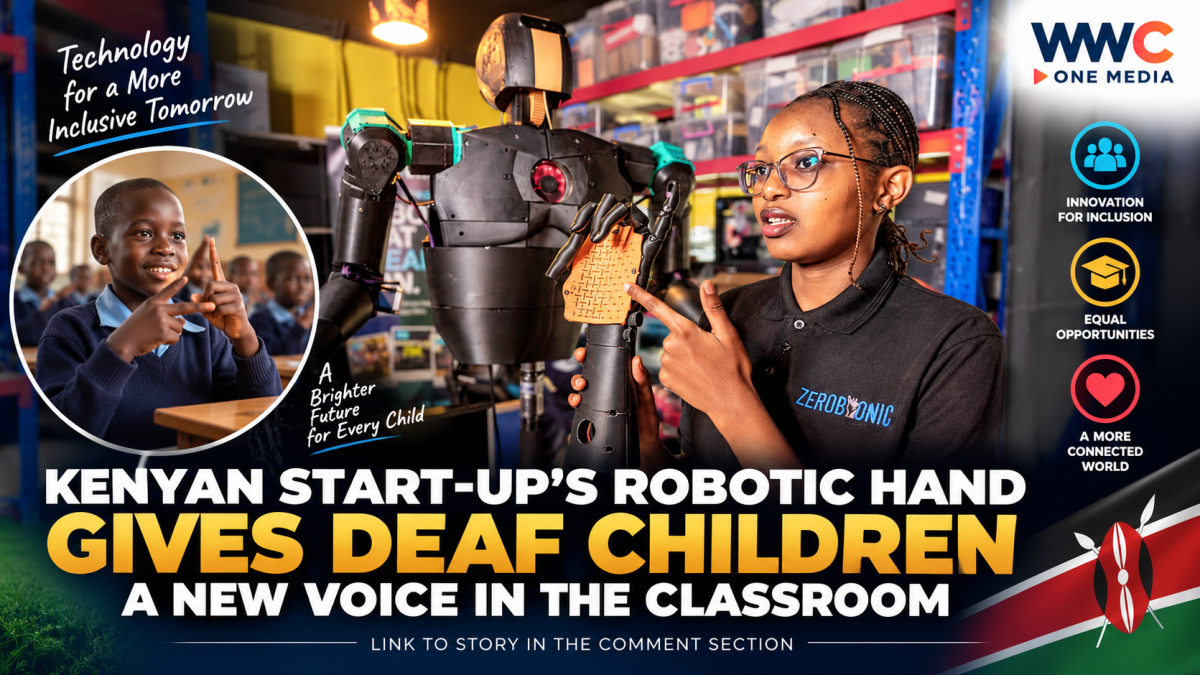
NAIROBI, Kenya — A young Kenyan start-up is using robotics and artificial intelligence to help deaf children overcome one of the biggest barriers in education: understanding teachers in real time.
ZeroBionic, a Nairobi-based technology start-up co-founded by 22-year-old Norah Kimathi, has developed a robotic hand capable of converting a teacher’s spoken words into sign language, offering deaf students a new way to follow lessons alongside their hearing classmates.
The technology is being demonstrated at schools for deaf students in Kenya, where the team hopes it could help transform access to education — particularly in science, mathematics and other subjects where technical vocabulary in local sign language can be limited.
A Robotic Hand That Signs What Teachers Say
The mechanical hand is designed to translate spoken classroom content into sign language in real time.
For many deaf students, the biggest challenge is not simply hearing a teacher. It is the lack of accessible interpretation for complex academic concepts, particularly in technical subjects.
ZeroBionic is trying to address that gap by combining AI, robotics and locally developed sign-language data. The company also works with deaf teachers who use a motion-capture bodysuit to record and store signs, helping build a database of technical vocabulary drawn from English, American and Kenyan sign systems.
The goal is to expand the range of signs available for subjects such as mathematics, science and biology.
Building a Sign-Language Database From Scratch
One of the biggest challenges facing the project is the lack of a standardized African sign-language dataset.
Kimathi said the team had to build much of its system from the ground up.
Many deaf children in Kenya learn a mixture of locally used or improvised signs, while some technical and scientific concepts lack widely recognized signs.
That can make advanced lessons significantly harder to follow.
For Sharon Mumbe, a 19-year-old student at Kasarani Treeside Secondary School for the Deaf in Nairobi, the technology offers hope that complex subjects could become easier to understand.
The Education Gap Is Huge
The need for better accessibility is significant.
According to the Kenya Society for Deaf Children, about 300,000 children in Kenya have a hearing impairment, but only about 20,000 were enrolled in schools as of 2024.
That education gap is one of the problems ZeroBionic hopes its technology can help address.
By making real-time interpretation more accessible, the robotic hand could potentially help deaf students participate more fully in classrooms rather than relying entirely on limited human interpretation resources.
Built in Kenya With Recycled Materials
ZeroBionic’s innovation is also notable because much of the technology has been developed and produced locally.
The company uses 3D printing and recycled materials to build the robotic hands, helping reduce both manufacturing costs and environmental impact.
Each hand costs about US$350 and can last for up to two years, according to the company. The technology is already being used in 78 schools across Kenya, the latest AFP report said.
The company says its speech-to-sign technology has achieved a 92 percent accuracy rate, although that figure is a company-reported performance claim.
Recognition Beyond Kenya
ZeroBionic’s work has also received international recognition.
The organization is listed by the Zero Project as developing an AI-trained, 3D-printed robotic hand for real-time sign-language translation in STEM education. The Zero Project says the system is designed for low-resource environments, can operate offline and adapt to local sign dialects.
Reuters has also documented the use of ZeroBionic’s technology by deaf students in Kenya, highlighting the growing international attention surrounding the Kenyan-developed innovation.
More Than a Robot
For ZeroBionic, the project is about far more than building an impressive machine.
It is about giving deaf students better access to knowledge.
A robotic hand may seem like an unlikely solution to an education crisis, but for students struggling to understand lessons because the language needed to explain complex concepts does not yet exist in their classrooms, the technology could be life-changing.
The project also sends a powerful message about African innovation.
Rather than waiting for an imported solution, a young Kenyan team is building technology around the specific challenges faced by deaf students in Africa.
The Bottom Line
A 22-year-old Kenyan entrepreneur and her team are using robotics to help deaf children understand their teachers in real time.
ZeroBionic’s robotic hand converts spoken words into sign language while helping build a growing database of technical signs for subjects such as science and mathematics.
With hundreds of thousands of children with hearing impairments in Kenya and a major gap in school enrollment, the need for accessible education remains enormous.
But in a small lab in Nairobi, a robotic hand is proving that technology can do more than move — it can help break down barriers and bring knowledge within reach of children who have too often been left behind.
WWC ONE MEDIA J.M.D




Leave a Reply