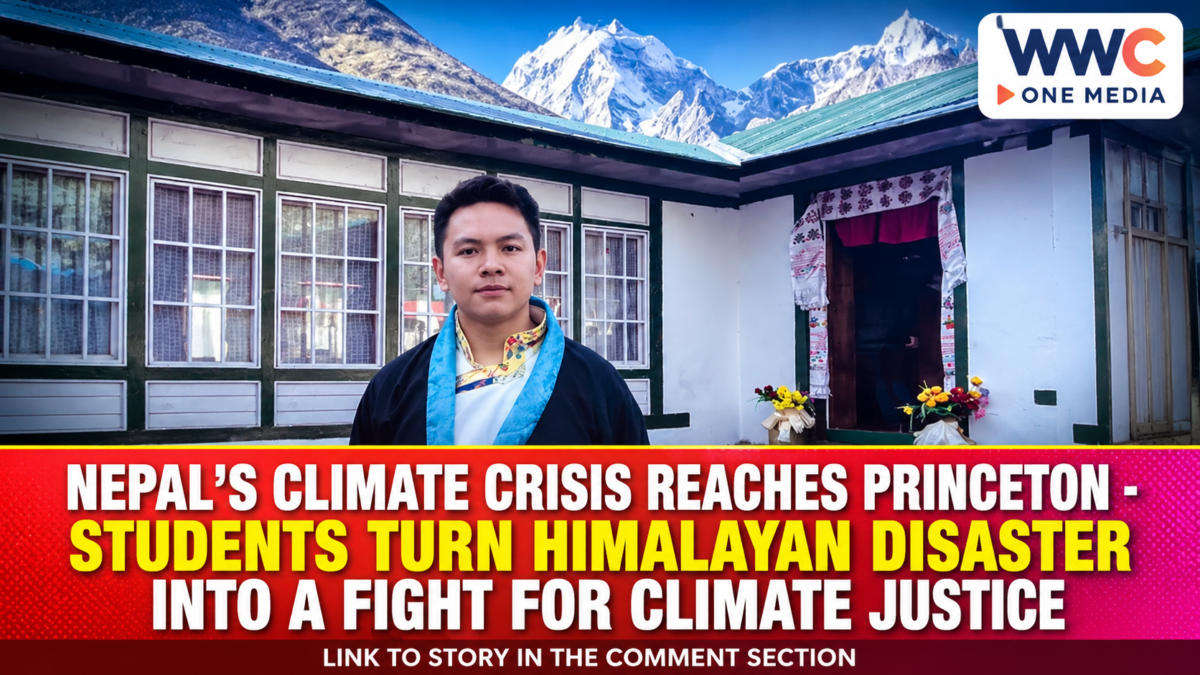
PRINCETON, New Jersey — A devastating Himalayan disaster has brought the issue of climate justice into sharper focus for Nepali students at Princeton University, where a student-led community is drawing attention to the growing risks facing mountain communities in Nepal.
At the centre of the discussion is a difficult imbalance: Nepal contributes less than 0.1% of global greenhouse-gas emissions, yet its people are increasingly exposed to the destructive consequences of a warming climate.
For Tenzing Sherpa, a Princeton student from Pangboche, Nepal, the issue is deeply personal. His connection to the Himalayan region has shaped his interest in technology that could help protect communities exposed to avalanches and other mountain hazards.
The discussion gained urgency following the catastrophic August 26, 2026, disaster along Nepal’s Bhote Koshi–Trishuli river corridor. A rock-and-ice avalanche transformed into a destructive debris flood, devastating communities near the Nepal-China border and sending water, rocks and sediment downstream.
The disaster was not simply another seasonal flood. It exposed how rapidly interconnected mountain hazards can overwhelm communities, infrastructure and existing warning systems.
A Himalayan disaster with a devastating human toll
The August 26 event began with the collapse of a large section of rock and glacier ice on the slopes of Langtang Lirung in Nepal’s Rasuwa region.
The collapse triggered a cascading sequence of events. Rock, ice, meltwater and sediment rushed down the mountain, transforming into a debris flood and then a powerful water-dominated flash flood.
The scale of the disaster was extraordinary.
Nepal’s disaster authority reported 1,451 deaths and 5,745 missing people as of September 21, 2026. The United Nations Development Programme also reported that 84,270 people were affected, with 7,570 buildings and 105 bridges damaged.
The destruction extended across the Bhote Koshi–Trishuli river corridor, affecting communities, roads, hydropower facilities and other essential infrastructure.
The Government of Nepal formally appealed for support for affected communities and the recovery effort, identifying Rasuwa, Nuwakot, Dhading and Gorkha among the severely affected districts.
The human toll is central to the climate justice debate. It raises questions about why communities with limited responsibility for global emissions face such severe exposure to climate-related risks.
Why climate change matters in the Himalayas
The scientific explanation is more complicated than saying global warming directly caused one flood.
An international research group coordinated through World Weather Attribution examined the August disaster and identified several interacting factors that may have weakened the mountain slope before it collapsed.
These included long-term warming, permafrost degradation, glacier thinning, changing precipitation patterns and geological weaknesses.
The researchers found that the 2015 earthquake may also have contributed to the long-term weakening of the underlying rock mass, although its specific role in the 2026 failure could not be confirmed.
The distinction is important: the research did not establish that climate change alone caused the collapse or prove that the event would not have happened without human-induced warming.
Instead, the analysis identified climate change as a destabilising influence acting on an already vulnerable geological setting.
The findings also showed how quickly the resulting disaster unfolded. The surge reached the Rasuwagadhi border area, about 22 kilometres downstream, in approximately seven minutes, moving at an average speed of 188 kilometres per hour.
That speed left communities close to the source with little opportunity to respond.
The researchers concluded that the event exceeded the design and predictive limits of existing risk-reduction measures. Conventional early-warning systems can help protect communities from more forecastable river floods, but the scale and speed of this cascading hazard presented a fundamentally different challenge.
WWC previously examined the scientific evidence behind the disaster in its report on how long-term warming may have destabilised the mountain before the Nepal-Tibet glacier disaster.
A Princeton student sees technology as part of the response
Tenzing Sherpa is a computer science student at Princeton University and an active member of the university’s Nepali Society.
His background connects the technological opportunities available at Princeton with the risks confronting communities in the Himalayas.
His interest in avalanche detection is not new. Princeton previously documented his ambition to bring technology and computer science skills back to Nepal, including the possibility of developing avalanche-detection tools to improve safety in the Everest region.
His current academic direction brings that ambition closer to a research challenge: using satellite information and machine-learning techniques to help identify avalanche risks in a region where reliable historical data can be scarce.
The concept is significant because avalanche prediction depends on information about previous events, mountain conditions and the environmental factors that influence slope stability.
In regions with extensive monitoring networks, researchers can use large collections of observations to develop and test detection models. In remote parts of the Himalayas, however, the lack of consistent measurements makes the task considerably harder.
A machine-learning system would not eliminate the danger of avalanches. Its usefulness would depend on the quality of satellite observations, the availability of ground-based measurements, model accuracy and whether warnings could reach exposed communities in time.
The research ambition nevertheless points to an important role for technology in climate adaptation: turning limited environmental data into information that could help authorities and residents understand where danger may be developing.
Nepali students turn campus solidarity into climate advocacy
The Princeton Nepali Society has provided a space for students to respond to the disaster as a community rather than treating it as a distant international news event.
The students’ response included a candlelight vigil outside Firestone Library and a community dinner held on September 24 to honour those affected by the floods. The group also directed people interested in supporting survivors toward Nepal’s official Prime Minister’s Disaster Relief Fund.
The effort reflects a wider form of climate advocacy: connecting personal experience, community organisation and public awareness.
For students whose families and communities remain connected to Nepal, the disaster is not an abstract discussion about emissions targets. It is about the safety of relatives, the resilience of mountain settlements and the future of communities that depend on fragile landscapes.
Princeton’s official student-organisation directory lists the Nepali Society among its undergraduate organisations. The university’s published profile of Sherpa also identifies his involvement in the society and his work on technology, digital access and issues affecting the Himalayan region.
Nepal’s climate justice argument reaches the United Nations
The disaster has also become a major issue in Nepal’s international climate diplomacy.
On September 24, 2026, Prime Minister Balendra Shah addressed the 81st session of the United Nations General Assembly in New York, where he linked the country’s disaster losses to the wider question of climate responsibility.
Shah stated that Nepal contributes less than 0.1% of global greenhouse-gas emissions. He also said that the country had recorded at least 1,400 confirmed deaths and more than 6,000 people missing at the time of his address.
The Prime Minister described the disaster as a development emergency, noting that damage to roads, bridges, schools, homes, farms and clean-energy infrastructure threatens years of progress.
He called for greater international support, including grant-based climate financing, and proposed a Himalayan Climate Resilience Mechanism involving Nepal, India and China.
The proposed mechanism would support cooperation in satellite data sharing, monitoring dangerous glacial lakes, strengthening early-warning systems and coordinating cross-border disaster assistance.
The proposal reflects a basic geographical reality: rivers, glaciers and mountain hazards do not stop at national borders.
The Hindu Kush Himalaya supports water systems, ecosystems, agriculture and livelihoods across a region inhabited by nearly two billion people. Risks in the mountains can therefore have consequences far beyond the communities closest to the source.
The next challenge: turning climate warnings into protection
The Princeton students’ response and Nepal’s international appeal point toward the same unresolved challenge: climate awareness must lead to practical protection.
For Himalayan communities, that means better observation of high-altitude terrain, reliable communication systems, stronger local preparedness and improved access to scientific information.
It also means recognising that technology alone cannot solve the problem. Satellite monitoring and machine-learning models require reliable data, trained personnel, funding and institutions capable of acting on the information they produce.
Nepal is already considering additional measures to reduce future glacial-lake and flood risks. The government’s plans to study the controlled lowering of four potentially dangerous glacial lakes are part of a wider effort to strengthen protection after the August disaster. WWC has reported on Nepal’s proposed work to drain four glacial lakes following the deadly floods.
The human consequences will also continue long after the initial emergency. Families are still seeking information about missing relatives, while authorities face the difficult work of identifying recovered victims and supporting survivors. WWC has examined the DNA identification challenge facing families after Nepal’s catastrophic floods.
The disaster has also required international assistance. Singapore, for example, deployed a crisis response team to Nepal to support its citizens and provide consular assistance during the emergency. That response was part of a wider regional effort as the consequences of the disaster crossed borders. Read WWC’s report on Singapore’s crisis response in Nepal as travellers remained missing.
Climate justice is also about who gets protected
The debate surrounding Nepal is not limited to how much the country emits or how much damage it has suffered.
It is also about whether vulnerable communities have access to the tools, financing and institutions needed to prepare for hazards that are becoming more complex.
For Nepali students at Princeton, the issue connects their education and opportunities to the realities facing their home country. For Nepal, it is a national challenge involving disaster preparedness, scientific research, public investment and international cooperation.
The August disaster demonstrated how quickly a mountain environment can change and how little time communities may have to react.
The larger question now is whether the knowledge and technology available to universities, governments and international research institutions can be translated into practical systems that protect people living in the world’s most vulnerable mountain regions.