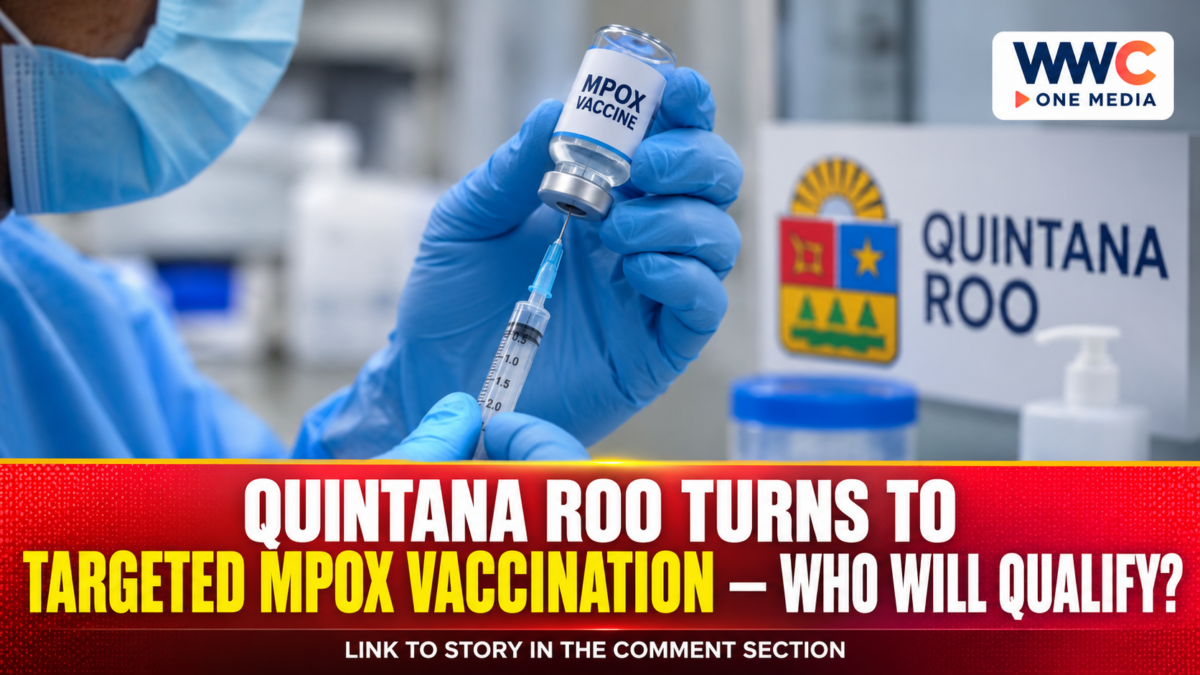
Quintana Roo will begin a targeted mpox vaccination programme on November 26, 2026, with health authorities scheduling sessions across three cities over three consecutive days. The state’s health department says the Jynneos vaccine will be offered only to people who meet established eligibility criteria following medical assessment and appointment arrangements.
The rollout marks a new phase in the state’s prevention response: rather than opening vaccination to everyone, officials are prioritising people considered at higher risk of exposure. The approach also puts screening, referrals and coordination between health institutions at the centre of the programme. Coordinación General de Comunicación
Three locations will host the first vaccination sessions
The State Health Secretariat, known as SESA, has announced the following schedule:
- November 26: Servicio de Atención Integral Hospitalaria (SAIH), Playa del Carmen
- November 27: CAPASITS Chetumal
- November 28: CAPASITS Cancún
The sessions will operate through an organised schedule and appointments assigned in advance. SESA says candidates must first be identified, assessed and validated by health personnel under the eligibility criteria established by Mexico’s National Center for the Prevention and Control of HIV and AIDS, or CENSIDA.
The announcement does not describe the programme as an open walk-in campaign. It also does not publish public appointment hours or guarantee that every person requesting a dose will be eligible. Those details matter for residents who may otherwise assume they can simply arrive at one of the listed facilities and receive a vaccination. Coordinación General de Comunicación
Why the programme is limited to people at higher risk
The targeted design is consistent with the World Health Organization’s current public guidance. WHO says mpox vaccination should prioritise people at risk of contracting the infection, with decisions shaped by individual exposure risk and national or local health policies.
The organisation does not currently recommend mass vaccination of entire populations regardless of risk. Its priority groups include people who have had close contact with someone infected, people in areas with a high risk of exposure, certain healthcare workers and outbreak-response personnel, as well as other groups identified in its guidance. World Health Organization
That distinction is important. A targeted campaign is not the same as a general immunisation programme available to every resident. Eligibility depends on the applicable national criteria and an assessment by health professionals.
SESA says CENSIDA’s technical vaccination manual will guide the selection process. The state announcement does not reproduce the full eligibility checklist, so residents should not rely on assumptions about who qualifies. They should seek confirmation from the health facilities or organisations involved in the referral process.
How Jynneos fits into mpox prevention
The vaccine named in the state announcement is Jynneos. WHO identifies Jynneos as one of the brand names for the MVA-BN mpox vaccine.
WHO’s public guidance describes the standard MVA-BN schedule as two injections given 28 days apart, although it also recognises that vaccination approaches can vary according to national guidance and available delivery arrangements. The Quintana Roo announcement, however, does not set out the local dose schedule or explain how follow-up appointments will be arranged. Those operational details should be confirmed with SESA rather than assumed. World Health Organization+1
Mexico’s federal health authorities have also published updated laboratory-surveillance guidance for mpox. The October 2026 document, issued by the country’s Directorate General of Epidemiology, sets out procedures for laboratory diagnosis and surveillance, including how suspected cases are handled and how testing supports detection and assessment. That framework illustrates why vaccination is only one part of the public-health response: identification, testing and monitoring remain necessary. Gob.mx
Health institutions and civil society will help identify candidates
SESA says the referral effort will involve civil-society organisations, CAPASITS clinics and public health institutions, including the Mexican Social Security Institute (IMSS), the Institute for Social Security and Services for State Workers (ISSSTE) and IMSS-Bienestar.
Their stated role is to help identify, guide and refer people who may qualify. Medical personnel will then carry out the required assessment and validation before vaccination.
This coordination could help connect people who may be eligible with the appropriate health facilities. It also makes clear that the campaign is not simply a matter of distributing doses at three locations: the screening and referral process is part of the programme itself. Coordinación General de Comunicación
For readers following other vaccination efforts, WWC ONE MEDIA has also examined how public-health campaigns confront access and participation challenges in its reports on Mandaue’s measles vaccination drive and Vigan’s campaign for young children. Those campaigns address different diseases and populations, but they show why clear eligibility rules and reliable communication matter when health authorities organise targeted immunisation.
Tourism and mobility add to the surveillance challenge
Quintana Roo’s health secretary, Jorge Gutiérrez Contreras, cited population mobility, tourism activity and border dynamics as reasons for maintaining continuous epidemiological surveillance and coordination between institutions.
The state’s announcement links those conditions to the need for early identification of possible cases and stronger prevention measures. It does not, however, provide a quantified assessment of how much tourism or cross-border movement contributes to mpox transmission in the state.
The broader public-health issue is that surveillance needs to keep pace with movement between communities. Mexico’s October laboratory guidelines describe close contact as an important route of person-to-person transmission, including direct skin-to-skin contact and contact with contaminated materials. The guidance also identifies prolonged face-to-face exposure as a possible respiratory route. Gob.mx
The subject should be discussed without stigma. Mpox is an infectious disease, and risk assessment should be based on exposure and public-health criteria, not assumptions about a person’s identity or background. WHO’s vaccination guidance likewise focuses on exposure risk and eligibility rather than recommending indiscriminate vaccination. World Health Organization
What happens next
The first scheduled session is set for November 26 at SAIH in Playa del Carmen, followed by CAPASITS Chetumal on November 27 and CAPASITS Cancún on November 28.
The immediate questions are how many people will be assessed, how many will qualify, and how the state will arrange any required follow-up doses. SESA’s public announcement does not disclose a target number of recipients, a vaccine inventory, a detailed appointment timetable or a breakdown of doses allocated to each facility.
Those figures should not be treated as established until the health authorities publish them. For now, the confirmed details are the three locations, the three dates and the requirement for prior assessment and appointments.
The programme’s reach will depend not only on vaccine availability but also on whether eligible people can be identified, informed and connected to the designated health services.
Frequently asked questions
When does mpox vaccination begin in Quintana Roo?
The first scheduled session is November 26, 2026, at SAIH in Playa del Carmen. Further sessions are scheduled for November 27 in Chetumal and November 28 in Cancún.
Is the Jynneos vaccine available to everyone?
No. SESA says the programme is targeted at people who meet CENSIDA eligibility criteria. Candidates must undergo identification, assessment and validation by health personnel.
Can residents walk in without an appointment?
The state announcement says vaccination will use advance appointment scheduling. It does not describe the sessions as open walk-in events.
Which facilities are included?
The announced sites are SAIH in Playa del Carmen, CAPASITS Chetumal and CAPASITS Cancún.
Does WHO recommend mass mpox vaccination?
WHO says mass vaccination of people regardless of their risk level is not currently recommended. Its guidance prioritises people with higher exposure risk and other specified groups, subject to national and local policies.