
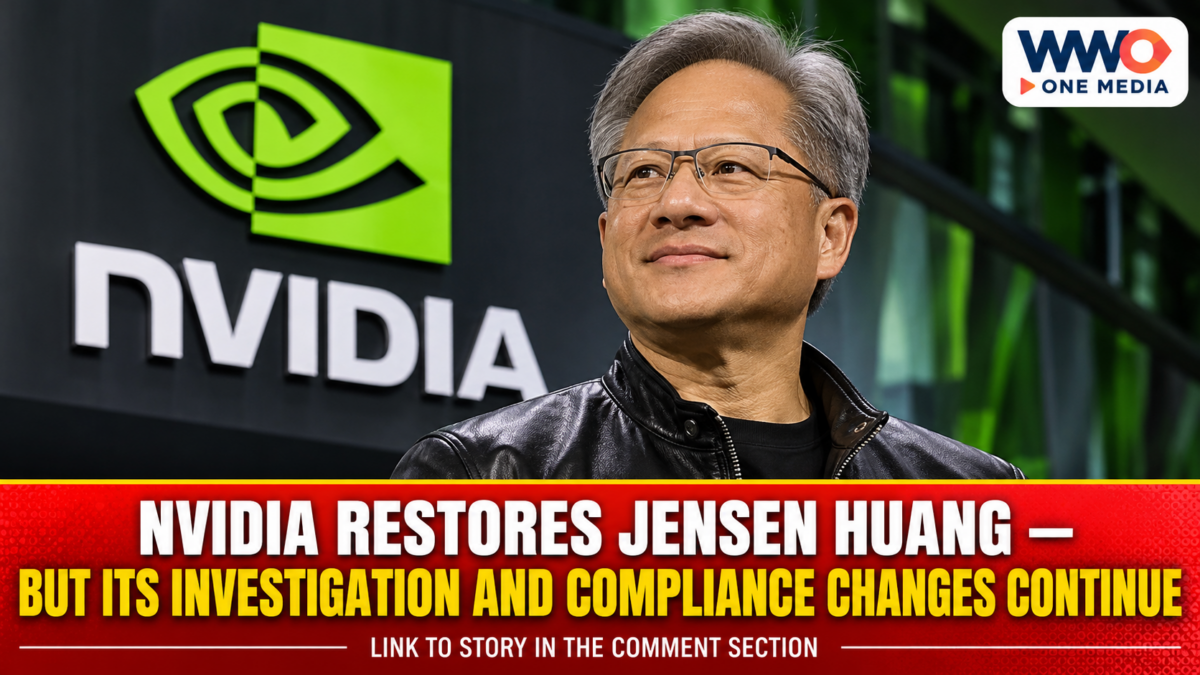
The SEC filing confirms Huang’s return took effect on November 22
NVIDIA’s November 23 announcement was accompanied by a Form 8-K filed with the US Securities and Exchange Commission. The filing identifies November 22, 2026, as the date the board reinstated Jen-Hsun Huang as president, chief executive officer and a member of the board, effective immediately.
The filing also confirms that Colette Kress would continue as NVIDIA’s executive vice president and chief financial officer after the leadership change. Her temporary role as interim chief executive therefore ended with Huang’s return.
The sequence is significant. On November 12, NVIDIA announced that Huang had resigned from the same three positions and that Kress would serve as interim CEO while directors considered permanent candidates. The November 23 announcement reversed that arrangement less than two weeks later.
The reinstatement was not described as a temporary appointment. The company’s filing records the restoration of Huang’s executive and board positions, while the accompanying announcement says the board voted unanimously after discussions with him.
The independent investigation has not been closed
The board’s decision to restore Huang does not mean the separate investigation has ended.
In its November 23 announcement, NVIDIA said a committee composed solely of independent directors had retained independent legal counsel to investigate the previously disclosed foreign-intelligence concern. The company explicitly said the investigation would proceed to conclusion and that Huang supported the process and would cooperate.
The board had announced the independent investigation on November 8. At that time, it said it had no reason to believe national security or NVIDIA secrets had been compromised, while also stating that the inquiry would examine available information.
This distinction is important for investors. Reinstating an executive and completing an investigation are separate corporate decisions. The first restores leadership responsibilities; the second is intended to establish what the available evidence shows.
The company has not announced a final investigative finding in the reinstatement release. It would therefore be premature to treat the board’s decision as proof that every concern raised during the controversy has been resolved.
Nvidia has created a separate export-control oversight structure
Another important development came on November 17, when NVIDIA announced the creation of its National Security and Export Control Oversight Committee.
The new standing committee is responsible for board-level oversight of national security policies, export-control compliance and global trade risk management. Director Suzanne Nora Johnson was appointed chair, with Stephen C. Neal and John O. Dabiri also named as members.
NVIDIA said the committee would meet at least quarterly, including with management and in executive session. The company’s existing National Security Team and Global Trade Compliance Team would report directly to the committee and to interim CEO Colette Kress on day-to-day operations.
The November 23 announcement added another compliance measure: NVIDIA is beginning a search for a Chief Compliance Officer. The position will oversee compliance across the company and report to the board’s Nominating and Corporate Governance Committee.
These measures do not establish that NVIDIA has violated export-control rules. They show that the company is formalising board-level supervision of areas that have become central to its risk-management responsibilities.
Why the board’s next decisions matter
For investors, the leadership reversal is only one part of the governance question.
NVIDIA has restored its chief executive, but it has also committed to completing an independent investigation, created a dedicated committee for national-security and export-control oversight, and announced plans to recruit a Chief Compliance Officer.
Those actions provide a clearer picture of the controls the company says it intends to strengthen. Their effectiveness, however, will depend on how independently the committees operate, how the investigation is concluded and whether the new compliance structure produces meaningful oversight.
The distinction between a corporate announcement and a completed review should remain central to coverage. The board’s confidence in Huang is its stated position; the investigation’s findings remain a separate matter.
NVIDIA’s situation also connects with WWC’s earlier coverage of the congressional inquiry into questions surrounding Huang and the company’s executives, as well as its report on the independent legal review commissioned by NVIDIA’s board. The company’s new oversight arrangements are also relevant to its reported California investigative subpoena, which should be covered separately from any conclusion about wrongdoing.
What happens next
The next milestones are the completion of the independent board investigation, the work of the National Security and Export Control Oversight Committee, and the appointment of a Chief Compliance Officer.
NVIDIA has not announced a final conclusion to the independent investigation in its November 23 release. It has also not said that the new compliance measures have already been fully implemented.
For shareholders, the key issue is whether the company can maintain executive continuity while demonstrating that its oversight arrangements are capable of addressing the risks associated with its global semiconductor business.










