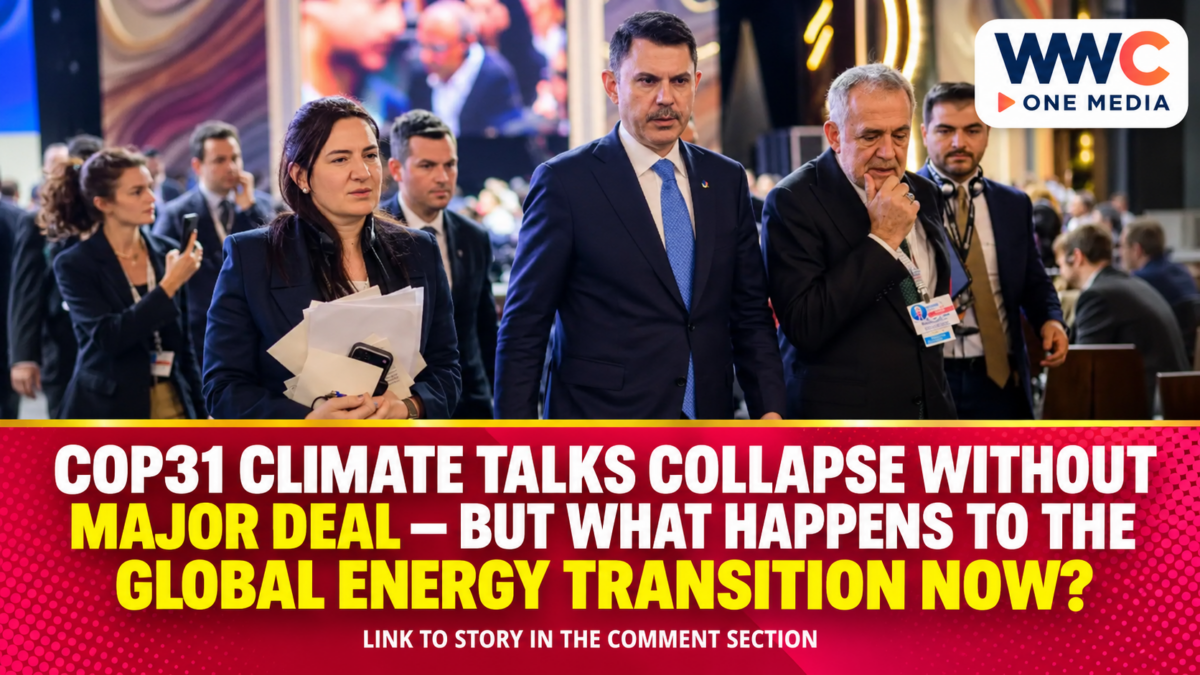
ANTALYA, Türkiye — The COP31 climate talks ended on November 22, 2026, without an overarching political agreement, exposing persistent divisions over how the international community should accelerate climate action amid mounting environmental and economic pressures.
The outcome represents a significant setback for global climate diplomacy, even as governments advanced separate initiatives involving renewable energy, climate finance, adaptation and support for communities affected by the energy transition.
The central question is no longer whether countries recognise the climate challenge, but whether they can translate existing commitments into measurable economic and environmental progress.
For Asia-Pacific economies, investors, energy companies and policymakers, the absence of a new political agreement introduces another layer of uncertainty into the global transition towards low-carbon development.
COP31 Climate Talks End Without Consensus
The 31st United Nations Climate Change Conference concluded without adopting its presidency-led overarching decision.
UN Climate Change Executive Secretary Simon Stiell acknowledged the unsuccessful negotiations during the closing plenary, while emphasising that international climate cooperation must continue.
The disagreement comes at a particularly difficult moment for global climate policy. Governments face the challenge of reducing emissions while maintaining affordable electricity, protecting industrial competitiveness and financing infrastructure development.
These priorities are not necessarily incompatible, but balancing them requires substantial investment and long-term policy coordination.
Without a new political framework emerging from Antalya, governments will have to rely more heavily on existing commitments and domestic implementation.
The competing demands also demonstrate why energy policy has become inseparable from international trade, manufacturing and economic security.
The Global Energy Transition Is Far From Over
Despite the diplomatic setback, the transition towards cleaner energy has not been abandoned.
The COP28 agreement reached in Dubai in 2023 had already called for countries to move away from fossil fuels in their energy systems while ensuring that the transition remains fair and orderly.
The absence of a new COP31 political agreement does not automatically reverse that earlier outcome.
Instead, it highlights the difficulty of agreeing on how quickly countries should move, who should shoulder the costs and how energy-dependent communities should be supported.
For businesses, the uncertainty surrounding international negotiations reinforces the importance of evaluating actual investment commitments rather than relying entirely on political declarations.
WWC ONE MEDIA’s coverage of China’s clean-technology investment push at COP31 provides additional context on the commercial opportunities emerging alongside international climate negotiations.
Clean-energy manufacturing, electricity infrastructure and industrial electrification could remain important areas of investment even without a comprehensive new diplomatic agreement.
The pace of development, however, will depend on financing, government policies and commercial demand.
Climate Science Highlights a Widening Emissions Gap
The breakdown in negotiations comes as scientific assessments underline the scale of emissions reductions still required.
The 2026 Emissions Gap Report outlines a scenario in which global warming could peak between 1.7°C and 1.8°C around the middle of the century before returning to 1.5°C or below by 2100, with approximately a 50% probability.
Achieving that pathway would require substantial greenhouse gas emissions reductions compared with 2025 levels.
| Year | Required global emissions reduction |
|---|---|
| 2030 | 18% |
| 2035 | 45% |
| 2040 | 69% |
Under full implementation of existing national climate commitments, however, emissions would decline by only 5% to 8% by 2030 and 11% to 15% by 2035.
That trajectory would limit warming this century to approximately 2.6°C, rather than achieving the more ambitious temperature pathway.
These figures are projections under specified scenarios, not guaranteed outcomes.
The difference illustrates the considerable distance between existing commitments and the reductions required to return warming to 1.5°C.
Regional temperature developments, including those examined in WWC ONE MEDIA’s coverage of Canada’s changing climate and Ontario’s November heat, further demonstrate the importance of monitoring long-term climate trends alongside individual weather events.
Climate Finance Remains a Critical Economic Challenge
Developing economies face a difficult financial equation.
Reducing emissions requires investment in electricity networks, industrial equipment, transportation systems and cleaner energy generation. Meanwhile, adaptation requires resources to protect communities and infrastructure from climate-related risks.
COP31 advanced work on improving access to climate finance and supporting adaptation despite the failure of its broader political agreement.
The challenge now is ensuring that financial commitments translate into projects that can be implemented.
A climate finance announcement is not equivalent to money being disbursed, and a project proposal does not guarantee that construction will proceed.
Investors must consider financing costs, regulatory stability, project feasibility and the ability of governments to sustain long-term commitments.
This distinction is particularly relevant to emerging carbon markets. WWC ONE MEDIA’s analysis of Indonesia’s carbon market investment opportunities examines the relationship between environmental objectives and commercially viable projects.
The credibility of future climate initiatives will increasingly depend on measurable results rather than the size of announced ambitions.
Electrification Emerges as a Major Opportunity
One of the more encouraging developments in Antalya was continued international support for electrification.
Countries representing approximately half of the global economy supported the initiative targeting 35% electrification by 2035 or indicated plans to achieve that level earlier.
The initiative forms part of the Global Climate Action Agenda rather than the failed overarching political agreement.
Its commercial implications extend across electricity generation, transmission networks, transportation, manufacturing and buildings.
For Asia-Pacific businesses, this creates potential opportunities throughout the clean-energy supply chain.
Demand for grid equipment, energy storage, renewable power components and industrial electrical systems could benefit from sustained electrification investment.
Regional manufacturing developments, such as the Vietnam wind turbine blade factory and local workforce development, illustrate the industrial dimension of this transition.
Nevertheless, electrification alone does not guarantee lower emissions. Its environmental benefits also depend on how electricity is generated and how efficiently it is consumed.
What Happens Next After COP31?
The diplomatic process will continue beyond Antalya.
Governments agreed to extend the existing just transition work programme for another three years, while advancing arrangements intended to support workers and communities affected by economic restructuring.
The second global stocktake under the Paris Agreement also began at COP31 and is scheduled to conclude at COP33 in November 2028.
That process will evaluate collective progress and help inform subsequent national climate actions.
For businesses and governments, the immediate test will be whether existing commitments produce financed projects, stronger electricity infrastructure, cleaner industrial operations and improved climate resilience.
COP31 may have ended without its most prominent political agreement, but the economic decisions surrounding climate change cannot be postponed indefinitely.
The next chapter of global climate policy will be shaped not only by what governments negotiate, but also by what they finance, construct and deliver.