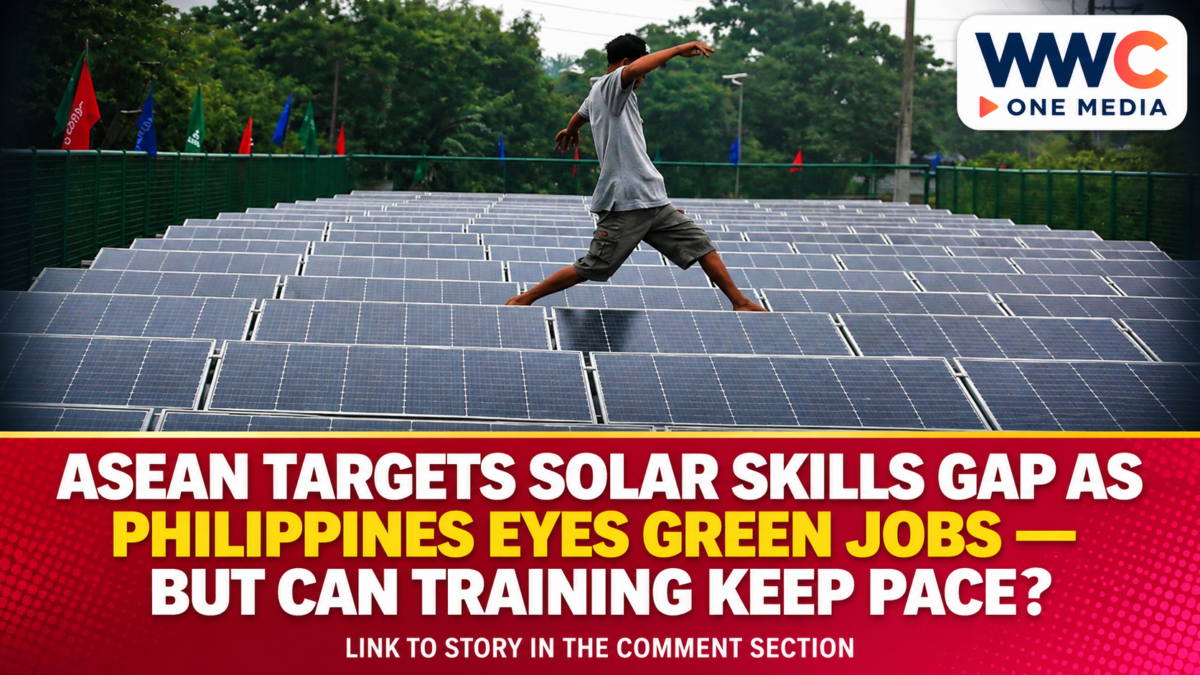
MANILA, Philippines — The Philippines stands to benefit from a regional effort to address the solar skills gap as Southeast Asia strengthens cooperation on technical training, professional qualifications and renewable energy workforce development.
The ASEAN Centre for Energy (ACE) and the Asian Photovoltaic Industry Association (APVIA) formalised their partnership on Oct. 8, 2026, during the 26th ASEAN Energy Business Forum in Manila.
The agreement comes at a critical stage for Southeast Asia’s energy transition, with renewable energy investments creating potential employment opportunities while raising questions about the availability of qualified technical workers.
For the Philippines, where renewable energy projects accounted for ₱745.10 billion in Board of Investments-approved investments during the first nine months of 2026, workforce development could become an increasingly important factor in turning investment commitments into operating power facilities.
The challenge is straightforward: financing solar projects is only part of the equation. Developing the workforce needed to deliver them is another.
ASEAN moves to address the solar skills gap
The ACE–APVIA partnership establishes a framework for regional collaboration on renewable energy workforce development.
Its priorities include developing consistent skills standards, improving recognition of professional qualifications, supporting training initiatives and facilitating exchanges of technical expertise across Southeast Asia.
Greater consistency in qualifications could help employers evaluate technical competencies more effectively while giving workers clearer professional development pathways.
However, regional recognition of qualifications should not be interpreted as automatic permission to work in another country. National licensing, employment and immigration requirements would still need to be satisfied.
The workforce initiative complements broader regional energy cooperation, including efforts involving energy storage, technical research and infrastructure development.
WWC ONE MEDIA previously examined the emerging demand for skilled solar workers in the Philippines, highlighting the importance of connecting renewable energy expansion with practical employment opportunities.
Philippines’ ₱745-billion renewable energy investment pipeline raises the stakes
The Philippine renewable energy industry has emerged as a significant destination for investment approvals in 2026.
Renewable energy projects represented 79% of the ₱942.90 billion in investments approved by the Board of Investments between January and September.
The Department of Energy has also awarded 20.7 gigawatts of renewable energy capacity through its Green Energy Auction Program, with another 25 GW targeted for auction through 2035.
These figures cover renewable energy technologies broadly and should not be interpreted as solar-only investments or capacity.
Nevertheless, they illustrate the scale of development that could require additional technical personnel as projects advance.
The national strategy targets renewable energy’s contribution to electricity generation at no less than 35% by 2030 and 50% by 2040.
Reaching those objectives will involve more than securing investment commitments. Developers must also navigate construction requirements, grid connections, technical assessments and long-term operational responsibilities.
The distinction between announced capacity and completed infrastructure remains essential, as illustrated by the country’s renewable energy development targets and implementation challenges.
Investment approvals do not automatically translate into immediate construction activity or employment.
Solar employment is becoming a global economic opportunity
Solar photovoltaic technology has become an important contributor to employment growth across the international electricity industry.
Global energy employment research published in 2025 found that the electricity sector added approximately 3.9 million jobs over five years, with solar photovoltaic activities accounting for around half of the sector’s employment additions since 2019.
At the same time, an international energy employment survey involving more than 700 participating organisations found that over half experienced significant recruitment difficulties.
The pressure is particularly relevant to occupations requiring practical technical expertise.
For Southeast Asia, the opportunity extends beyond increasing the number of solar installers.
A growing renewable energy industry may also create demand for workers involved in engineering, electrical infrastructure, project supervision, equipment maintenance and system monitoring.
The economic opportunity depends on whether education providers and employers can develop training pathways that correspond to actual vacancies.
Why the skills shortage matters to investors
A workforce shortage can become a commercial risk when companies cannot recruit personnel with the qualifications needed to complete projects efficiently.
For solar developers, potential consequences include higher recruitment expenses, greater training requirements and difficulties maintaining construction schedules.
Businesses must also consider the importance of installation quality and long-term reliability.
A technically sound solar installation requires more than placing photovoltaic panels on a rooftop or an open field. Electrical compatibility, system testing and ongoing maintenance are essential considerations throughout a project’s operating life.
Major developments, such as the financing of PetroGreen’s Isabela solar project, provide a practical illustration of the broader investment and project-development ecosystem surrounding renewable energy.
Workforce planning should therefore form part of commercial project preparation rather than being treated as a separate concern after financing has been secured.
ASEAN cooperation could create wider business opportunities
The regional partnership could encourage closer coordination between training institutions, renewable energy companies and industry associations.
For technical education providers, this creates a potential opportunity to develop programmes aligned with employer requirements.
For workers, accessible training and credible qualifications could improve career prospects, provided employers recognise the resulting competencies.
Existing initiatives offer examples of how industry-oriented training can be organised.
In the Philippines, New Energy Nexus developed a Solar Innovation Program that combines technical education, business development and mentoring, with a focus on commercial and industrial solar markets.
Regional cooperation could complement such initiatives rather than requiring individual economies to develop every training resource independently.
The importance of technical expertise also extends to more specialised developments, including the Philippines–Indonesia–Vietnam island solar and energy storage initiative.
Such projects highlight the potential importance of maintaining qualified personnel beyond major metropolitan and industrial centres.
What happens next?
The next major test for the ACE–APVIA partnership is implementation.
Training schedules, participating institutions, assessment procedures, funding arrangements and employer recognition will determine how effectively regional cooperation translates into practical career opportunities.
The public announcement confirms the partnership’s objectives but does not establish a guaranteed number of jobs for Filipino workers.
For investors and energy companies, the emerging workforce agenda reinforces the importance of developing human capital alongside physical infrastructure.
For workers, the clean energy transition offers potential career opportunities, but those opportunities will depend on actual project development, accessible training and employer demand.
Southeast Asia’s renewable energy ambitions are increasingly becoming an economic development and workforce issue as much as an infrastructure challenge.
The region can invest billions in clean energy, but its ability to deliver projects will also depend on the people qualified to build and operate them.