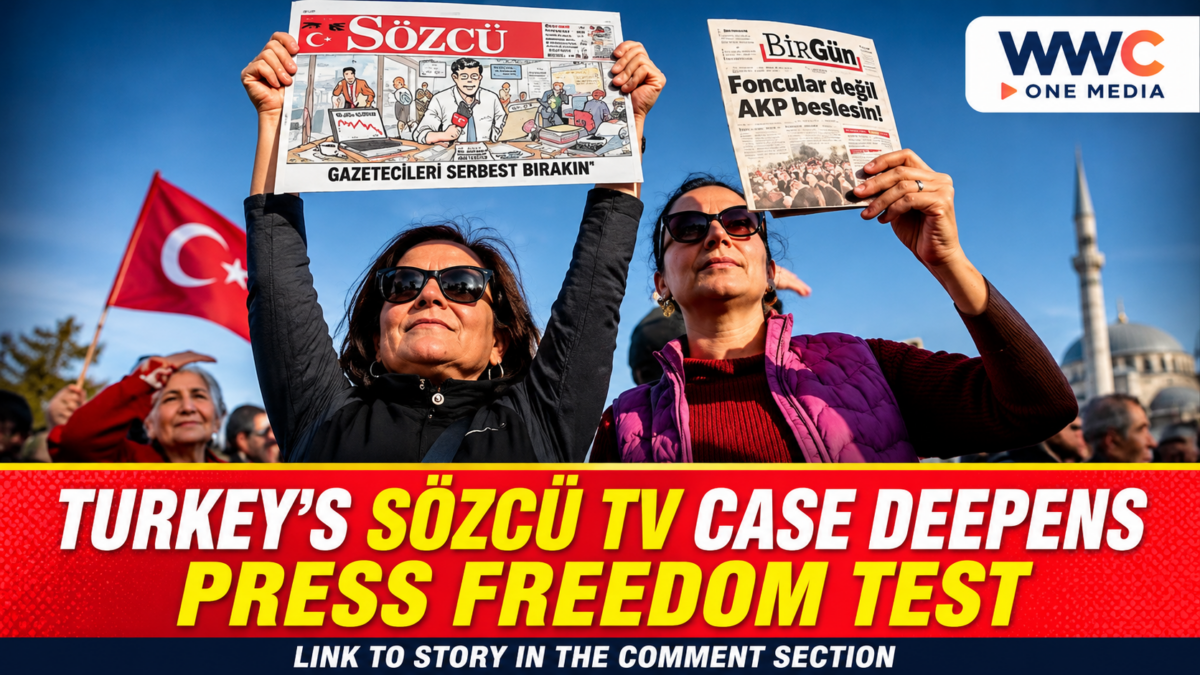
ISTANBUL — The takeover of Turkish broadcaster Sözcü TV has brought renewed attention to the country’s treatment of independent media, following a European Commission assessment that documented growing pressure on journalists and opposition-aligned news organisations.
The developments place a November 17 police operation against the broadcaster within a wider pattern of legal and administrative action affecting media outlets. The immediate case involves allegations raised by prosecutors against media-group owner Burak Akbay. The broader question is whether the use of criminal investigations and state-appointed trustees is narrowing the space for independent journalism in Türkiye.
For readers outside Turkey, the distinction is important. A judicial investigation is not proof of guilt, and the appointment of a trustee does not by itself establish that a newsroom has been censored. But the powers exercised over media companies can have consequences for ownership, editorial decision-making and the public’s access to competing viewpoints.
Turkey press freedom concerns predate the Sözcü TV operation
The European Commission’s Türkiye 2026 Report, dated November 4, described the country’s media-freedom environment as continuing to deteriorate during the reporting period.
The assessment identified the use of criminal investigations and administrative measures against government-critical voices. It also raised concerns about the appointment of trustees to private media organisations and restrictions on media outlets’ online presence.
The report specifically documented the October 2026 seizure of Halk TV by the Savings Deposit Insurance Fund, known by its Turkish abbreviation TMSF, following a criminal investigation involving the broadcaster’s chairman. The channel was taken off air after trustees were appointed.
That development is relevant to the Sözcü TV case because it shows that the use of trustees in media organisations was already a subject of international institutional scrutiny before the November operation.
The Commission’s assessment did not determine the outcome of the separate Sözcü investigation. Instead, it raised a broader concern about whether Turkey’s laws and their implementation provide sufficient protection for independent reporting and political pluralism.
What happened at Sözcü TV on November 17
On November 17, police carried out searches at locations connected with Sözcü TV, Sözcü newspaper and associated companies. The Istanbul Chief Public Prosecutor’s Office said the operation formed part of an investigation involving allegations against Burak Akbay.
In its written statement, the prosecutor’s office referred to an investigation involving alleged membership in the FETÖ/PDY organisation and alleged violations of legislation on preventing the financing of terrorism. It said financial analysis reports and material from earlier investigations formed part of the basis for the inquiry.
The statement also referred to allegations that Akbay had financed Estetik Yayıncılık A.Ş. and Mega Ajans through overseas bank accounts. These are allegations made in the investigation, not findings of guilt.
Four people associated with the media group were named in reports of the operation: Funda Sıdalı, Mustafa Asım Akgül, Yonca Yücekaleli and İsmail Öz.
The prosecutor’s statement said a court had appointed TMSF as trustee to Mega Ajans ve Reklamcılık Ticaret A.Ş. The distinction between the company named in the court measure and the media operations affected by it is important when describing the legal scope of the intervention.
The case should therefore be reported through the exact wording of the court measure and prosecutor’s statement, rather than treating every company or publication associated with the group as having been placed under identical control.
The EU report documents a wider pattern
The Commission’s report provides context beyond the latest broadcaster operation.
It recorded that 74 journalists and media workers had been arrested, imprisoned or remained in pre-trial detention between September 2025 and September 2026, citing civil-society organisations working on media freedom. The corresponding figure for the previous reporting period was 51.
The report also described the continued use of criminal provisions involving national security, counter-terrorism and other broadly defined offences in cases affecting freedom of expression.
It raised concerns about administrative fines and broadcasting restrictions imposed by Turkey’s media regulator, including measures that it said disproportionately affected independent and opposition-aligned outlets.
These findings are the European Commission’s assessment of the country’s institutional and legal environment. They should not be confused with a judicial ruling on the Sözcü investigation or proof that every prosecution involving a journalist is politically motivated.
The report does, however, provide a documented basis for examining how enforcement powers affect the ability of media organisations to operate independently.
Why trustee appointments matter to a newsroom
A trustee appointment is a legal and corporate measure. Its practical effects depend on the scope of the court order, the company involved and the authority granted to the appointed administrator.
For a media organisation, the consequences can extend beyond the formal ownership or management structure. Decisions about budgets, staffing, editorial leadership, digital operations and publishing priorities can influence what a newsroom is able to produce.
That does not mean every trustee appointment automatically results in editorial interference. It means the implementation of the measure deserves public scrutiny, especially when the organisation involved operates a news service.
The public-interest questions are concrete: Who controls the company’s operations? Are journalists able to continue working? Can editors make independent decisions? Are existing publications and digital services operating normally? What safeguards exist against interference in editorial content?
These questions also matter in the Philippines, where debates over legal action involving journalists remain active. WWC has previously examined the arrest of veteran journalist Philip Lustre in a cyberlibel case and the importance of distinguishing allegations from proven findings.
The international standard is not immunity from investigation
Press freedom does not exempt media owners, executives or journalists from generally applicable laws. Authorities may investigate suspected financial or criminal wrongdoing, and courts may issue lawful orders where legal requirements are met.
The central test is whether those powers are exercised under clear rules, with independent judicial review and safeguards against disproportionate restrictions on expression.
The Commission’s report called for changes to legal provisions and their implementation, including measures to create a safer and more pluralistic environment for independent media.
That concern is not limited to one broadcaster. A media landscape with fewer independent voices gives audiences fewer opportunities to compare reporting, scrutinise public decisions and hear competing interpretations of events.
WWC has explored similar questions in its coverage of press-freedom commitments and government accountability in the Philippines. The wider principle is that public assurances must be assessed alongside the legal safeguards and actual practices that shape the work of journalists.
What happens next
The next developments in the Sözcü case will depend on the legal proceedings, the scope of the court’s trustee order and how the affected media operations are administered.
The public record should clarify which legal entities are covered, what powers have been granted to TMSF and whether the media organisations can continue operating under their existing editorial structures.
The allegations against Akbay must remain allegations unless established through the appropriate judicial process. At the same time, the consequences of state intervention in a media organisation deserve scrutiny independently of the eventual outcome of the criminal investigation.
The European Commission’s November report makes the broader issue difficult to dismiss as an isolated corporate dispute. It had already raised concerns about media trusteeships, legal pressure and the erosion of pluralism. The Sözcü case now adds another important test of how those concerns are addressed in practice.
Frequently asked questions
1. Why was Sözcü TV targeted in November 2026?
The Istanbul Chief Public Prosecutor’s Office said the November 17 operation was part of an investigation involving allegations against media-group owner Burak Akbay, including alleged financing and terrorism-related offences. The allegations have not been established as a final finding of guilt.
2. Was Sözcü TV placed under trustee control?
The prosecutor’s statement said a court appointed TMSF as trustee to Mega Ajans ve Reklamcılık Ticaret A.Ş. The precise legal scope should be determined from the court order and the companies covered by it.
3. What did the European Commission say about media freedom in Turkey?
Its November 4, 2026 report documented concerns over criminal investigations, administrative measures, trustee appointments and restrictions affecting independent media.
4. How many journalists and media workers were affected by detention or imprisonment during the EU reporting period?
The report cited 74 journalists and media workers arrested, imprisoned or held in pre-trial detention between September 2025 and September 2026, based on information from civil-society organisations.
5. Does a trustee appointment automatically mean a newsroom has been censored?
No. The legal appointment itself does not establish censorship. Its effect on editorial independence depends on the order’s scope and how the appointed administrator exercises the authority granted by the court.