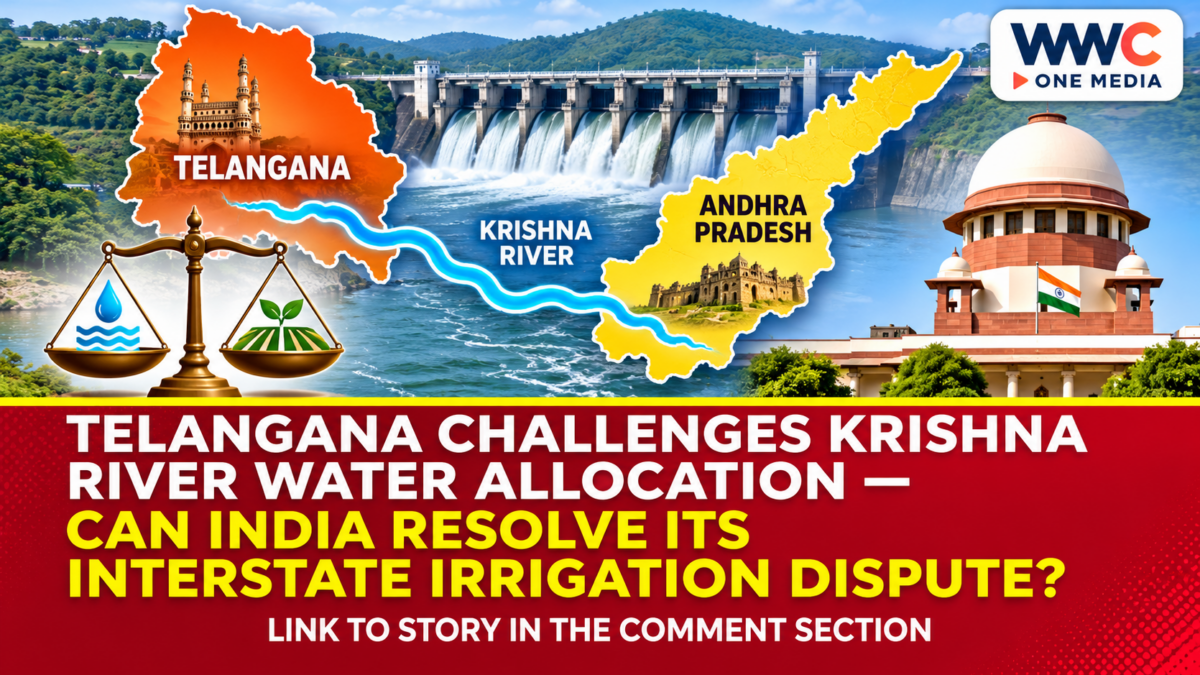
Telangana’s campaign to protect its share of Krishna River water has placed renewed attention on the economic and administrative challenges surrounding interstate irrigation in southern India. Chief Minister A. Revanth Reddy outlined his administration’s concerns during an official irrigation department meeting on Jan. 1, 2026, questioning earlier water-sharing arrangements and the development of major infrastructure projects.
The dispute highlights the difficulty of distributing a shared natural resource among competing agricultural, residential and infrastructure requirements.
For both Telangana and neighbouring Andhra Pradesh, the economic challenge extends beyond determining how much water each state should receive. It also involves establishing whether infrastructure investments can deliver dependable supplies without undermining existing obligations.
Krishna River Water Allocation Remains a Governance Challenge
India’s division of the former Andhra Pradesh state in 2014 created a new administrative framework for managing shared river resources.
The Andhra Pradesh Reorganisation Act established institutional arrangements governing the management of the Krishna and Godavari rivers.
The resulting framework includes an Apex Council and separate river management boards intended to address matters involving shared water infrastructure.
In his January 2026 presentation, Reddy recalled that the former undivided Andhra Pradesh had received an allocation of 811 thousand million cubic feet, commonly abbreviated as TMC, of Krishna River water.
He described an earlier arrangement assigning 512 TMC to Andhra Pradesh and 299 TMC to Telangana.
The chief minister has questioned whether previous arrangements adequately protected Telangana’s interests.
However, the figures cited in his presentation should not be confused with a newly adjudicated permanent entitlement for either state.
Determining the appropriate distribution involves a separate legal and administrative process.
Why Irrigation Approvals Require More Than Political Agreement
Large irrigation projects can involve several distinct administrative decisions.
These may include technical assessments, financial authorisations, environmental clearances and approvals involving shared water resources.
Consequently, identifying when a project received government funding does not necessarily establish when it obtained every required regulatory permission.
The distinction matters when assessing political disagreements over infrastructure development.
A state administration may support a proposed project while other authorities retain responsibility for evaluating its engineering design, environmental implications or effects on interstate water distribution.
For taxpayers, incomplete documentation can create difficulties in assessing whether public expenditure corresponds with authorised construction and realistic operating requirements.
A comprehensive project review should distinguish between proposed infrastructure, approved construction, completed facilities and operating systems.
Without that distinction, public discussions risk treating several different administrative processes as a single decision.
Water Monitoring Could Improve Interstate Accountability
An important development occurred during a meeting in New Delhi on July 16, 2025.
Telangana Chief Minister Revanth Reddy and Andhra Pradesh Chief Minister N. Chandrababu Naidu participated in discussions facilitated by Union Minister of Jal Shakti C.R. Patil.
Telangana’s official account of the meeting confirmed an agreement to introduce telemetry for monitoring water utilisation.
The participants also discussed institutional arrangements for the river management boards and repairs to the Srisailam project.
A committee involving senior officials and technical experts was proposed to examine outstanding water utilisation and infrastructure matters.
Telemetry involves transmitting measurements from monitoring equipment to locations where the information can be analysed.
In a shared river system, such monitoring could help authorities compare recorded water flows with authorised operational arrangements.
Its effectiveness, however, would depend on reliable equipment, consistent measurement practices and agreement about how the resulting information should be interpreted.
An announcement supporting telemetry does not independently establish that the entire monitoring network has been installed or is fully operational.
Why Water Security Matters to Agricultural Investment
From an economic perspective, irrigation reliability is an important consideration when evaluating agricultural infrastructure.
A hypothetical farming community may receive access to a newly constructed irrigation network but still experience financial uncertainty if water deliveries vary substantially between growing seasons.
Farmers deciding which crops to cultivate must consider whether sufficient water will be available throughout the production cycle.
Infrastructure investment therefore requires more than assessing the maximum capacity of a reservoir or pumping installation.
Its economic value also depends on actual water availability, maintenance requirements and operating expenditure.
WWC analysis: Evaluating irrigation projects against dependable delivery targets could provide a more meaningful assessment of public investment than relying exclusively on announced construction budgets.
Governments should also consider whether pumping and distribution costs remain manageable once infrastructure becomes operational.
A project that requires substantial recurring expenditure could impose long-term financial obligations even after its construction has been completed.
What Philippine Infrastructure Planners Can Learn
India’s interstate water allocation framework differs from the legal and institutional arrangements governing Philippine water resources.
Nevertheless, its experience provides a useful comparison for governments evaluating infrastructure projects that serve multiple communities.
Philippine agricultural and infrastructure planners could benefit from clearly separating water availability assessments from engineering design and construction expenditure.
For example, a proposed irrigation system should be evaluated not only on the amount of land it is intended to serve but also on whether the necessary water can be delivered consistently.
Transparent monitoring arrangements could also help communities understand how shared resources are being distributed.
When disagreements arise, accessible records of project approvals, water measurements and operational responsibilities could provide a stronger basis for resolving competing claims.
Such measures would not automatically eliminate disputes, but they could improve the quality of information available to policymakers and affected communities.
What Happens Next?
Further official water allocation decisions, technical assessments and project-specific approvals will be necessary to establish how the competing requirements of Telangana and Andhra Pradesh can be accommodated.
Political statements about previous administrations should be evaluated against the relevant government orders and regulatory records.
For both states, resolving uncertainty surrounding water access could help improve the planning of future agricultural and infrastructure investments.
The central economic question is not simply which administration authorised a particular project. It is whether the shared river system can support dependable, financially sustainable water supplies under an agreed regulatory framework.
Frequently Asked Questions
Why are Telangana and Andhra Pradesh disputing Krishna River water?
The dispute involves competing requirements for shared river resources, water allocation arrangements and the development of irrigation infrastructure following the division of Andhra Pradesh.
What does TMC mean in water allocation?
TMC means one thousand million cubic feet. It is a unit used to express water volumes.
What is the purpose of water telemetry?
Telemetry allows measurements to be transmitted remotely. In water management, it can support the monitoring of river flows and withdrawals.
Has Telangana received a new permanent Krishna River water allocation?
The chief minister’s January statement describes the state’s position and previous arrangements. It does not establish a newly adjudicated permanent allocation.
Why does the dispute matter to farmers?
Dependable irrigation supplies can influence crop planning, production costs and the economic viability of agricultural investments.