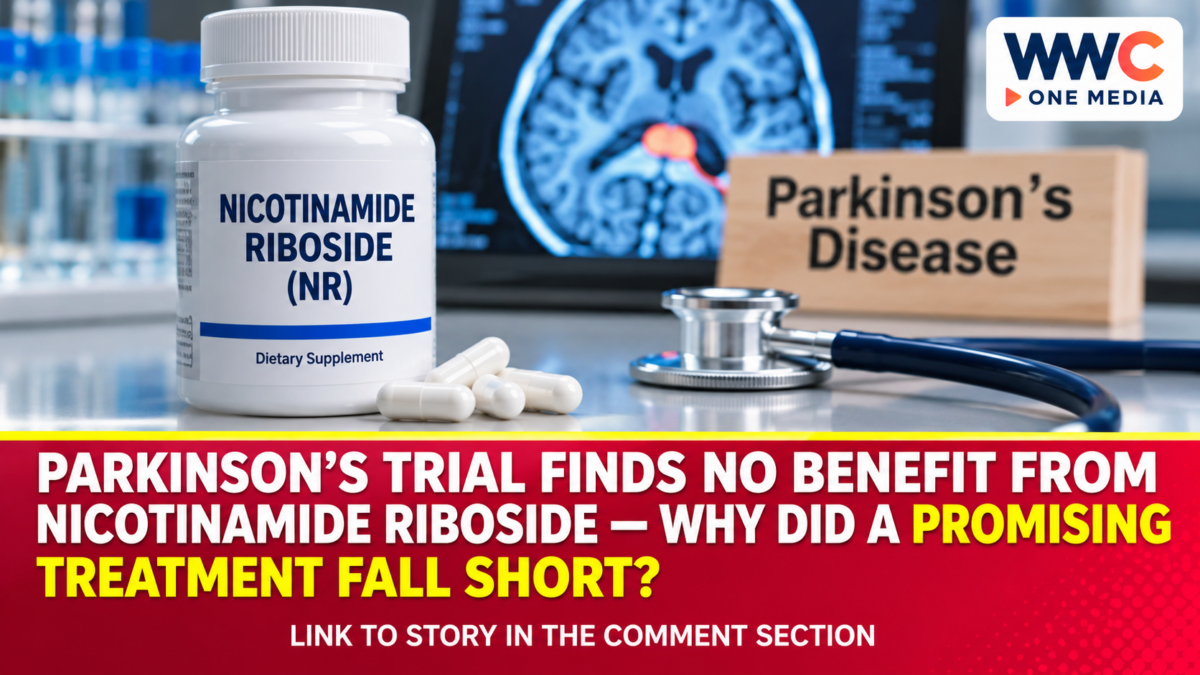
BERGEN, NORWAY — A major Norwegian clinical trial has delivered disappointing results for researchers investigating nicotinamide riboside as a potential treatment for Parkinson’s disease. Findings from the NOPARK study, published online on Oct. 8, 2026, showed no clinical advantage from the compound after a year of treatment.
The research represents a setback for one proposed approach to slowing the underlying progression of Parkinson’s disease.
More importantly, it highlights a distinction that matters to patients, healthcare professionals and the pharmaceutical industry: producing a measurable biological response does not necessarily translate into better health outcomes.
Nicotinamide Riboside Faces a Major Clinical Setback
The NOPARK research programme examined whether increasing the availability of a molecule involved in cellular metabolism could improve outcomes for people with recently diagnosed Parkinson’s disease.
The phase 3 investigation enrolled 410 participants across 11 Norwegian research centres.
Participants were randomly assigned to receive either nicotinamide riboside or an inactive substitute over 52 weeks.
The trial’s double-blind design meant that treatment assignments were concealed during the investigation, helping researchers limit the influence of expectations on the results.
Haukeland University Hospital sponsored the study.
Rather than relying exclusively on laboratory measurements, the investigators evaluated changes in participants’ clinical condition.
The results did not support using the compound to slow Parkinson’s disease or alleviate its symptoms under the conditions studied.
For researchers and companies developing neurological treatments, the outcome illustrates why promising preliminary findings must undergo rigorous clinical evaluation before they become the basis for treatment recommendations.
What the Parkinson’s Symptom Scores Actually Reveal
The researchers’ principal assessment used a standardised Parkinson’s disease rating scale covering different aspects of the condition.
The assessment produced an adjusted difference of 2.72 points between the two treatment groups, favouring those who received the inactive substitute.
Although the difference was statistically significant, it remained below the study’s specified threshold for clinically important deterioration.
That distinction requires careful interpretation.
Statistical significance helps researchers evaluate whether an observed difference is unlikely to be attributable to random variation under their analytical assumptions.
Clinical significance concerns whether the magnitude of that difference is meaningful in a patient’s everyday life.
The findings therefore do not justify claiming that every participant who received nicotinamide riboside experienced substantial deterioration.
They do, however, undermine the proposed therapeutic benefit.
Patients considering experimental treatments face similar questions when interpreting early clinical and real-world pharmaceutical research.
The strength of a medical claim depends not simply on whether researchers identify a numerical change, but also on what that change represents.
Why a Biological Response Did Not Guarantee Patient Benefits
Nicotinamide riboside is a form of vitamin B3 that can serve as a precursor to nicotinamide adenine dinucleotide, commonly abbreviated as NAD.
Scientists have investigated NAD-related mechanisms as possible avenues for treating neurological disorders.
The challenge is determining whether changes in cellular chemistry can influence the complex processes responsible for Parkinson’s disease.
The NOPARK findings demonstrate the importance of testing that connection.
A treatment may successfully influence a biological measurement without producing the improvements that patients and clinicians need.
Consider a hypothetical experimental medicine that changes a laboratory marker associated with a neurological condition. If patients nevertheless experience no improvement in movement or daily functioning, the laboratory result alone would not establish therapeutic effectiveness.
The same evidentiary challenge applies to emerging technologies discussed in WWC’s examination of whether AI-designed medicines can succeed in human clinical trials.
The commercial and scientific implications are substantial: medical innovation requires evidence that extends beyond an attractive biological theory.
A Negative Trial Still Provides Valuable Evidence
Disappointing clinical results should not automatically be interpreted as wasted scientific effort.
A carefully conducted study can help researchers identify approaches that do not deliver the expected outcomes, preventing unsupported assumptions from guiding subsequent treatment decisions.
It can also help determine which scientific questions require additional investigation.
For pharmaceutical developers, negative findings may influence how future studies select participants, measure treatment effectiveness and allocate research resources.
These considerations are also relevant to the wider discussion about patient safeguards and accountability in experimental medical research.
WWC analysis: Publishing unsuccessful trial results is valuable for healthcare decision-making because it allows patients, clinicians and researchers to evaluate an intervention using evidence rather than expectations.
An unsuccessful investigation does not necessarily invalidate an entire field of biological research. It does, however, establish limits on what can responsibly be claimed about the intervention that was tested.
What Filipino Patients and Families Should Understand
Parkinson’s disease can affect physical movement, sleep, mental health and other aspects of everyday functioning.
Although there is no established cure, available medical treatments and rehabilitation can help manage symptoms.
For Filipino families, the Norwegian findings reinforce the importance of distinguishing experimental research from established clinical care.
A product’s availability as a nutritional supplement should not be interpreted as proof that it can treat a neurological disorder.
Patients who are considering nicotinamide riboside or other supplements should discuss their use with a qualified healthcare professional, particularly when they are receiving prescribed medication.
The study is not a reason to discontinue existing Parkinson’s treatments or to avoid medically recommended vitamin supplementation.
Its conclusion concerns a specific compound tested for a particular therapeutic purpose.
For households managing healthcare expenses, evaluating the quality of evidence behind supplementary products can help inform discussions about treatment priorities.
What Happens Next?
The scientific question now is whether alternative research strategies targeting cellular metabolism can produce meaningful neurological benefits.
The Norwegian trial does not establish that every intervention involving NAD will fail. Neither does it establish that another formulation or treatment schedule will succeed.
Any alternative approach would require its own appropriate clinical evaluation.
Researchers will need to demonstrate that future interventions produce benefits meaningful to patients while maintaining an acceptable safety profile.
Until such evidence becomes available, the NOPARK findings do not support recommending nicotinamide riboside as a Parkinson’s disease treatment.
The broader lesson is that scientific plausibility can justify an investigation, but clinical evidence must determine whether an experimental therapy belongs in routine patient care.
Frequently Asked Questions
Does nicotinamide riboside treat Parkinson’s disease?
The NOPARK trial found no clinical benefit from nicotinamide riboside in participants with early-stage Parkinson’s disease over the treatment period studied.
Did nicotinamide riboside worsen Parkinson’s disease?
The principal assessment modestly favoured the placebo group. However, the difference was smaller than the study’s threshold for clinically important worsening.
Is nicotinamide riboside the same as vitamin B3?
It is a form of vitamin B3. The trial findings should not be generalised to every form of vitamin B3 or medically indicated vitamin supplementation.
Is there an established cure for Parkinson’s disease?
No. Existing treatments can help manage symptoms and support daily functioning, but they do not constitute a cure.
Should patients stop taking their Parkinson’s medication?
No. Patients should continue following their healthcare professional’s treatment plan and discuss any proposed medication or supplement changes with their clinician.