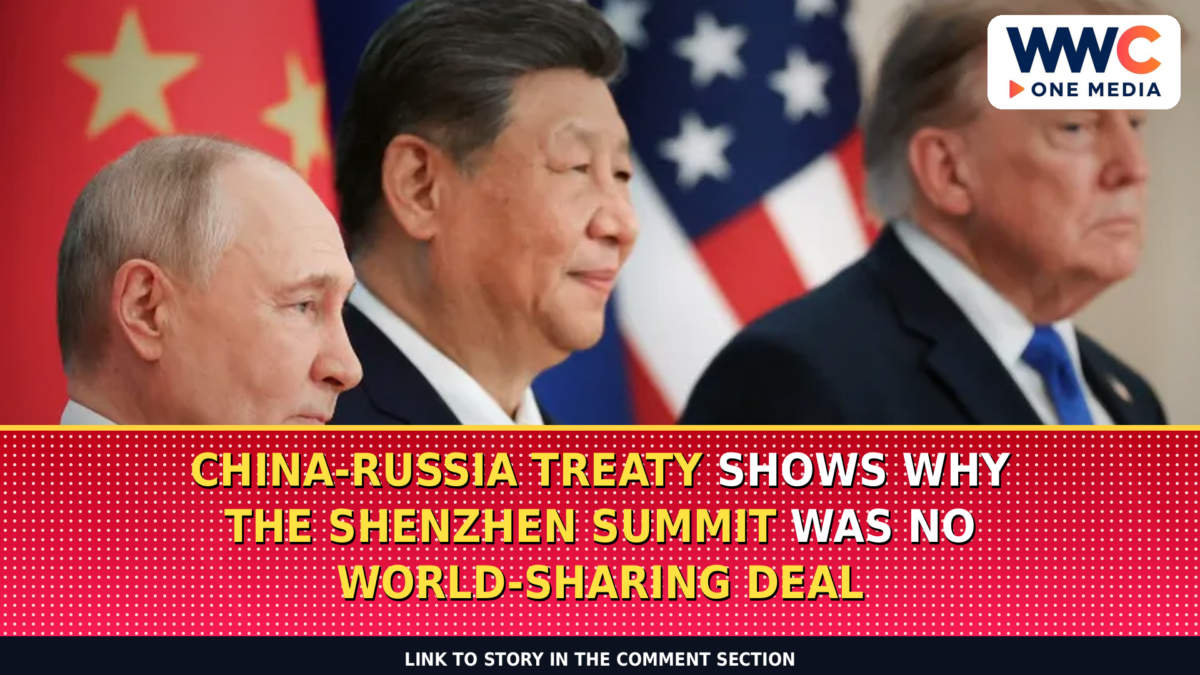
China’s long-standing treaty with Russia offers a clearer picture of Beijing’s strategic relationship with Moscow than the public ceremony at the November 19 summit with US President Donald Trump and Russian President Vladimir Putin. The documents show that China and Russia have built a substantial bilateral partnership over decades, while their latest three-country declaration with Washington sets out a more limited programme of diplomatic cooperation.
The distinction matters as observers assess whether the Shenzhen meeting signalled a new arrangement among the world’s major powers. The official declaration confirms commitments involving United Nations reform, energy supplies, state sovereignty and nuclear-risk dialogue. It does not establish a division of global territory, a new military alliance or a comprehensive agreement on the major disputes separating the three governments.
The more defensible conclusion is that Beijing is pursuing two diplomatic tracks: a formal, long-running strategic partnership with Moscow and a separate channel for managing relations with Washington and Russia together.
China and Russia already have a formal strategic partnership
The foundation of the China-Russia relationship predates the latest summit by more than two decades.
On July 16, 2001, Chinese President Jiang Zemin and Russian President Vladimir Putin signed the Treaty of Good-Neighborliness and Friendly Cooperation in Moscow. The treaty describes the relationship as a long-term strategic cooperative partnership based on mutual respect for sovereignty, territorial integrity, non-aggression, non-interference, equality and peaceful coexistence.
Its provisions go beyond general diplomatic language. Article 4 records reciprocal support for each country’s policies concerning the defence of its national unity and territorial integrity. Article 5 sets out Russia’s position on the Taiwan issue, including its recognition of the People’s Republic of China as the sole legal government representing China and its opposition to Taiwan independence.
The treaty also establishes mechanisms for consultation and cooperation. Article 9 calls for immediate contacts and consultations when either party considers peace threatened or its security interests involved. Article 10 provides for regular meetings at different levels, including summit and high-level meetings, to coordinate positions on bilateral relations and important international issues.
These are bilateral commitments between China and Russia. They should not be confused with the broader statements made by all three leaders in Shenzhen.
The treaty also contains a significant qualification: Article 8 says neither party will enter an alliance or join a bloc, or take actions that compromise the other party’s sovereignty, security or territorial integrity. That language is important when describing the relationship. The treaty establishes a strategic partnership, but it does not describe a conventional mutual-defence alliance.
The 2025 China-Russia declaration reinforces their shared diplomatic position
The two governments continued to develop their common diplomatic language in a joint declaration signed on May 8, 2025, and transmitted to the United Nations in July of that year.
The document, formally titled the Joint Declaration of the People’s Republic of China and the Russian Federation on Further Strengthening of Cooperation to Uphold the Authority of International Law, reaffirms their comprehensive strategic partnership. It also supports a United Nations-centred international system and an international order based on international law.
The declaration explicitly refers to the realities of a multipolar world. It argues that the development of international law should take account of that environment and identifies sovereign equality, territorial integrity and non-intervention as central principles.
One provision is especially relevant to claims that major powers can simply decide arrangements for other countries. The declaration states that international treaties do not create rights or obligations for third states without their consent.
This is the position China and Russia jointly placed before the UN in a formal document. It does not prove that the two governments agree on every international dispute, nor does it establish a plan to divide the world into spheres of influence. It does show that both governments have publicly promoted a diplomatic framework centred on state sovereignty, multipolarity and their own strategic partnership.
The Shenzhen declaration has a different scope
The November 19, 2026, declaration signed by Trump, Putin and Chinese President Xi Jinping is narrower in its stated commitments.
The White House published four areas of agreement.
First, the three countries committed to reforming the United Nations so it can respond more effectively to global challenges and fulfil its mission of international peace and security.
Second, they said they planned to increase the production and supply of refined petroleum products and reaffirmed the importance of stable energy flows.
Third, they recognised the importance of state consent and respect for the immunities of state officials. They also said the International Criminal Court and similar bodies must not abuse their jurisdiction.
Fourth, they reaffirmed that a nuclear war cannot be won and must never be fought. The declaration says the three countries will conduct dialogue on reducing nuclear risks and preventing nuclear proliferation.
Those points provide a basis for continued discussion, but the published text does not specify a timetable, verification system, enforcement mechanism or numerical target for nuclear-arms reductions. It does not announce a new trilateral defence pact, a settlement of the war in Ukraine, or an agreement resolving the Taiwan question.
That distinction is central. A commitment to conduct dialogue is not the same as a binding arms-control treaty. A stated intention to increase energy supplies is not a published production schedule or a completed supply contract.
The declaration should therefore be read according to what it says, rather than as proof that the three governments have agreed to manage the world jointly.
Beijing describes multipolarity as a diplomatic objective
China’s own explanation of the summit provides another indication of how Beijing wants the meeting to be understood.
In its November 19 account, China’s Foreign Ministry said Xi urged the three countries to respect each other’s sovereignty, territorial integrity, political and social systems, development paths and core interests. The Chinese account also emphasised non-interference and caution on sensitive issues.
Foreign Minister Wang Yi later described the meeting as a step towards a relationship among major powers based on peaceful coexistence, overall stability and balanced development. He reiterated China’s stated commitment to an “equal and orderly multipolar world.”
These are official descriptions of China’s diplomatic position. They should be attributed to Beijing rather than presented as an agreed interpretation shared in identical terms by Washington and Moscow.
The difference is important because the White House declaration records the three governments’ specific commitments, while the Chinese Foreign Ministry’s explanation sets out Beijing’s broader interpretation of the summit and its preferred international order.
China can seek a larger role in global institutions and diplomacy without having secured agreement from the United States or Russia on every element of its vision.
Why the summit does not amount to a three-power division of the world
The idea that Washington, Beijing and Moscow might divide the world into spheres of influence is a political interpretation, not a provision contained in the published Shenzhen declaration.
The official text does not allocate countries, territories or regions to any of the three powers. It does not establish a joint authority over smaller states, nor does it give the three leaders a new legal mechanism for deciding disputes involving countries that were not represented at the meeting.
The 2025 China-Russia declaration also states that treaties cannot impose rights or obligations on third states without their consent. That principle sits uneasily with any suggestion that the two governments have formally agreed to decide the status of other countries without their participation.
This does not mean that major-power diplomacy has no consequences for smaller countries. Decisions involving energy, nuclear risks, international institutions and the interpretation of state sovereignty can influence the environment in which other governments operate.
For the Philippines and its neighbours, the practical concern is whether the major powers’ statements are followed by policies affecting regional security, maritime disputes, trade and access to international institutions. The Shenzhen declaration itself does not announce a new settlement of South China Sea disputes or a specific security arrangement for Southeast Asia.
WWC’s earlier examination of the US-Philippines alliance explains why public diplomatic assurances must be distinguished from the actual wording of treaties and other formal commitments.
What happens next
The credibility of the Shenzhen declaration will depend on whether the three governments turn its broad language into practical steps.
For nuclear-risk reduction, the next indicators would include the start of formal talks, agreed subjects, participation by relevant officials and any published framework for continuing discussions. For energy cooperation, governments and companies would need details about supply volumes, production plans and implementation.
United Nations reform is likely to require a much wider process involving other member states. The three countries are permanent members of the Security Council, but their declaration does not by itself amend the UN Charter or change the Council’s membership and voting rules.
China and Russia, meanwhile, will continue to have their separate bilateral treaty and consultation mechanisms. Their relationship is not dependent on the participation of the United States in the Shenzhen declaration.
The documents point to a more measured conclusion than the idea of a new world-sharing arrangement. China has a formal strategic partnership with Russia, while the three leaders have opened another channel for discussing selected global issues. Whether that channel produces lasting results remains to be seen.
For now, the strongest evidence is in the written commitments: a detailed bilateral treaty, a later China-Russia declaration submitted to the United Nations, and a four-point trilateral statement. They describe overlapping diplomatic interests, but they are not interchangeable agreements.
Frequently asked questions
Does China have a treaty with Russia?
Yes. China and Russia signed the Treaty of Good-Neighborliness and Friendly Cooperation on July 16, 2001. It establishes a long-term strategic cooperative partnership and sets out provisions on sovereignty, consultation and cooperation.
Is the China-Russia treaty a military alliance?
The treaty establishes a strategic cooperative partnership, but Article 8 says neither country will enter an alliance or join a bloc. It should not be described as a conventional mutual-defence treaty.
What did Trump, Xi and Putin agree to in Shenzhen?
Their November 19, 2026, declaration covered UN reform, refined petroleum production and supply, state consent and official immunities, and dialogue on nuclear-risk reduction and non-proliferation.
Did the three leaders agree to divide the world into spheres of influence?
The published declaration contains no such provision. It does not allocate territories or countries among the three governments or establish a new system for governing other states.
What does China mean by a multipolar world?
In its official statements, China describes an international system in which countries have a more equal role and global relations are not dominated by a single power. China’s Foreign Ministry has described this as an “equal and orderly multipolar world.”