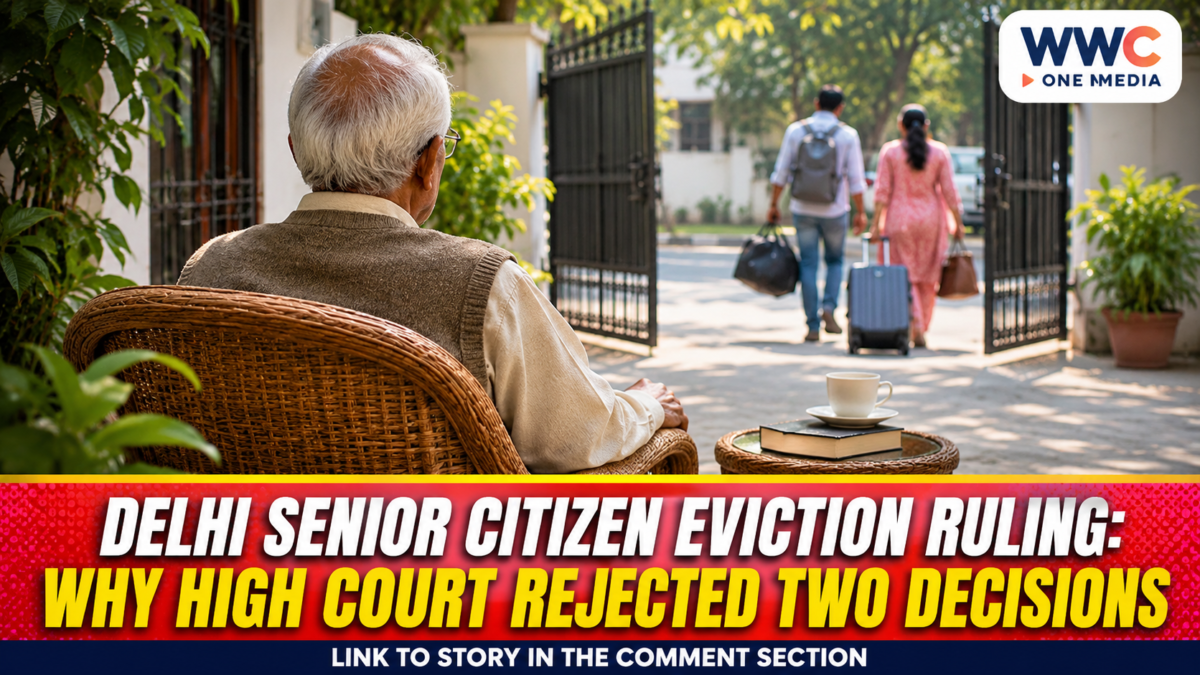
The Delhi High Court on November 20, 2026, ordered an 85-year-old man’s eldest son and daughter-in-law to vacate his self-acquired home within four weeks, setting aside earlier decisions that had rejected his eviction request. Justice Amit Mahajan ruled in Subhash Chander Malhotra v. Raman Malhotra & Ors., W.P.(C) 6452/2026, after finding that the authorities had applied an evidentiary requirement that the governing senior-citizen law did not impose. oral item 62 final- 20.11.2026+1
The decision matters because it explains how Delhi’s senior-citizen protection rules may operate when an older property owner says that continued occupation by adult family members prevents him from living peacefully in his own home. But it is not a blanket order allowing parents to remove relatives whenever a household disagreement occurs. The court examined ownership, the history of the proceedings, the administrative inquiries and the protections already sought from police.
The dispute was about ownership and the right to live peacefully
The petitioner was identified in the judgment as Subhash Chander Malhotra. The court recorded that he was 85 and the absolute owner of the property involved in the case. He had acquired it from the Delhi Development Authority in 1980 and converted it into freehold property in 2000. His eldest son and daughter-in-law were occupying the home, but the judgment states that they did not claim ownership rights over it. oral item 62 final- 20.11.2026+1
The father had sought their eviction through proceedings under the Maintenance and Welfare of Parents and Senior Citizens Act, 2007, and the Delhi rules made under that law. His case included allegations of harassment and a series of police complaints beginning in 2022. Those allegations should be distinguished from independently established criminal findings: the High Court’s decision concerned whether the administrative authorities had correctly assessed his application for protection and eviction.
The respondents disputed his account. Their counsel argued that the dispute was connected to a business disagreement between the father’s sons and that the younger brother was using the petitioner to advance his own interests. The court did not treat the existence of a possible business dispute as sufficient reason to dismiss the father’s request. oral item 62 final- 20.11.2026+1
Why the High Court overturned the earlier decisions
The case had moved through several rounds of administrative review. The District Magistrate rejected the father’s initial application in August 2023. After further proceedings and an inquiry, the District Magistrate again rejected the complaint on October 28, 2025. The Divisional Commissioner upheld that outcome on April 28, 2026.
The High Court found a central legal problem in the approach taken by those authorities: they had treated clear and credible proof of harassment as a necessary condition for eviction. Justice Mahajan held that the statute and the applicable rules did not impose that requirement in the manner the authorities had applied it. The court also criticised the inquiry reports for failing to properly explain their conclusions and for not adequately addressing relevant material, including the earlier police-assistance directions. oral item 62 final- 20.11.2026+2
The court’s reasoning drew on earlier decisions, including Pritam Singh v. Government of NCT of Delhi. It said a senior citizen seeking eviction does not necessarily have to prove ill-treatment if he can show that his property needs protection so that he can live there peacefully and with dignity. That is a legal assessment of the protection required in the circumstances—not a finding that every allegation made in the family dispute was independently proven. oral item 62 final- 20.11.2026+1
What the senior-citizen law provides
India’s Maintenance and Welfare of Parents and Senior Citizens Act, 2007, establishes a framework for the maintenance and welfare of older people. The law defines a senior citizen as an Indian citizen aged 60 or above. It also defines property broadly, covering movable and immovable property, whether ancestral or self-acquired. indiacode.nic.in
Delhi’s rules provide a route for a senior citizen or parent to apply to the Deputy Commissioner or District Magistrate for eviction of a son, daughter or legal heir from property. The procedure requires verification of ownership and the facts, notice to affected occupants, an opportunity for them to respond, and a reasoned decision. The rules also provide for enforcement through authorised officials and police assistance where required. upload.indiacode.nic.in+1
The High Court’s decision interprets how that framework should be applied. It does not erase the procedural protections of people facing eviction, nor does it turn a family disagreement into automatic grounds for removal. The case involved an undisputed ownership finding, the father’s stated wish not to live with the respondents, and deficiencies in the way the earlier authorities assessed his application.
The broader question of how courts weigh older people’s financial security, housing and family responsibilities also appears in other jurisdictions. WWC has examined a separate dispute involving an elderly former spouse’s maintenance claim and the division of a long-married couple’s home in Singapore. The legal systems are different, but both cases show how housing and financial security can become central issues in later life.
The judgment does not settle every family-property dispute
One important feature of the Delhi case was that the respondents had not claimed title to the property. The court recorded the father as its absolute owner. A different dispute involving competing ownership claims, a registered transfer, inheritance rights or a pending civil suit could raise different legal questions.
That distinction is important because occupancy, ownership and family relationships are not interchangeable. A person may live in a property without holding title, while a person who owns a home may still face legal questions about the rights of other occupants. The court’s ruling must be read against the specific record before it.
WWC has previously examined how courts distinguish ownership from long-term occupation in a report on the land and housing dispute surrounding India’s Auroville township. In a separate property case, a Pennsylvania court reversed a family-home tax sale over notice procedures, underscoring that property enforcement depends not only on the underlying claim but also on whether the required process is followed.
The Delhi ruling is therefore best understood as a decision about the proper application of a protective legal process. It does not establish that every parent can evict an adult child without a review of ownership, evidence, applicable rules and the circumstances of the occupants.
What happens next
The High Court directed the son and daughter-in-law to vacate the property within four weeks from November 20, 2026. It also directed the station house officer concerned to provide necessary assistance to the petitioner to ensure compliance if required. The petition was allowed, and the pending application was disposed of. oral item 62 final- 20.11.2026
The immediate issue is whether the respondents comply with the order within the period set by the court. The judgment does not establish whether they have already vacated the property, and no such outcome should be assumed as of November 24.
For other families, the decision is a reminder that the Senior Citizens Act and Delhi’s rules provide a formal process for addressing disputes over an older person’s property and welfare. The outcome will depend on the legal framework and the facts established in each case—not simply on the age of the owner or the existence of a family disagreement.
Frequently asked questions
1. What did the Delhi High Court order in the 85-year-old man’s case?
The court directed his eldest son and daughter-in-law to vacate his self-acquired property within four weeks and ordered police assistance if needed to enforce compliance.
2. Who decided the case?
Justice Amit Mahajan of the Delhi High Court decided Subhash Chander Malhotra v. Raman Malhotra & Ors., W.P.(C) 6452/2026, on November 20, 2026.
3. Did the court require the father to prove harassment?
The court held that clear and credible proof of harassment was not necessarily a precondition for eviction under the applicable framework where the senior citizen showed that the property needed protection so he could live peacefully and with dignity.
4. Which law governs eviction applications by senior citizens in Delhi?
The relevant framework is the Maintenance and Welfare of Parents and Senior Citizens Act, 2007, together with the Delhi Maintenance and Welfare of Parents and Senior Citizens Rules, 2009, as amended.
5. Does the ruling mean every parent can evict an adult child?
No. Applications must be assessed under the applicable law and rules, including ownership verification, notice, an opportunity to respond and consideration of the facts. The judgment addressed the particular record in this case.