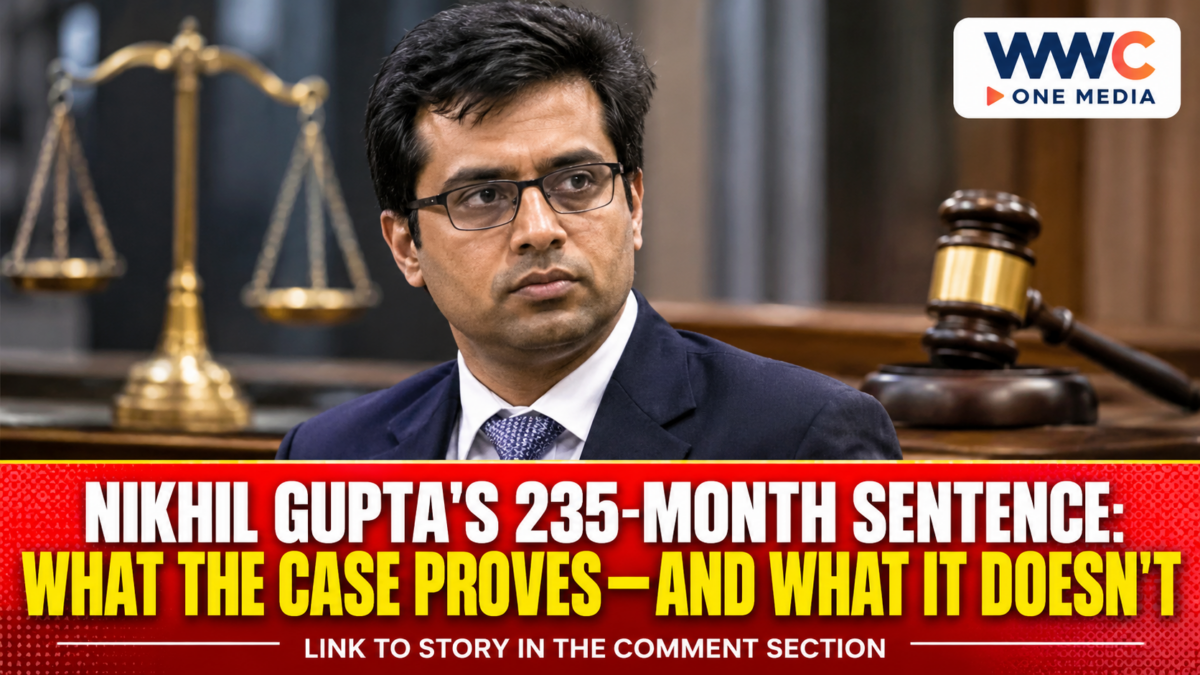
An Indian national has been sentenced to 235 months in a United States federal prison after admitting his role in a plot to kill Sikh activist Gurpatwant Singh Pannun in New York. The Nov. 20, 2026, sentence closes a major part of the criminal case against Nikhil Gupta, but a second defendant identified by US prosecutors remains charged and has not been arrested in connection with the case.
The judgment is significant because the prosecution involved an alleged operation planned across national borders and directed, prosecutors said, by an Indian government employee. It also raises a question that requires careful treatment: what does Gupta’s guilty plea establish, and what remains an allegation involving other people or separate incidents?
The distinction is essential. A criminal conviction applies to the defendant who pleaded guilty. It does not automatically establish the guilt of every person named in the prosecution documents, nor does it settle every allegation involving India and Sikh activists overseas.
What the 235-month sentence means
The US Department of Justice announced that Gupta, also known as “Nick”, received a prison term of 235 months on Nov. 20. That is equivalent to 19 years and seven months.
Gupta had pleaded guilty in February 2026 to three federal offences: murder-for-hire, conspiracy to commit murder-for-hire and conspiracy to commit money laundering. US District Judge Victor Marrero imposed the sentence in the Southern District of New York.
The case concerned a planned killing in New York City. The intended target was Gurpatwant Singh Pannun, an attorney and political activist who is a US citizen of Indian origin and leads a US-based organisation advocating for Punjab’s secession from India.
The sentence represents a completed legal outcome against Gupta, not simply a charge or an accusation. His guilty plea is the key procedural development separating his case from the unresolved allegations against his co-defendant.
How prosecutors described the planned attack
The second superseding indictment and subsequent Justice Department statements describe an operation that prosecutors said began in 2023. They identified Vikash Yadav, then an Indian government employee, as the person who recruited Gupta to arrange the killing.
The prosecution record says Gupta approached someone he believed to be a criminal associate. That person was actually a confidential source working with the US Drug Enforcement Administration. The source introduced Gupta to a supposed hitman who was, in fact, an undercover law enforcement officer.
The Justice Department said Yadav agreed, through arrangements brokered by Gupta, to pay US$100,000 for the killing. On or about June 9, 2023, an associate delivered US$15,000 as an advance payment.
Prosecutors also said personal information about Pannun—including his home address, phone numbers and details of his daily activities—was passed to the undercover officer. These details formed part of the prosecution account of the operation.
The plan was disrupted before Pannun was killed. The case therefore involved a foiled murder-for-hire plot, not a completed assassination in the United States.
Why Yadav’s legal status must be treated separately
The Justice Department identified Yadav as an employee of the Government of India’s Cabinet Secretariat, which houses the country’s foreign intelligence service, the Research and Analysis Wing.
However, the department’s Nov. 20 statement also made clear that Yadav had been charged in the second superseding indictment but had not yet been arrested in connection with those charges.
That distinction must remain visible in any account of the case. Gupta pleaded guilty and received a prison sentence. Yadav remains an accused person whose allegations have not been resolved through the same court process.
The sentence against Gupta does not amount to a conviction of Yadav. It also does not, by itself, constitute a criminal judgment against the Government of India as an institution.
This is not a technicality. Individual criminal responsibility requires evidence and legal proceedings directed at each accused person. Treating an unresolved charge as a conviction would misstate the public record.
The Nijjar connection is a separate Canadian issue
The US prosecution record also refers to Hardeep Singh Nijjar, a Sikh activist who was shot dead outside a Sikh temple in British Columbia on June 18, 2023.
The Justice Department’s account says Gupta told the undercover officer the day after Nijjar’s killing that Nijjar “was also the target” and that “we have so many targets”. The same account records Gupta saying there was “now no need to wait” before proceeding against Pannun.
Those statements are relevant to the US prosecution’s account of the alleged plot. They are not, on their own, a judicial finding identifying who ordered or carried out Nijjar’s killing.
Canada’s security record must be read separately. In its 2024 public report, the Canadian Security Intelligence Service described foreign interference and transnational repression as national-security concerns. It said Canadian investigations had identified activities linked to Indian officials and proxy agents targeting communities and political figures in Canada.
The Canadian government also publicly stated in November 2024 that the RCMP and officials had made accusations of serious criminal activity in Canada involving agents of the Government of India. The same statement cautioned that Canada had not stated, and was not aware of evidence, linking Prime Minister Narendra Modi, Foreign Minister S. Jaishankar or National Security Adviser Ajit Doval to that criminal activity.
These records describe intelligence assessments and official government positions. They should not be presented as a criminal conviction of any named Indian political leader.
The US case and the Canadian proceedings therefore concern connected public concerns but remain legally distinct. WWC has also examined India’s diplomatic engagement with the United States at the Manila Quad summit and the proposed restoration of India-Canada trade relations. Those diplomatic developments are separate from the criminal proceedings.
What the case says about cross-border security
The case illustrates how an alleged criminal operation can involve people, communications and financial arrangements across several countries. The intended victim was in the United States, the alleged recruitment and planning described by prosecutors took place partly in India, and the arrest of Gupta occurred in the Czech Republic before his extradition to the United States.
That international dimension makes cooperation among law-enforcement agencies important. The US prosecution involved the Justice Department, FBI and DEA, while Czech authorities assisted with Gupta’s arrest and extradition.
It also shows why governments face a difficult task when allegations involve political activists living abroad. States have legitimate interests in investigating threats and violence, but peaceful advocacy and political criticism are not themselves proof of criminal activity.
The wider India-Pakistan security environment provides another reason to separate evidence from political claims. WWC’s report on the disputed Indian-Pakistani naval collision in the Arabian Sea examined how competing official accounts can differ over the same incident. The same discipline applies here: allegations about other countries, intelligence networks or unrelated attacks need their own documentary support.
Analysis: Gupta’s sentence demonstrates that prosecutors can secure a conviction when an intended violent act is planned across borders. It does not justify treating every allegation about India’s foreign policy, intelligence activity or regional conduct as proven. The strength of the case lies in the evidence and legal outcome actually recorded.
What happens next
The immediate unresolved issue in the US case is Yadav’s status. The Justice Department’s latest statement, dated Nov. 20, said he remained charged and had not been arrested in connection with the indictment.
Any change to that status should be established through a new court filing or an official statement. Until then, he must be described as charged, not convicted.
The investigation and legal proceedings concerning Nijjar’s killing in Canada also remain separate from Gupta’s US sentence. Canadian intelligence assessments, police investigations and any criminal proceedings must be reported according to their own records and legal stages.
For now, the firmest conclusion is specific: Gupta pleaded guilty to three federal offences and received 235 months in prison. The unresolved allegations involving other people and other incidents require separate evidence and due process.
Frequently asked questions
How long was Nikhil Gupta sentenced to prison?
Gupta was sentenced to 235 months in US federal prison on Nov. 20, 2026. That is equivalent to 19 years and seven months.
Why was Nikhil Gupta sentenced?
He pleaded guilty to murder-for-hire, conspiracy to commit murder-for-hire and conspiracy to commit money laundering in connection with a foiled plot targeting Gurpatwant Singh Pannun in New York.
Who is Vikash Yadav?
The US Justice Department identified Yadav as an Indian government employee accused of directing the plot. As of Nov. 20, 2026, he remained charged and had not been arrested in connection with those charges.
Did the US case determine who killed Hardeep Singh Nijjar?
No. The US prosecution record refers to statements attributed to Gupta after Nijjar’s killing, but the case against Gupta concerned the plot targeting Pannun in New York. Nijjar’s killing is a separate Canadian investigation.
Does Gupta’s sentence prove that the Indian government ordered the plot?
The Justice Department described the alleged scheme as directed by an Indian government employee. Gupta pleaded guilty and was sentenced, but Yadav remains charged rather than convicted. The sentence is not a criminal conviction of the Indian government as an institution.