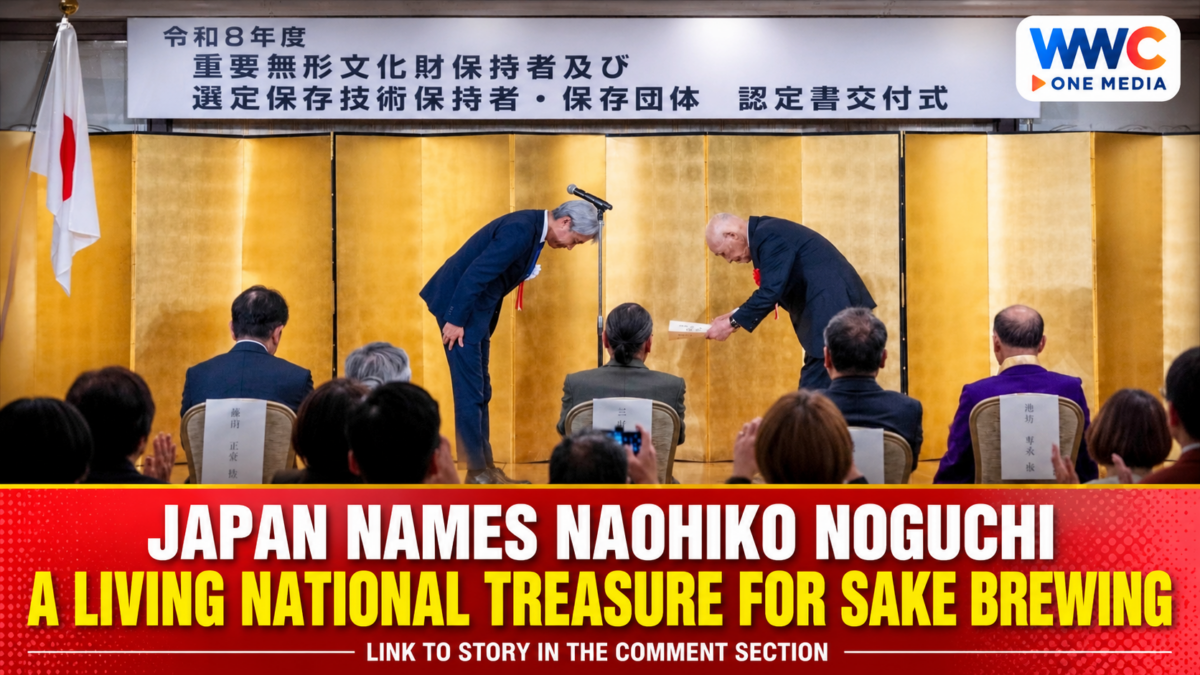
Japan has formally recognised master brewer Naohiko Noguchi as a holder of an Important Intangible Cultural Property for ginjo-zukuri, a specialised technique used in producing premium sake. The 93-year-old brewer received his certificate during a government ceremony at Kyoto Brighton Hotel on Nov. 16, 2026, marking a significant moment for the recognition of traditional Japanese brewing skills.
The distinction goes beyond an individual honour. It places a specialised form of sake production within Japan’s official cultural heritage framework, highlighting the importance of preserving the knowledge, experience and techniques passed from one generation of brewers to another.
The recognition also reflects a broader change in how Japan defines cultural heritage. Skills associated with everyday life, including food preparation and traditional brewing, are increasingly being recognised alongside established performing arts and crafts.
Why Naohiko Noguchi’s recognition matters
The Agency for Cultural Affairs confirmed that the certificate ceremony took place on Nov. 16 at Kyoto Brighton Hotel, from 1:30 p.m. to 2:30 p.m.
The event recognised seven individually certified holders of Important Intangible Cultural Properties, alongside five holders and one organisation recognised under the system for Selected Conservation Techniques. Certificates were presented by the Commissioner for Cultural Affairs, according to the agency’s official account of the ceremony. 文化庁
Noguchi’s recognised field is ginjo-zukuri. The designation identifies him as a holder of the cultural property associated with that brewing technique, rather than simply giving him an honorary title for his career.
The distinction matters because traditional skills often depend on knowledge that cannot be fully preserved through written instructions alone. Experience, timing, judgement and the ability to respond to changing conditions can all form part of a craft.
Recognising a practitioner under Japan’s cultural heritage system gives the technique a formal place in the country’s preservation efforts.
What is ginjo-zukuri?
Ginjo-zukuri refers to a method of making ginjo sake, a category associated with carefully controlled brewing and highly polished rice.
The process requires close attention to ingredients and production conditions. Rice preparation, fermentation management, temperature and the work of the brewing team all influence the final product.
Unlike industrial processes that can rely heavily on standardised procedures, traditional brewing also depends on the judgement of experienced specialists.
Noguchi’s recognition therefore draws attention to the people behind the production process. A bottle of sake represents more than ingredients and machinery; it reflects accumulated knowledge about how those ingredients behave under particular conditions.
That distinction is central to understanding why a brewing method can be treated as cultural heritage.
A career built around preserving brewing knowledge
Noguchi’s career began long before the establishment of the institute that now carries his name.
The Japan Tourism Agency’s official multilingual tourism database records that he was born in Ishikawa Prefecture in 1932 and began brewing in 1949, following his father and grandfather into the profession.
He became a chief brewer, or toji, at Kikuhime in Ishikawa in 1961, when he was 28. He remained there for 36 years before retiring in 1997.
He returned to brewing the following year, working at another Ishikawa brewery, Kano Shuzo, where he produced sake under the Jokigen label. After retiring again at 79, he returned to the profession in 2017 at the newly established Noguchi Naohiko Sake Research Institute in Komatsu. Japan Tourism Agency,Japan Tourism Agency
His professional history is closely connected with the development of premium ginjo brewing and the revival of the traditional yamahai method.
The institute’s own account describes Noguchi as a key figure in bringing the nearly lost yamahai technique back into wider use. It also says he has spent more than 70 years brewing sake and continues to work with younger brewers. noguchi-naohiko.co.jp
The next generation is part of the legacy
The institute in Komatsu was established to preserve Noguchi’s methods and approach to brewing.
Its official description explains that younger brewers work closely with him, combining knowledge gathered over decades with newer technology and production data. The institute says it can accommodate up to seven aspiring brewers at a time under his guidance.
This detail is important because cultural preservation is not simply about recognising an accomplished individual. It also involves ensuring that the skills associated with that person can continue after the original practitioner is no longer able to teach or work.
Analysis: Noguchi’s recognition could help bring greater attention to the importance of training future brewers. The title itself cannot guarantee that traditional methods will survive, but formal recognition can strengthen the case for documenting, teaching and supporting specialised techniques.
The challenge is to make sure that preservation does not stop at a ceremony or a certificate. A living craft needs people who can practise it, understand its principles and adapt responsibly as conditions change.
Japanese brewing gains a wider cultural and international profile
Japan’s sake industry has also been working to introduce regional brewing traditions to international audiences.
Different prefectures have their own breweries, ingredients, water sources and production histories. These regional identities are part of what makes Japanese sake more varied than a single national product category.
That international dimension is visible in Hiroshima’s efforts to promote regional food products abroad. WWC previously reported on Hiroshima’s presentation of oysters and sake to British buyers in London, an example of how regional producers are using food culture to develop overseas recognition.
Traditional Japanese food techniques also extend well beyond brewing. The principles of seasonality, careful preparation and respect for ingredients are visible in the country’s dining traditions, including the seasonal kaiseki experience at Yamazato in Manila.
Meanwhile, historic breweries are increasingly being considered as cultural and tourism destinations. A planned hospitality development involving a century-old Japanese brewery featured in WWC’s report on Bill Bensley’s projects combining traditional sites, design and hospitality.
These examples illustrate how traditional food and drink practices can connect heritage, regional identity and international interest without reducing their value to commercial products alone.
What happens next
Noguchi’s recognition is now formally marked by the certificate presented at the Nov. 16 ceremony.
The longer-term question is how the designation will support the continued practice of ginjo-zukuri. The institute’s existing work with younger brewers provides one avenue for passing on technical knowledge, while the national recognition gives the craft greater visibility within Japan’s cultural preservation system.
For the wider sake industry, the honour also offers an opportunity to explain the work behind traditional brewing to audiences who may know the finished product but not the skills required to produce it.
Noguchi’s achievement highlights a central principle of intangible cultural heritage: traditions survive when people continue to practise and teach them. The recognition celebrates an individual, but its lasting significance will depend on the generations that follow.
Frequently Asked Questions
Who is Naohiko Noguchi?
Naohiko Noguchi is a Japanese master sake brewer from Ishikawa Prefecture. He has worked in the brewing industry for more than seven decades and is associated with the development of premium ginjo brewing and the revival of the yamahai method.
Why was Naohiko Noguchi recognised as a Living National Treasure?
He was recognised as a holder of an Important Intangible Cultural Property for ginjo-zukuri, a traditional technique used in producing ginjo sake.
When did Noguchi receive the recognition certificate?
He received his certificate on Nov. 16, 2026, during a ceremony at Kyoto Brighton Hotel organised by Japan’s Agency for Cultural Affairs.
What is ginjo-zukuri?
Ginjo-zukuri is a specialised sake-brewing technique associated with ginjo production. It involves careful control of ingredients and brewing conditions and requires considerable technical knowledge.
Where is the Noguchi Naohiko Sake Research Institute?
The institute is located in Kanagaso, Komatsu City, Ishikawa Prefecture, Japan. It was established to preserve Noguchi’s brewing approach and support the training of younger brewers.