
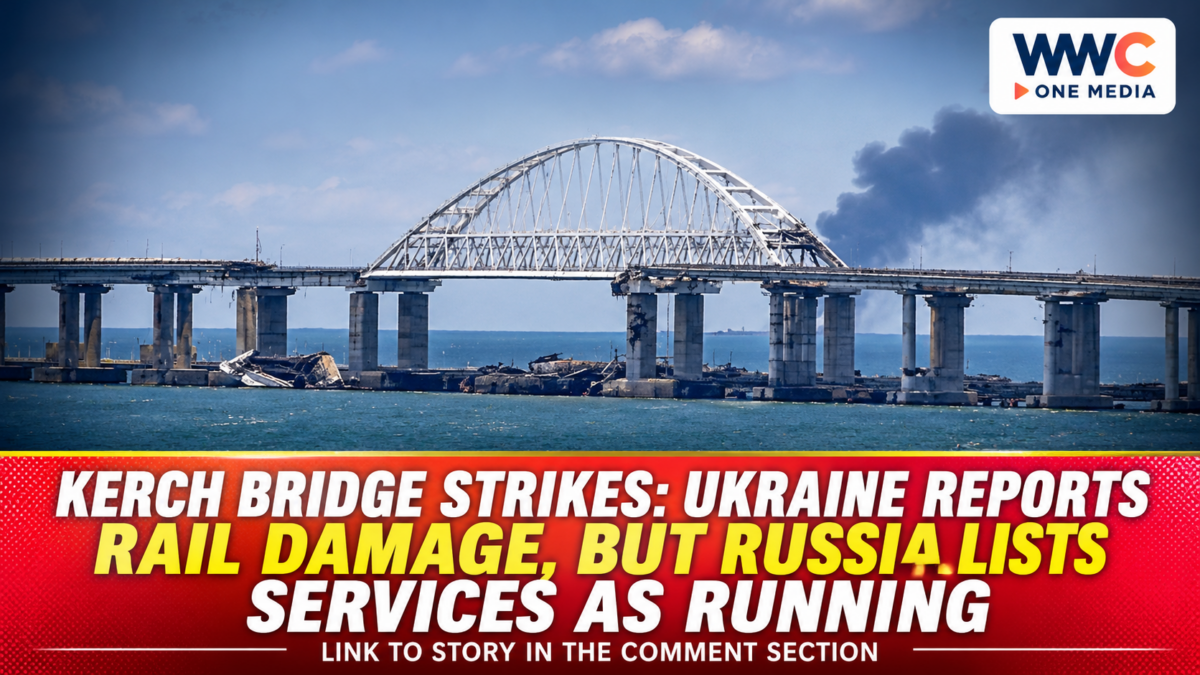
A series of Ukrainian strikes against the Kerch Bridge in November has produced sharply different official accounts of the crossing’s condition, with Ukraine reporting damage to both road and rail infrastructure while Russia’s Transport Ministry lists passenger services as operating. The latest public records available on November 23 do not provide a jointly verified engineering assessment or a clear explanation of how the two accounts fit together.
The distinction matters because the bridge is more than a high-profile structure across the Kerch Strait. It carries civilian road and rail traffic and has been identified by Ukraine’s military as an important supply route for Russian forces operating in occupied Crimea and southern Ukraine.
For readers, the central question is no longer simply whether the bridge was struck. It is what the separate official records establish about its damage and transport availability.
Kerch Bridge strikes: What Ukraine says happened
Ukraine’s Armed Forces said its forces struck the Kerch Bridge during the night of November 17. Its public statement said an arch and a span of the road section had collapsed, leaving the roadway unusable for vehicles. It added that the railway section remained standing but had a damaged arch.
The Security Service of Ukraine separately described the operation as a multi-stage effort carried out with other Defence Forces units. The agency said the operation lasted around a month and involved seven stages, culminating in strikes against the bridge.
The Security Service identified its Alfa Special Operations Centre as the unit that targeted the road section with Palyanytsia drone missiles. It said the road span collapsed into the water.
These are Ukrainian government and military accounts of the operation. They are not an independent structural inspection, and the published statements do not provide a complete engineering survey of the remaining bridge.
A second reported strike targeted the railway
The next major development came on November 19. Ukraine’s Armed Forces said missile forces using Neptune coastal-defence systems operated by the Ukrainian Navy struck the bridge again.
The military statement said the railway tracks were damaged and traffic across the crossing was suspended. Ukraine’s Defence Ministry later included the November 19 operation in a broader account of strikes against Russian military logistics infrastructure.
The distinction between road and rail damage is important. The two sections perform different transport functions, and a statement about damage to one does not automatically establish the condition of the other.
The November 19 announcement did not publish a measured length of damaged track, a detailed structural report, a count of affected trains or a repair timetable. Those missing details limit what can responsibly be said about the practical effect on freight and passenger movement.
Russia’s transport information presents a different picture
Russia’s Transport Ministry published an operational update on November 18 following a meeting of a transport coordination headquarters. It said road movement across the bridge had been temporarily suspended while passenger trains were operating according to schedule.
The ministry also described measures to maintain travel connections, including additional long-distance and suburban train services, scheduled bus connections from several stations to Kerch and the possible use of the Kerch ferry crossing for passengers and freight.
The ministry’s public information pages currently provide further guidance. One says passenger cars and buses can use the road section in both directions under normal operating conditions. Another says long-distance passenger trains generally depart and arrive according to schedule, while warning that changes may occur.
These pages do not amount to a detailed engineering report addressing every claim made by Ukraine. They also do not explain in technical terms how the transport arrangements relate to the damage reported after the November 19 strike.
The responsible reading is to distinguish the records by date and purpose: Ukraine’s military statements describe the attacks and the damage it says resulted; Russia’s Transport Ministry describes the transport services and arrangements it publishes for travellers.
Why the bridge matters beyond civilian travel
The Kerch Bridge links Russia with Crimea across the Kerch Strait. Ukraine’s military describes it as one of the main routes used to move fuel, ammunition, weapons and military equipment to Russian forces on the peninsula and the southern front.
That role gives damage to the crossing a significance beyond the inconvenience of a road or rail closure. If either transport mode is restricted, operators may need to rely more heavily on alternative routes, ferry services or other supply arrangements.
But the public records reviewed do not quantify how much freight was delayed, how many military shipments were diverted or how long any disruption lasted. It would be misleading to convert the reported structural damage into a precise estimate of military or economic losses without those figures.
The broader campaign against infrastructure has also involved energy and export facilities. WWC has examined the vulnerability of Russia’s Ust-Luga oil-export hub, where the consequences of an attack must likewise be separated from unverified assumptions about long-term export losses.
Infrastructure attacks are affecting both sides
The Kerch Bridge developments are taking place amid continued attacks on transport and energy infrastructure in Ukraine and Russia.
Kyiv’s own transport network has faced disruption. WWC’s report on damage to bridges and other infrastructure during Russia’s November 20 attack on Kyiv examined how restrictions on major crossings can affect movement across a city.
The wider conflict also has a diplomatic dimension. The relationship between military pressure and negotiations remains a central issue in discussions involving Ukraine, the United States and European partners. WWC previously examined the US Russia-sanctions waiver and its implications for Ukraine peace discussions.
These developments should not be treated as proof that attacks on infrastructure will determine the outcome of negotiations. They show instead that transport links, energy facilities and military supply routes remain part of the conflict’s operational environment.
What happens next
The key evidence to watch is a dated, detailed transport update from Russia’s authorities and any technical assessment that clarifies the condition of the road and railway structures after the November 19 strike.
A useful update would identify which vehicle categories can cross, whether passenger and freight trains are running normally, what restrictions remain and whether repairs have begun. A published engineering assessment would also help distinguish damage to the visible road span from the condition of supporting structures and the adjacent railway.
Until such details are available, the public record supports a careful conclusion: Ukraine has reported substantial damage from the November 17 and 19 strikes, while Russia’s transport information describes passenger services as operating. The available statements do not provide a single, independently verified account of the bridge’s full structural condition.
Frequently asked questions
Was the Kerch Bridge struck in November 2026?
Yes. Ukraine’s Armed Forces and Security Service published statements describing strikes on November 17, followed by another reported strike on November 19.
Did part of the Kerch Bridge collapse?
Ukraine’s Armed Forces said an arch and a span of the road section collapsed during the November 17 operation. The Security Service also said its strike caused the road section to fall into the water.
Was the railway section damaged?
Ukraine’s November 17 statement described damage to the railway arch. Its November 19 statement said railway tracks were damaged in a subsequent strike.
Is the Kerch Bridge open to traffic?
Russia’s Transport Ministry public guidance lists passenger cars and buses as able to use the road section and says long-distance passenger trains generally operate according to schedule. Ukraine’s military statements have described closures and damage. The records do not provide a single independently verified operational assessment covering all traffic categories after the latest strike.
Why is the Kerch Bridge strategically important?
The crossing connects Russia and Crimea by road and rail. Ukraine’s military describes it as a major route for supplying Russian forces with fuel, ammunition, weapons and equipment.










