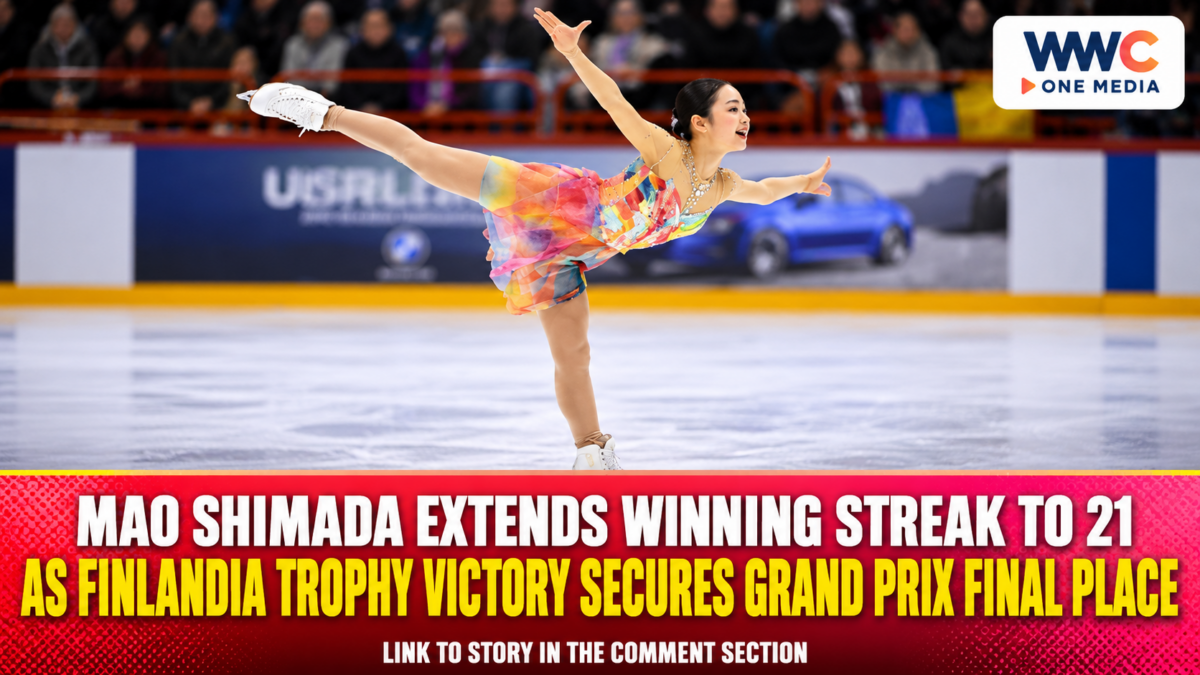
Japan’s Mao Shimada strengthened her position among figure skating’s leading senior competitors after winning the women’s event at the ISU Grand Prix Finlandia Trophy in Helsinki on Nov. 21, 2026. Her total of 229.49 points delivered a second Grand Prix victory this season and secured her place in the series’ season-ending Grand Prix Final. isuresults.com+1
The result also extended Shimada’s international winning streak to 21 consecutive competitions, a run that the International Skating Union (ISU) says has remained unbroken since her international debut in 2023. At 18, she is now leading the women’s Grand Prix standings as the 2026–27 series approaches its final qualifying event. isu-skating.com+1
But the Helsinki result was more than another gold medal. It showed how Shimada has carried her success as a junior skater into the senior circuit, where she is now competing against established international champions and building a case for a major role in the season’s biggest events.
Finlandia Trophy results put Shimada firmly on top
The Finlandia Trophy took place at Helsinki Ice Hall from Nov. 20 to 21, with the women’s competition decided across the short programme and free skating.
Shimada finished first in both segments. She earned 79.06 points in the short programme and 150.43 in free skating, producing a combined score of 229.49. isuresults.com+1
Estonia’s Niina Petrokina placed second with 214.06 points, while American Isabeau Levito finished third with 207.19. Levito had been sixth after the short programme but moved into the medal positions following the free skate. isuresults.com+1
The gap between Shimada and Petrokina was 15.43 points. That margin reflected Shimada’s advantage across both portions of the competition rather than a victory decided by a single strong performance.
The official judging protocol also provides a more detailed picture of her free skate. Shimada received 83.61 points for technical elements and 67.82 for programme components, with a one-point deduction. Her total for the segment remained 150.43. isuresults.com
Those figures matter because figure skating rewards more than the difficulty of individual jumps. Technical elements, execution and programme components all contribute to the final score, making consistency across the full routine essential.
The triple Axel remains a defining weapon
One of the notable features of Shimada’s Finlandia Trophy performance was her triple Axel in both the short programme and free skating.
The triple Axel is among the sport’s most demanding triple jumps because it requires an additional half-rotation compared with other triple jumps. Executing it successfully can provide a valuable scoring advantage, although the overall result still depends on the rest of the programme.
The official ISU report highlighted Shimada’s execution of the jump in both segments. Her technical record also shows a successful triple Axel in the short programme, earning a panel score of 10.06, and another in free skating, earning 10.74. isuresults.com+1
Her free skate was not flawless. The protocol recorded a fall and an under-rotation on a planned quadruple toe loop, resulting in a reduced score for that element. Yet the rest of her performance was strong enough to preserve a substantial lead. isuresults.com
That detail adds useful perspective to the victory. Shimada did not need a completely error-free programme to win. Her overall scoring advantage came from the quality of her performance across multiple elements and the strength of her short-programme lead.
From junior champion to senior Grand Prix leader
Shimada’s latest result carries additional significance because of the transition she has made from junior competition to the senior international circuit.
The ISU described her as undefeated since her international debut in 2023, with the Finlandia Trophy victory marking her 21st consecutive international competition win. The organisation also noted that she had put her four years as a junior behind her and was approaching senior competition with a fresh mindset. isu-skating.com
Moving into senior competition is a major step for any skater. Athletes face a different competitive environment, with more experienced opponents, greater expectations and the challenge of sustaining performance across a demanding international calendar.
Shimada’s two Grand Prix victories this season suggest that she has adapted effectively. Her earlier win at Skate Canada International and her Finlandia Trophy triumph gave her two victories on the 2026–27 circuit. isu-skating.com
Her progress also fits into a broader period of attention on young athletes in international sport. WWC has previously examined how teenage competitors are making their mark across major Asian sporting events, while its coverage of Japan’s Olympic-winning figure skating pair Riku Miura and Ryuichi Kihara has explored another part of the country’s strength in the sport.
Shimada’s path is different: she competes individually, and her results will be measured against a field of international women’s singles skaters. Still, her achievements add to Japan’s growing presence in high-level figure skating.
What the Grand Prix standings mean
The Grand Prix series is not decided by one competition alone. Skaters earn points based on their placements at assigned events, with the strongest competitors advancing to the Grand Prix Final.
The ISU standings published after the Finlandia Trophy placed Shimada first in the women’s rankings with 30 points. She had collected 15 points from each of her two Grand Prix victories. results.isu.org+1
A strong position in the standings is important because only the top six women qualify for the Final. The event brings together the leading performers from the series, creating a smaller field in which every result carries greater significance. isu-skating.com
Shimada’s qualification means she can now prepare for the season-ending competition without needing to depend on the results of other skaters at the final qualifying stop.
The wider Grand Prix circuit remains competitive, however. The standings list Japan’s Ami Nakai in second place, while Estonia’s Niina Petrokina is also among the leading contenders. The final rankings will determine the six women who advance. results.isu.org
For a closer look at how the sport’s scoring system can shape a competition, WWC’s report on Ilia Malinin’s Skate America victory explains how results across the short programme and free skate combine to determine the overall champion.
What happens next
The next major target for Shimada is the ISU Figure Skating Grand Prix Final, scheduled for Dec. 10–13, 2026, in Chongqing, China. The event will bring together the top six qualifiers in women’s singles, along with the leading competitors in the other Grand Prix disciplines. isu-skating.com
Her Finlandia Trophy performance gives her a strong foundation heading into the Final, but the next competition will present a different challenge. A smaller field of top-ranked skaters means there will be less room for mistakes, and the pressure to deliver across both segments will be considerable.
The main question is whether Shimada can carry her winning form into the Final against the strongest qualifiers of the season. Her record so far makes her one of the leading contenders, but the result will still depend on what happens on the ice in December.
For now, her Helsinki victory has established two important facts: she remains unbeaten in international competition since her 2023 debut, and she has successfully translated her junior-era achievements into senior Grand Prix success.
Frequently asked questions
Did Mao Shimada win the Finlandia Trophy 2026?
Yes. Shimada won the women’s event at the Finlandia Trophy in Helsinki on Nov. 21, 2026, with a combined score of 229.49 points.
How many points did Mao Shimada score?
She scored 79.06 in the short programme and 150.43 in free skating, giving her a total of 229.49 points.
Who finished second and third at the Finlandia Trophy?
Niina Petrokina of Estonia placed second with 214.06 points. Isabeau Levito of the United States finished third with 207.19 points.
Has Mao Shimada qualified for the 2026 Grand Prix Final?
Yes. Her two Grand Prix victories gave her 30 points in the women’s standings and secured her qualification for the Final in Chongqing, China.
When is the 2026 ISU Grand Prix Final?
The Grand Prix Final is scheduled for Dec. 10–13, 2026, in Chongqing, China.