
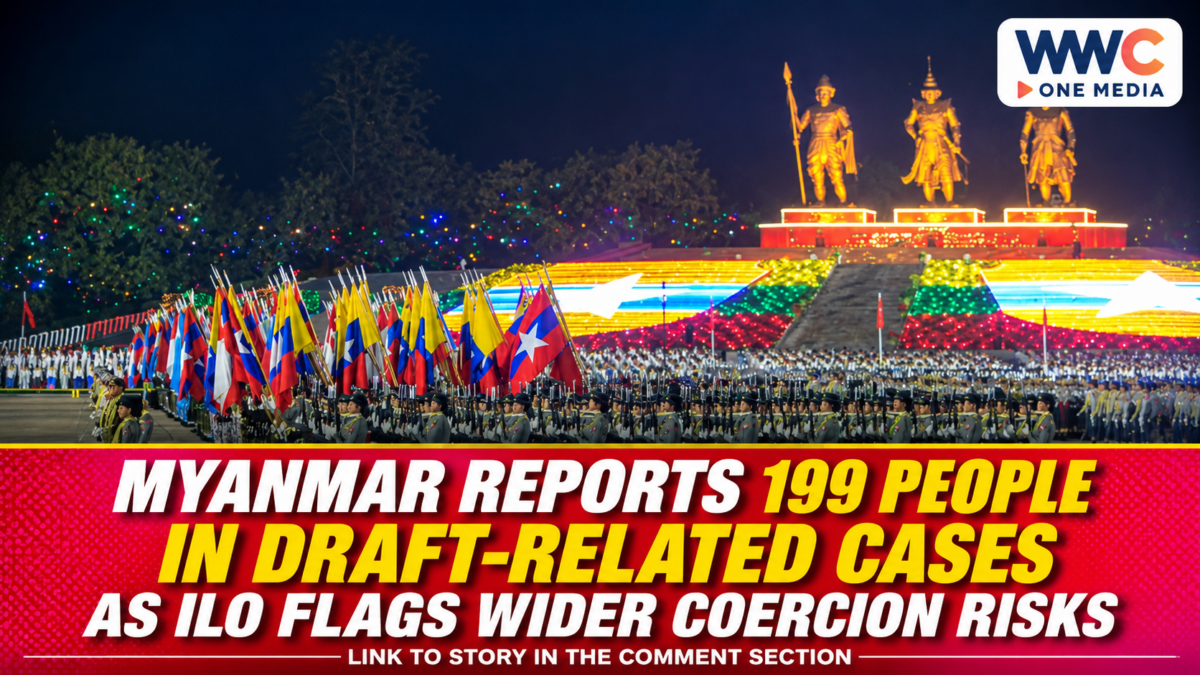
Myanmar’s military authorities said they had taken action in 71 cases involving 199 people accused of financial extortion or unauthorised forced conscription as of Oct. 31, 2026. The announcement, published on Nov. 22, also acknowledged complaints involving payments demanded from communities and alleged abuses by people exploiting the country’s compulsory military service system. Ministry of Information Myanmar+1
The figures offer a rare official accounting of misconduct connected to Myanmar’s military draft. But they also raise a bigger question: whether action against individual offenders can address a wider problem that international labour monitors say involves coercive recruitment, arbitrary detention and pressure on families to pay for the release of relatives.
The distinction matters because the government’s latest announcement describes enforcement activity, not a complete measure of the scale of abuses. A separate assessment by the International Labour Organization (ILO), released in November, says reports of forced recruitment and forced labour point to practices extending beyond isolated incidents. International Labour Organization+1
Myanmar’s conscription system faces an accountability test
The announcement came from the Central Committee on Public Military Service Conscription and the Ministry of Defence. It said the Public Military Service Law and its implementing rules were being used to summon eligible male citizens for service through committees operating at regional, state, district and township levels.
The same announcement described alleged misconduct involving individuals who impersonated officials, detained people, demanded money and unlawfully enlisted them for military service. It also identified unauthorised collections by some ward and village administrators, including monthly payments described as support for conscripted personnel and money allegedly collected to pay substitutes for people seeking to avoid service. Ministry of Information Myanmar+1
The government said 71 enforcement cases involving 199 offenders had been acted upon by Oct. 31. These consisted of 49 financial extortion cases involving 102 offenders and 22 forcible conscription cases involving 97 offenders.
Those figures should not be interpreted as 199 convictions. The announcement does not specify how many cases resulted in convictions, what penalties were imposed, or whether all the people involved had completed legal proceedings.
That distinction is important when assessing whether the announced measures have produced accountability or represent investigations and other enforcement steps still in progress.
What the complaint figures reveal
The announcement also provided a separate breakdown of complaints submitted to the Central Committee for Public Military Service Conscription.
Of 182 financial extortion complaints, action had been completed in 91, while 56 remained under investigation. The authorities classified the remaining 35 as false allegations.
For complaints involving forcible conscription, 43 had been submitted. Action had been completed in 17, 14 remained under investigation and 12 were classified as false allegations. Ministry of Information Myanmar+1
The distinction between enforcement cases and complaints is essential. The 71 cases involving 199 offenders are not the same dataset as the 225 complaints submitted to the central committee. The announcement does not explain whether the two sets overlap, how complaints were assessed or what criteria were used to classify allegations as false.
Nor does it provide a breakdown by township or region, the amount of money allegedly collected, the number of people released after payments, or the identities and positions of those facing action.
For communities, these missing details matter. A public announcement can show that authorities have acknowledged complaints and begun enforcement, but transparent case outcomes would provide a stronger basis for evaluating whether people can report abuses safely and obtain remedies.
The legal framework predates the latest crackdown
Myanmar’s compulsory military service framework did not begin with the November announcement.
The government stated that the People’s Military Service Law took effect on Feb. 10, 2024. The Ministry of Information later reported that the Ministry of Defence promulgated implementing rules through Notification No. 2/2025 on Jan. 23, 2025. Those rules contain 10 chapters, 59 sections and 12 appendices, covering matters including eligibility, service periods, registration, enlistment, exemptions, postponements and summonses. Ministry Of Information+1
The framework establishes an administrative structure for calling citizens into service. The latest announcement, however, indicates that the process has also created opportunities for people to exploit public uncertainty about who has authority to issue summonses and collect payments.
That creates a practical governance challenge. If residents cannot readily distinguish authorised procedures from fraudulent demands, they may be vulnerable to extortion or unlawful detention even when they are trying to comply with official requirements.
The authorities said people could report incidents through hotline numbers published in newspapers in their respective regions and states. The announcement did not provide a consolidated national hotline number or describe safeguards for complainants.
ILO assessment points to a wider problem
The government’s figures must also be considered alongside the wider labour-rights assessment published for the ILO Governing Body’s 358th Session, held in Geneva from Nov. 9 to 19.
The ILO document reviewed information submitted by Myanmar’s military authorities as well as communications and reports from international entities and labour organisations. It recorded the authorities’ claims that they had established a committee to investigate forced-labour and recruitment complaints involving military personnel. The authorities reported that 383 personnel had been penalised as of May 2026. International Labour Organization+1
But the ILO said the information provided did not clearly address its Commission of Inquiry’s recommendations on forced labour and recruitment. It also reported that information received from various sources pointed to systematic irregular recruitment practices.
The document cited an OHCHR communication dated Sept. 30, 2026, which referred to more than 270 alleged and reported abductions, arbitrary arrests and possible enforced disappearances associated with conscription during 2026. It described reports of incidents in urban and rural areas, including at checkpoints and during house inspections. Some families were reportedly asked to pay bribes or ransoms to secure the release of relatives. International Labour Organization
The ILO further said information received by its Office indicated a broader pattern of forced recruitment, including arrests of workers travelling to and from work, threats linked to workplace disputes and monthly payments demanded to avoid recruitment. International Labour Organization
These are findings and reported information presented in the ILO assessment, not a claim that every complaint has been independently proven in court. They nevertheless show why the latest government enforcement figures cannot, by themselves, settle the wider question of whether coercive recruitment has been brought under control.
For additional context on Myanmar’s wider human-rights and labour concerns, WWC has examined the legal and humanitarian issues surrounding the Rohingya crisis. The country’s labour pressures also affect people seeking safer opportunities abroad, including those caught in fraudulent overseas recruitment and scam-centre operations.
Why the issue matters beyond Myanmar
The consequences of compulsory recruitment and alleged abuses do not stop at the country’s borders.
The ILO assessment noted that forced conscription remained a major protection concern and a driver of displacement, with young people reportedly leaving Myanmar in large numbers. It also described acute labour shortages linked to military conscription as one of the pressures affecting businesses operating in the country. International Labour Organization+1
For neighbouring countries, including the Philippines, displacement and irregular migration can increase the need for effective protection, screening and cross-border cooperation. Filipino workers considering overseas employment in the region also have reason to verify recruitment arrangements carefully, particularly when a job offer involves unclear destinations, duties or documentation.
WWC has also reported on the wider regional risks facing jobseekers targeted by scam-centre trafficking networks. These issues are distinct from military conscription, but both demonstrate how people can become vulnerable when coercion, weak safeguards and limited access to reliable information intersect.
The broader economic effect is equally significant. A workforce affected by insecurity, displacement and recruitment pressure faces obstacles to stable employment and business activity. For employers, persistent labour shortages can complicate operations and long-term investment decisions.
What happens next
The Myanmar authorities said the central committee and the Ministry of Home Affairs would continue identifying and prosecuting offenders, with the stated aim of reducing forced conscription, nighttime arrests, paid substitution and unauthorised collections.
The next meaningful test will be whether authorities publish verifiable outcomes. That includes the number of completed prosecutions, penalties imposed, money recovered, people released and safeguards introduced to prevent further abuses.
The ILO, meanwhile, said it would continue developing a monitoring mechanism for confidential and credible documentation of fundamental-rights violations in Myanmar. Its Governing Body was also set to remain informed about steps taken by the authorities to implement the Commission of Inquiry’s recommendations. International Labour Organization
For now, the November announcement establishes that Myanmar’s authorities have acknowledged and acted on cases involving extortion and forcible conscription. It does not establish that the underlying problem has been resolved. The credibility of the response will depend on whether enforcement produces transparent results and whether people can exercise their rights without fear of unlawful detention or demands for payment.
Frequently asked questions
How many people were involved in Myanmar’s draft-related enforcement cases?
Myanmar’s authorities reported 71 cases involving 199 offenders as of Oct. 31, 2026. These included 102 people in financial extortion cases and 97 in forcible conscription cases. The announcement did not provide a final conviction count.
How many complaints involved extortion and forced conscription?
The Central Committee on Public Military Service Conscription received 182 financial extortion complaints and 43 complaints involving forcible conscription. The government said some remained under investigation and others had been classified as false allegations.
When did Myanmar’s military service law take effect?
The Myanmar government stated that the People’s Military Service Law took effect on Feb. 10, 2024. Its implementing rules were promulgated through Notification No. 2/2025 on Jan. 23, 2025.
What has the ILO said about forced recruitment in Myanmar?
The ILO’s November 2026 assessment said information received by its Office pointed to a broader pattern of forced recruitment and forced labour. It called for action to end forced recruitment, including the recruitment of children, and for accountability for violations.
Has Myanmar ended abuses connected to conscription?
The latest government announcement does not establish that abuses have ended. It reports enforcement cases and complaint investigations, while the ILO continues to identify serious concerns and calls for further action and monitoring.










