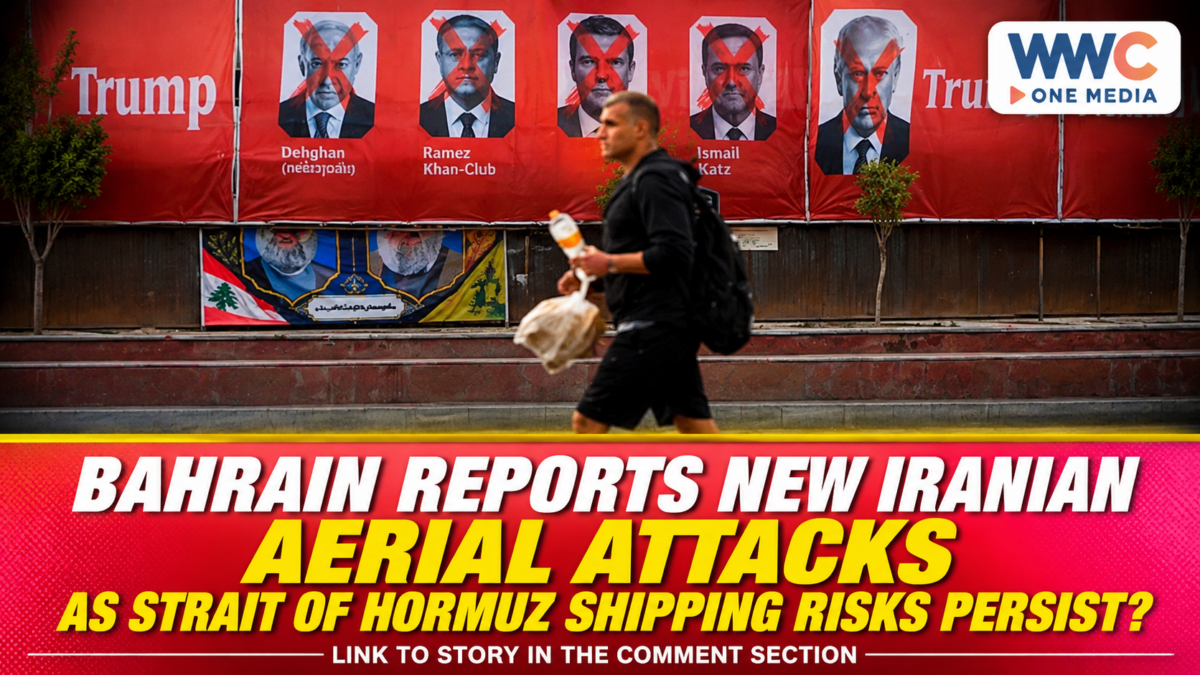
Bahrain’s Defence Force said its air-defence systems intercepted several Iranian aerial attacks on November 21, 2026, with falling debris causing minor material damage but no reported injuries. The announcement came as international maritime authorities continued documenting attacks on commercial vessels around the Strait of Hormuz, keeping regional security and energy-shipping routes under pressure.
The developments underline how the conflict affects more than military installations. Bahrain’s security position, the safety of civilian infrastructure and the reliability of commercial shipping are connected concerns for Gulf countries and energy-importing economies, including the Philippines.
The official records establish that Bahrain reported intercepting aerial attacks and that international agencies have documented repeated maritime incidents. They do not, however, establish that every reported incident in the Gulf was part of one coordinated operation or identify the perpetrators behind every vessel strike.
Bahrain’s air defences intercept reported attacks
In a statement dated November 21, the Bahrain Defence Force General Command said its air-defence systems had responded to several Iranian aerial attacks targeting the kingdom.
The force reported that debris from the interceptions caused minor material damage. It said there were no human casualties at the time of its announcement. BahrainDefenseForce
The statement is significant because it confirms that Bahrain’s authorities were still reporting aerial threats more than eight months after the regional conflict began. It also illustrates the limits of relying on interception figures alone to assess the security situation.
An intercepted projectile may not reach its intended target, but debris can still create risks on the ground. Damage to property, disruption to civilian activity and the possibility of further attacks remain concerns even when air-defence systems prevent a direct impact.
Bahrain’s public statement did not provide a detailed breakdown of the number or type of aerial threats intercepted on November 21. It also did not identify specific locations where debris caused damage.
Those details should not be filled in through speculation.
The Strait of Hormuz remains a major maritime-security concern
The pressure on Bahrain is unfolding alongside continuing security incidents involving commercial vessels in the wider Gulf region.
The International Maritime Organization’s confirmed-incident register listed 138 incidents in the Strait of Hormuz and the Middle East as of November 17, 2026. It also recorded 25 confirmed seafarer fatalities. Highlighted (Confirmed) incidents
The register includes several vessels damaged during November. Among them were AL DHANNAH on November 15 in the Arabian Gulf, DAR SALWA on November 13 in the Strait of Hormuz, and DOMINICA PROSPERITY on November 11 northwest of Ra’s al Khaymah in the United Arab Emirates.
The IMO’s table also recorded one seafarer injured aboard FUJAIRAH ENERGY following an incident on November 10. These entries demonstrate the scale of the maritime-security problem, but they do not establish that all incidents had the same cause or responsible party.
The United Kingdom Maritime Trade Operations has separately reported tanker incidents around the Strait. Its November 18 incident notices described two separate cases north of Khasab, Oman: one tanker was reportedly struck by an unknown projectile, while another was hit and caught fire, with a crew member initially reported missing. UKMTO
The wording matters. An unknown projectile is not a confirmed identification of a weapon or its operator. Maritime warnings communicate reported incidents and advise vessels to take precautions while investigations continue.
A UN resolution already addresses attacks and freedom of navigation
The latest developments also come against the background of United Nations Security Council Resolution 2817, adopted on March 11, 2026.
The resolution condemned attacks by Iran against Bahrain, Kuwait, Oman, Qatar, Saudi Arabia, the United Arab Emirates and Jordan. It demanded that Iran cease attacks against those countries and called for compliance with international humanitarian law, particularly regarding the protection of civilians and civilian objects. Digital Library
The resolution also addressed commercial shipping directly.
It reaffirmed the navigational rights and freedoms of merchant and commercial vessels and condemned actions or threats aimed at closing, obstructing or interfering with international navigation through the Strait of Hormuz. It described interference with lawful passage through the waterway as a serious threat to international peace and security.
This is important because the strait is not simply a regional passage used by Gulf countries. It is part of the international shipping network connecting energy producers with buyers across Asia and other markets.
The resolution provides an international legal and diplomatic framework for addressing the threats. Its existence, however, does not automatically stop attacks or guarantee that commercial vessels can travel without risk.
Why the security situation matters to the Philippines
For the Philippines, the consequences of instability around the Gulf extend beyond diplomatic concern.
The country relies on imported petroleum, and its energy costs are influenced by international oil prices, shipping conditions and the availability of refined products. Prolonged disruption around the Strait of Hormuz could increase uncertainty for shipping companies and energy buyers.
That does not mean every attack will automatically cause a Philippine fuel-price increase. Pump prices also depend on crude and refined-product prices, exchange rates, freight costs, inventories, taxes and local pricing schedules.
The wider risk is that repeated incidents could make energy shipments more expensive or less predictable. Shipping operators may need to account for security assessments, insurance costs, delays and alternative routing decisions.
WWC previously examined how tanker attacks around Hormuz expose Asian oil supply to maritime disruption. The issue is particularly relevant to Asian economies because a large share of the region’s energy imports moves through Gulf shipping routes.
The human consequences also matter to the Philippines, which supplies seafarers to international shipping companies. The deaths of two Filipino crew members aboard the tanker Sidr earlier in the conflict showed how regional maritime insecurity can affect Filipino workers and their families. WWC documented the return of the two seafarers’ remains to the Philippines.
The country’s exposure is not limited to fuel prices. Disruption to shipping can affect delivery schedules, freight costs and the movement of goods between major trading markets.
Gulf governments face a difficult security and economic balance
Bahrain’s latest statement highlights the challenge facing Gulf governments: protecting their territories while preserving the commercial activity that supports their economies.
Air-defence systems are one part of that response. Civilian protection, emergency readiness, infrastructure resilience and coordination with regional partners are also important.
The maritime picture adds another layer. Even when a vessel is not directly connected to a military operation, an attack or suspected attack can affect the decisions of shipowners, insurers, charterers and crews.
WWC has previously examined why Gulf governments remain concerned about a prolonged US-Iran conflict and the difficulty of securing a lasting settlement. The November incidents reinforce the point that reduced fighting in one location does not necessarily mean the wider region has returned to normal.
The challenge for governments is to prevent security measures from becoming a substitute for diplomatic efforts. Protecting civilian populations and keeping international trade routes open require both operational readiness and sustained efforts to reduce the risk of further escalation.
What happens next
The next indicators to watch are official updates from Bahrain’s Defence Force, additional maritime incident notices and any confirmed findings from investigations into attacks on commercial vessels.
For Bahrain, further details about damage, locations and the nature of intercepted threats would help establish the extent of the latest incidents. For shipping operators, updated assessments from maritime authorities will remain important when planning voyages through the Gulf.
The IMO’s confirmed-incident register will also provide a way to track the documented impact on ships and seafarers, although its published figures must be read with their reporting cut-off dates in mind.
For the Philippines, the priority is to monitor developments that could affect energy supply, shipping costs and the safety of Filipino seafarers. Any claim of an immediate change in domestic fuel prices or supply availability should be supported by separate Philippine market and government data.
Bahrain’s November 21 announcement confirms another reported round of aerial threats and interceptions. The wider maritime record shows that commercial shipping remains exposed to serious risks.
The central question is whether regional governments can prevent these incidents from developing into a broader disruption of civilian infrastructure and international trade. For countries far beyond the Gulf, the answer could carry significant economic consequences.