
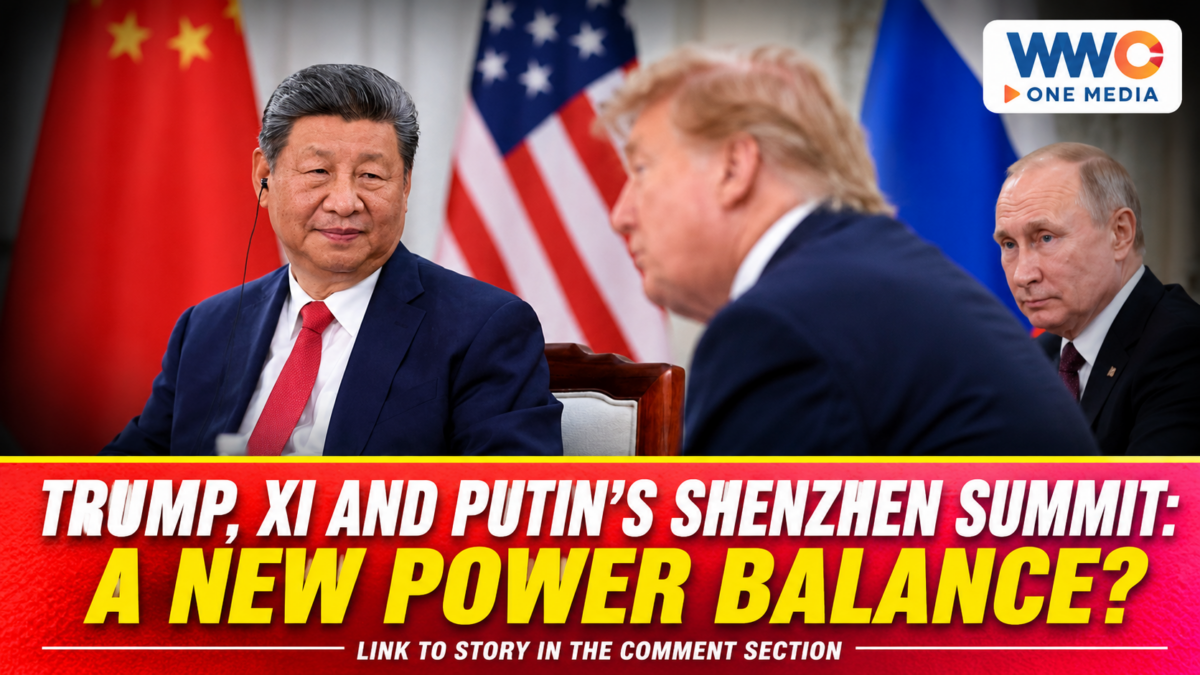
US President Donald Trump, Chinese President Xi Jinping and Russian President Vladimir Putin met in Shenzhen on November 19, 2026, for a trilateral summit that produced a joint declaration on international security, energy cooperation and nuclear-risk discussions. The meeting gave China a prominent role as host of a rare three-power gathering, while leaving major questions about the future of US-China competition unresolved.
The declaration matters because it places Washington, Beijing and Moscow in a shared diplomatic framework, even as their interests remain sharply different. For the Philippines and other Indo-Pacific countries, the important question is not simply which leader appeared strongest at the summit, but whether the three governments will translate their statements into actions that affect regional security, trade and international rules.
The Shenzhen summit gave Xi a diplomatic platform
The November 19 meeting brought together the leaders of the United States, China and Russia in Shenzhen, during China’s hosting of the Asia-Pacific Economic Cooperation Economic Leaders’ Meeting.
The White House’s published declaration confirmed that the three leaders discussed the international situation and committed to maintaining strategic stability and international security. It also identified China as the host of the trilateral summit. The White House+1
Hosting the meeting gave Xi an opportunity to present China as a central venue for high-level international diplomacy. It also placed the Chinese president in a position to convene discussions involving two other permanent members of the United Nations Security Council.
That is a diplomatic advantage, but it should not be mistaken for proof that Beijing now controls the international agenda or that Washington and Moscow have accepted China’s preferred positions.
The gathering demonstrates that China can provide a platform for major-power engagement. Whether it can turn that access into lasting influence depends on what the other governments agree to do after the leaders leave the meeting.
The joint declaration contains commitments, not a new world order
The White House declaration outlined four principal areas of cooperation.
First, the three countries committed to reforming the United Nations so it can respond more effectively to global challenges and fulfil its stated mission of international peace and security.
Second, they said they planned to increase the production and supply of refined petroleum products, while reaffirming the importance of stable energy flows.
Third, they recognised the importance of state consent and respect for the immunities of state officials. The declaration also said the International Criminal Court and similar bodies must not abuse their jurisdiction.
Fourth, the leaders reaffirmed that a nuclear war cannot be won and must never be fought. They agreed to conduct dialogue on reducing nuclear risks and preventing nuclear proliferation. The White House
These are significant subjects, particularly nuclear-risk communication and energy stability. However, the published declaration does not specify numerical nuclear-arms reduction targets, verification procedures, enforcement mechanisms or a timetable for completing negotiations.
That distinction matters. A commitment to hold dialogue is not the same as a completed arms-control agreement. Likewise, a stated intention to increase refined petroleum supplies does not establish how much additional production will come from each country or when it will reach international markets.
The declaration is therefore best understood as a diplomatic framework for continued engagement, not evidence that the three powers have settled their major disagreements.
Trump and Xi still describe the relationship differently
The November summit followed several rounds of direct engagement between Trump and Xi in 2026. Their public statements show a shared interest in avoiding uncontrolled escalation, but they also reveal different priorities.
In the Chinese Foreign Ministry’s account of their November 19 meeting, Xi emphasised a constructive relationship of strategic stability based on respect, fairness and reciprocity. He called for stronger communication between negotiating teams, more areas of cooperation and the constructive management of unresolved differences.
Xi also raised Taiwan, urging the United States to avoid actions that could create major setbacks in bilateral relations. China’s Foreign Ministry
Trump’s remarks, as recorded in the same official account, highlighted trade, investment, agricultural products, energy and advanced intelligence technologies. He also stated that the United States does not support “Taiwan Independence.” China’s Foreign Ministry
The statements indicate that both governments want to preserve communication, but they do not establish that the Taiwan issue has been resolved. Nor does Trump’s statement amount to a new agreement on Taiwan’s security arrangements.
For regional governments, the difference between diplomatic language and actual policy remains essential. A leader’s statement can signal direction, but its practical meaning depends on subsequent government decisions and official agreements.
China’s influence is growing, but competition with Washington continues
The broader strategic picture is more complicated than the public ceremony in Shenzhen.
The US-China Economic and Security Review Commission’s 2026 assessment described China as using its growing military, technological, economic and diplomatic capabilities more assertively while seeking to avoid direct confrontation with the United States.
The commission also documented continued Chinese military modernisation, activity around Taiwan and efforts to strengthen Beijing’s influence in the Indo-Pacific. At the same time, it noted that other governments and groupings have resisted or slowed some Chinese-backed initiatives. USCC
This assessment points to two developments occurring at once.
China is expanding its international reach and seeking greater influence in institutions, technology supply chains and security relationships. But that expansion does not mean Beijing can automatically secure the support of other countries or dictate regional outcomes.
The United States, meanwhile, continues to pursue its own economic and security priorities. The September 25 White House fact sheet documented the operation of the US-China Boards of Trade and Investment, which were established following the leaders’ May 2026 summit in Beijing.
The Board of Trade reached consensus on recommendations for more favourable tariff treatment for US$30 billion of non-sensitive goods in each direction. It also established an agricultural market-access working group. The Board of Investment was designed to provide a channel for discussing investment opportunities and obstacles. The White House
These mechanisms show that economic negotiations were already under way before the Shenzhen gathering. The November summit did not, in its published declaration, announce a comprehensive new trade agreement or settle the wider technology and supply-chain competition.
Why the outcome matters to the Philippines
For the Philippines, the relationship among Washington, Beijing and Moscow has direct implications for regional diplomacy and economic planning.
Manila maintains a defence treaty with the United States while also managing economic relations and maritime disputes involving China. Any change in the strategic calculations of the major powers can affect the environment in which the Philippines pursues its security and commercial interests.
The summit declaration did not announce a new arrangement governing the South China Sea, nor did it establish a settlement of maritime disputes in the region. Its broad language on international security should not be interpreted as a specific guarantee for the Philippines.
WWC has previously examined what the US-Philippines alliance legally provides and what public assurances do not automatically guarantee. The distinction remains important: diplomatic statements and treaty obligations are different forms of commitment.
The economic implications are just as relevant. A more stable US-China relationship could reduce uncertainty for companies that depend on cross-border supply chains, but unresolved disputes over tariffs, technology and market access can still affect investment decisions.
The Philippines also has reason to avoid relying too heavily on either major economy. Its export strategy benefits from access to multiple markets and diversified sources of investment. WWC has examined why Philippine exporters are being encouraged to expand beyond the US and China.
A changing balance among major powers makes that strategy more important, not less.
Trade and technology remain the real tests of strategic stability
The public language of cooperation will ultimately be measured against decisions that businesses and governments can observe.
For trade, the relevant indicators include tariff implementation, market access, agricultural purchases, investment flows and the treatment of critical minerals. For technology, the key questions concern export controls, advanced computing, artificial intelligence safeguards and supply-chain security.
The November Chinese readout specifically called for greater coordination on artificial intelligence risks and said the technology should remain under human control. Trump’s recorded remarks also identified cooperation in agricultural products, energy and advanced intelligence technologies as areas for further work. China’s Foreign Ministry
These subjects are economically significant, but the published account does not provide a detailed implementation schedule for new technology or trade arrangements.
That leaves businesses with a familiar challenge: distinguishing a political commitment from a change in operating conditions. Companies still need written rules, effective dates and regulatory clarity before they can adjust investment plans with confidence.
The same principle applies to governments. Strategic stability becomes meaningful when it reduces the risk of miscalculation and creates reliable channels for managing disputes, rather than simply producing more high-level meetings.
What happens next
The next test will be whether the three governments follow the Shenzhen declaration with practical discussions and measurable steps.
The nuclear-risk dialogue will need a clear process if it is to produce more than general statements. Energy cooperation will require details on supply, production and implementation. United Nations reform will also face the challenge of reconciling the different interests of major powers and other member states.
For Trump and Xi, the bilateral relationship will remain a separate and difficult track. Trade, Taiwan, advanced technology and regional security are issues that cannot be resolved simply by adding Russia to a summit.
For the Philippines, the sensible response is to monitor official agreements and policy changes while maintaining its own diplomatic, security and economic priorities.
Xi gained an important diplomatic moment by hosting the three leaders in China. Trump retained a direct channel for negotiating with Beijing, while Putin participated in a forum that placed Russia alongside the two largest powers in the gathering.
But the summit did not establish a new hierarchy among the three countries. Its more concrete achievement was to create another public commitment to dialogue. Whether that becomes a durable change in international relations will depend on what happens after the cameras are gone.
Frequently Asked Questions
What happened at the Trump-Xi-Putin summit in Shenzhen?
The three leaders met on November 19, 2026, and issued a declaration covering United Nations reform, energy supply, state sovereignty and nuclear-risk dialogue. The White House
Did the three countries sign a nuclear arms reduction agreement?
The published declaration says the countries will conduct dialogue on reducing nuclear risks and preventing nuclear proliferation. It does not announce specific arms-reduction targets or a binding nuclear treaty.
Did Trump and Xi resolve the Taiwan issue?
No. Their November meeting included statements about Taiwan, but the published account does not establish a new settlement or agreement resolving the issue. China’s Foreign Ministry
Does the Shenzhen summit mean China is now more powerful than the United States?
The summit alone cannot establish that conclusion. It demonstrated China’s ability to host high-level diplomacy, but military, economic, technological and diplomatic influence involve several different measures.
What does the summit mean for the Philippines?
It reinforces the importance of monitoring US-China relations, regional security and trade developments. The declaration did not announce a new South China Sea settlement or a specific security commitment to the Philippines.










