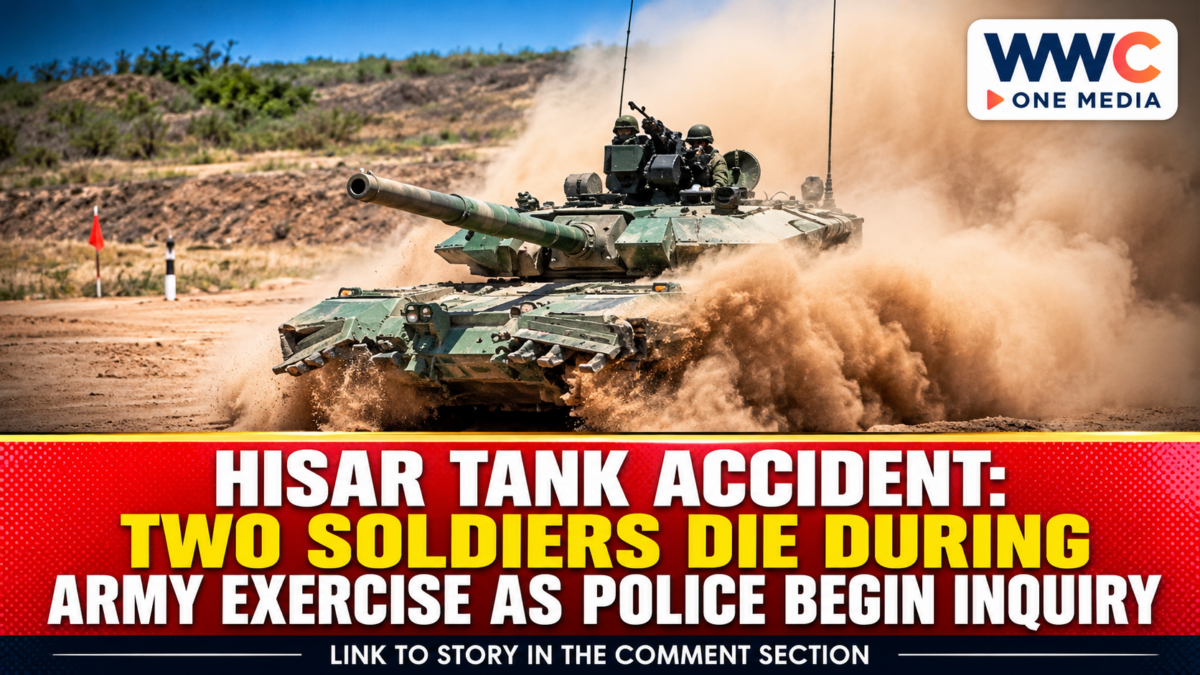
Two Indian Army soldiers died after a tank ran over them during a military training exercise near Bhojraj village in Haryana’s Hisar district on Saturday, November 21. Police accounts reported in public coverage say dust raised during the exercise may have restricted the tank driver’s visibility, while investigators began the required procedures following the deaths.
The soldiers were identified as Naik Manish Kumar, from Shamli district, and Naik Ankush Kumar, from Budaun district, both in Uttar Pradesh. They were reportedly positioned ahead of the advancing tank when the incident occurred. The two were taken to Hisar Military Hospital, where medical staff declared them dead.
The deaths have placed attention on the safety challenges involved in exercises where armoured vehicles and personnel operating on the ground share the same training area. But the reported explanation involving dust should not be mistaken for a final investigation finding: publicly available accounts describe it as preliminary information, not a completed determination of responsibility.
Hisar tank accident: What is known about the exercise
The incident occurred on November 21 at a training area near Bhojraj village, according to accounts attributed to Hisar Police. The exercise reportedly involved approximately 32 tanks, with soldiers deployed at positions on the ground as part of the training activity.
Police information carried in public reports said dust generated by the movement of the vehicles reduced visibility. A tank then struck the two soldiers positioned in front of it.
The distinction between a preliminary account and an established cause is important. The available descriptions do not provide a complete technical reconstruction of the tank’s movement, the soldiers’ assigned positions, communications between personnel or the precise visibility conditions at the moment of impact.
Those details matter when investigators assess how an accident occurred and whether existing procedures were followed. Until an official investigation report is made public, it would be premature to conclude that a particular person, crew member or unit was responsible.
The two soldiers and the response after the incident
The deceased were identified in the reported police account as Naik Manish Kumar of Shamli and Naik Ankush Kumar of Budaun, both in Uttar Pradesh.
The soldiers sustained critical injuries and were taken to the military hospital in Hisar. Medical staff later declared them dead, according to the information attributed to police.
Investigating Officer Ashok Kundu was quoted in public coverage as saying that Hisar Police received information about the incident while the exercise was taking place at the Army training centre in Bhojraj village. The officer also described police action following the incident, including the recording of family statements and post-mortem examinations.
The reported sequence indicates that civilian police procedures and military notification followed the deaths. Senior Army officials were informed, and the soldiers’ remains were handed over to the Army after the post-mortem process, according to the accounts of the investigating officer.
The public information reviewed for this report does not establish whether a separate military inquiry has been formally announced, who will lead it or when its findings may be released.
Why dust and visibility matter in armoured training
Tank exercises require coordination between vehicle crews, commanders and personnel who may be positioned outside the vehicles. Visibility is one of the practical conditions that can affect how safely those elements operate together.
Dust can be raised when heavy vehicles move across dry or loose ground. In a training environment involving several vehicles, that dust may affect what crews and ground personnel can see. The reported police explanation in this case identifies reduced visibility as a preliminary factor, but it does not establish whether visibility was the only factor or whether other conditions contributed.
A proper investigation would need to establish the sequence of movements and the information available to the people involved. Relevant questions include where the tank was travelling, where the soldiers were assigned, what communication arrangements were in place and whether the exercise had procedures for pausing movement when visibility deteriorated.
These are questions for investigators, not conclusions that can be drawn from the reported circumstances alone.
WWC has previously examined how military authorities communicate what is known—and what remains unanswered—after a training accident in its coverage of a Jordanian Black Hawk crash during a military exercise. The aircraft incident involved different equipment and circumstances, but it illustrates why early incident details should be separated from final findings.
What the incident raises about training safety
Military exercises are designed to prepare personnel to operate in demanding conditions. That purpose does not remove the need for clear movement controls, reliable communication and safeguards for personnel working near moving equipment.
The Hisar incident is a reminder that training safety involves more than the operation of a vehicle. It also depends on how the exercise is organised, how ground positions are identified and how crews respond when conditions change.
However, the available public accounts do not establish that a safety rule was breached or that the Army’s procedures were inadequate. Those conclusions would require evidence from the exercise plan, relevant operating procedures, witness accounts and the official investigation.
A similar distinction applies when examining other military training accidents. WWC’s report on the fatal Philippine Air Force training aircraft collision in Batangas discusses why an accident’s circumstances should not be confused with a confirmed cause. The incidents are not directly comparable, but both require evidence specific to the event.
What happens next
The immediate priority is to establish the full circumstances surrounding the deaths. Police procedures, including post-mortem examinations and the recording of family statements, were reported after the incident. The Army’s internal response and any formal inquiry findings remain matters requiring confirmation through an official statement or document.
A public investigation update could clarify whether the preliminary visibility explanation is supported by further evidence, whether any equipment or operational issues were identified and whether changes to training arrangements are considered necessary.
Until then, the reported dust conditions should remain a preliminary explanation rather than a definitive finding. The available information also does not establish whether any disciplinary action, procedural change or equipment restriction has been ordered.
WWC has also reported on a fatal military-base training-area fire in Canada, where official findings and updates were important to understanding the incident beyond its initial reports. In Hisar, the same principle applies: the investigation, rather than early accounts alone, must determine what happened.
Frequently asked questions
Where did the tank accident happen?
The incident was reported near Bhojraj village in Hisar district, Haryana, at an Army training area.
When did the two soldiers die?
The incident occurred on Saturday, November 21, 2026. The deaths were reported publicly on November 22.
Who were the soldiers?
They were identified as Naik Manish Kumar of Shamli district and Naik Ankush Kumar of Budaun district, both in Uttar Pradesh.
What caused the tank to run over the soldiers?
Preliminary police information reported publicly said dust raised during the exercise may have obstructed the driver’s visibility. That explanation should not be treated as a final investigation finding.
Has the Army announced the investigation findings?
No completed Army investigation findings were established in the public information reviewed for this article. Any formal inquiry announcement or conclusions should be confirmed through an official military or police release.