
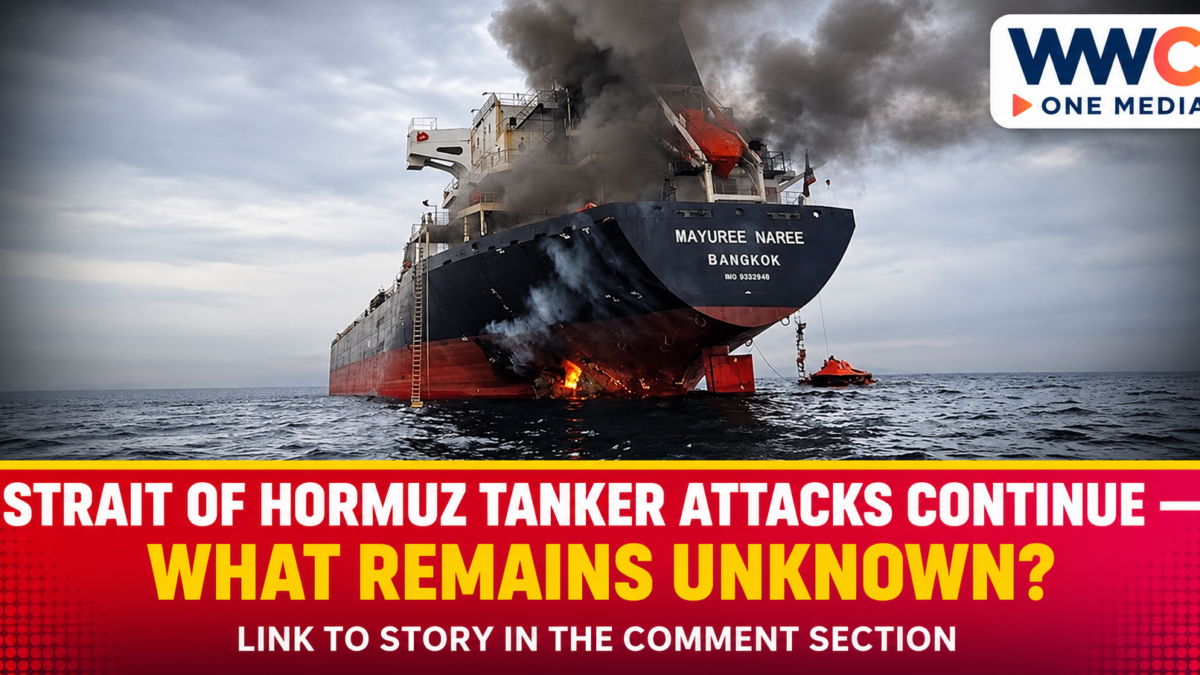
STRAIT OF HORMUZ — Nov. 22, 2026. Maritime security monitors recorded three separate incidents involving tankers struck by unidentified projectiles near Oman’s Musandam Peninsula on Nov. 20–21. The alerts described an onboard fire in one incident and damage to different parts of two other vessels, while reporting no casualties at the time of the initial notices.
The latest Hormuz tanker attacks put a practical question before shipping companies: how much can operators know about threats while investigators have yet to identify those responsible? The recorded incidents establish immediate reasons for caution, but neither the projectiles’ origins nor the longer-term consequences for affected vessels have been conclusively established in the public notices.
Hormuz Tanker Attacks: Three Alerts in Two Days
United Kingdom Maritime Trade Operations (UKMTO) listed the first of the three incidents as occurring at 15:00 UTC on Nov. 20, approximately eight nautical miles north of Khasab, Oman. Its warning said an outbound tanker had been struck on the port bow by an unknown projectile. The company security officer reported a fire, and the notice said no casualties or environmental impact had been reported at that stage.
A second warning recorded an incident at 05:00 UTC on Nov. 21, approximately 11 nautical miles north of Khasab. In this case, a tanker travelling outbound was hit on its stern by an unidentified projectile. The warning again recorded no reported casualties, while environmental consequences remained unconfirmed.
The third notice described another outbound tanker struck in its engine room at 05:50 UTC on Nov. 21, around 17 nautical miles east of Khasab. It also identified the projectile as unknown and reported no casualties at the time, with the environmental impact unconfirmed.
These are three separately logged events. The notices do not establish that the same weapon, group or operation was involved in all three.
What the Alerts Say — and What They Do Not
UKMTO uses its notices to communicate reported threats to mariners and to encourage caution while relevant authorities investigate. The warnings identify a reported strike and the information available when each notice was issued. They are not final forensic findings.
In particular, the term unknown projectile does not identify the weapon or the person who launched it. It would be inaccurate to attribute any of these three attacks to a government, military force or armed organisation without an official finding that supports that conclusion.
Nor does the phrase no reported casualties prove that every crew member escaped injury. It states the information available at the time of the alert. The same caution applies to environmental assessments: an impact described as unconfirmed must not be reclassified as either a spill or a confirmed absence of pollution.
A separate report described a loud explosion offshore near Sirik, Iran, late on Nov. 21. No original authority statement reviewed here independently established its cause or linked it to these tanker alerts. Consequently, the Sirik account is not being treated as a fourth verified vessel strike or as evidence of a coordinated sequence.
Why the Location Matters to Commercial Ships
The three recorded positions were near Khasab, at the northern end of Oman’s Musandam Peninsula, in or near the Strait of Hormuz shipping corridor. This is an important passage between the Persian Gulf and the Gulf of Oman for commercial vessels carrying energy cargoes and other goods.
A threat near a narrow transit corridor creates operational questions even before final damage assessments arrive. Masters and ship operators need to weigh the availability of reliable navigational information, instructions from maritime authorities and the safety of crew when deciding how to proceed.
WWC previously examined Hormuz tanker attacks and Asian oil-supply exposure. That earlier article considered shipping risks documented before these Nov. 20–21 alerts; it should not be read as a report of the three newly logged incidents.
The latest warnings do not establish that the strait was closed, that oil shipments stopped, or that a particular cargo failed to reach its buyer. Those outcomes would require separate shipping, port or official trade records.
What Can Be Said About Mines and Other Threats?
Earlier maritime-security guidance circulated through the International Maritime Organization warned mariners about mine hazards and the need to follow safe routing information in the strait. Such standing guidance provides context for the broader navigational environment.
It does not, however, establish that a mine caused any of the three November strikes. The UKMTO notices specifically describe unknown projectiles; substituting a more specific explanation would go beyond their findings.
The consequences for maritime workers deserve particular attention. WWC’s earlier coverage of Filipino seafarers affected by an earlier tanker incident described a separate episode and its human costs. It is not evidence of casualties or Filipino crew involvement in the latest three warnings.
For the present incidents, the public records reviewed do not identify the vessels’ names, crews’ nationalities, cargo quantities or final repair requirements. Those details should remain open rather than be filled in from unrelated episodes.
What This Could Mean for Energy and Insurance
Analysis: Repeated warnings in a major shipping route can complicate commercial planning even where initial reports show no casualties. Operators may have to evaluate security exposure alongside voyage schedules and the availability of insurance. Whether premiums or freight charges actually increased because of these particular attacks cannot be established from UKMTO notices alone.
This is also why the three alerts should be separated from wider political claims. WWC’s earlier report about another tanker in the Strait of Hormuz addressed a different incident and a separate public claim of responsibility. It cannot establish attribution for the November strikes.
The immediate public interest is in accurate, time-stamped safety information. Commercial consequences can be assessed later if port records, shipping schedules, insurers or official agencies document them.
What Happens Next?
The most useful next records will be updated maritime warnings, confirmed damage assessments and any official findings about the origin of the projectiles. Investigators may also clarify whether any environmental consequences occurred.
Until then, the evidence supports a clear but limited conclusion: three outbound tankers were reported struck near Khasab over two days, and maritime authorities advised caution. It does not support a named perpetrator, a confirmed link to the reported Sirik explosion or a claim that the shipping corridor had shut down.
Frequently Asked Questions
How many tanker incidents were recorded on Nov. 20–21, 2026?
UKMTO recorded three separate tanker strikes near Khasab, Oman, during those two days.
Were any casualties confirmed?
The three initial warnings reported no casualties at the time. Those notices are not final medical or incident investigations.
Who attacked the tankers?
The UKMTO alerts described unidentified projectiles and did not identify a perpetrator.
Was the reported explosion near Sirik linked to the tanker strikes?
No original official record reviewed establishes a connection.
Did the Strait of Hormuz close?
The three UKMTO notices do not announce a closure. Current sailing instructions should be checked directly with maritime authorities.










