
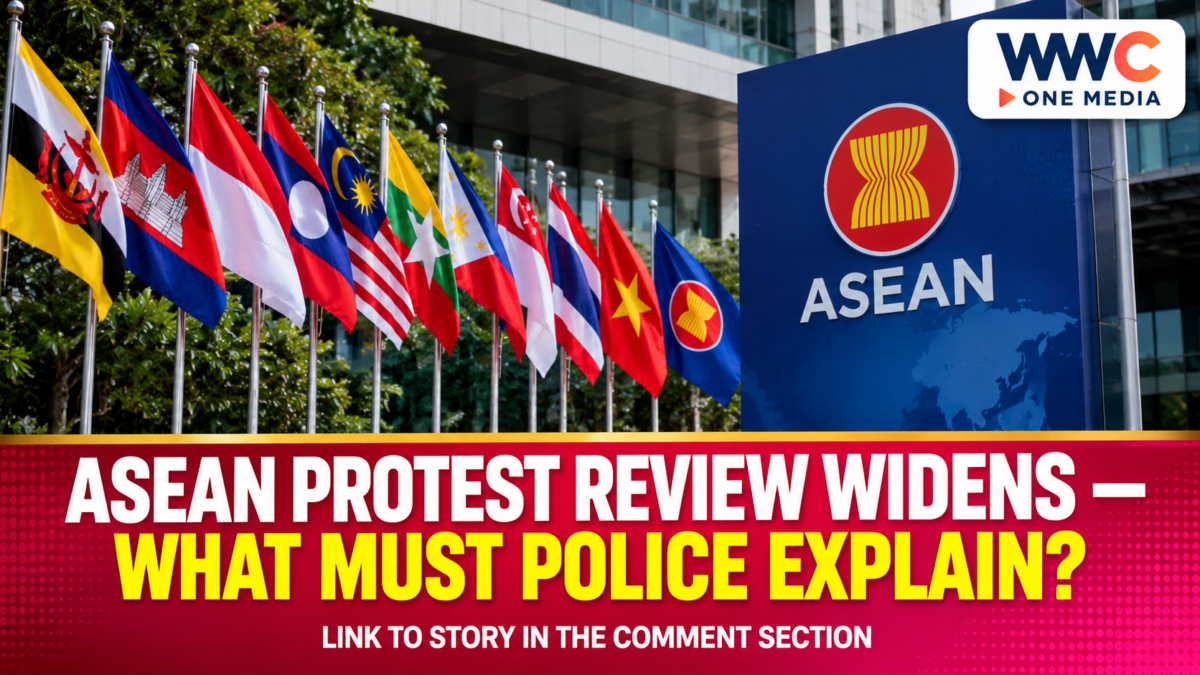
MANILA, Philippines — The ASEAN protest review has placed police detention procedures and constitutional safeguards under closer examination after the Commission on Human Rights (CHR) confirmed on Nov. 18, 2026, that it was investigating reported violations during demonstrations held on Nov. 15. The inquiry covers incidents in Manila, Muntinlupa City and other areas during the opening of the 49th ASEAN Summit.
The central question is whether police interventions, custody arrangements and access to detainees complied with legal requirements.
The CHR has not issued a final determination that human rights violations occurred. Its investigation instead highlights the importance of establishing what happened through official records, medical documentation and independent examination.
ASEAN Protest Review: What Investigators Have Established
The CHR deployed monitoring and investigation teams beginning Nov. 15, drawing personnel from its National Capital Region Office, Protection Office, Investigation Division and Regional Office IV-B.
Its response included visits to the Manila Police District and the Philippine National Police’s National Capital Region Police Office at Camp Bagong Diwa.
The commission’s preliminary monitoring identified 11 people reportedly apprehended in Manila, including one minor. It also reported that more than 200 individuals were brought to Camp Bagong Diwa following demonstrations in Muntinlupa City, including several minors.
These preliminary figures do not establish how many individuals were formally charged, subsequently released or found to have been unlawfully detained.
The distinction matters because a reported apprehension is not automatically equivalent to a criminal conviction or even a formally filed charge.
WWC previously examined the accountability questions arising from ASEAN protest arrests, including the need to establish the legal basis for individual police actions.
Why Access to Detainees Became a Critical Issue
One significant issue concerns the CHR’s ability to examine conditions at Camp Bagong Diwa.
The commission reported that its lawyers and investigators initially encountered restrictions on access on Nov. 15. Access was eventually granted late that evening after several hours.
The CHR also reported observing individuals with visible injuries and raised concerns about congestion and ventilation in a temporary holding area.
Allegations involving mistreatment and restrictions on food deliveries remained subject to verification.
Article XIII, Section 18 of the 1987 Constitution grants the CHR investigative authority over human rights complaints involving civil and political rights, along with visitorial powers over detention facilities.
The delay therefore raises an institutional accountability question: whether independent monitors can exercise their constitutional functions promptly during large police operations.
That question is separate from determining whether an individual officer committed misconduct.
Police Security Duties and Protest Rights Must Both Be Examined
The police also had significant security responsibilities during the summit.
Official police communications described preparations to protect delegates, maintain public order and respond to changing operational requirements across Metro Manila.
On Nov. 17, the National Capital Region Police Office publicly outlined instructions to adjust personnel deployments as conditions developed. Police districts were told to coordinate on crowd movements, traffic congestion and emerging security concerns.
Those operational responsibilities provide context for the decisions taken during the demonstrations. They do not independently establish whether particular arrests or detention conditions were lawful.
The 1987 Constitution protects peaceful assembly and freedom of expression. Batas Pambansa Blg. 880, the Public Assembly Act of 1985, also requires maximum tolerance from law enforcement authorities managing public gatherings.
The law provides procedures for police intervention and distinguishes lawful enforcement from unjustified interference with peaceful assembly.
WWC’s earlier report on ASEAN security preparations and public-rights safeguards explored that balance before the demonstrations.
What Police Records Could Clarify
Analysis: A credible review should distinguish operational decisions made to protect public safety from decisions that may have unnecessarily restricted individual rights.
Arrest reports and custody records could establish when each person was apprehended, the legal grounds recorded by police and the time and circumstances of release or further legal proceedings.
Medical records, where lawfully available to investigators, could help clarify concerns about injuries and whether appropriate care was provided.
Operational logs and relevant communications could also explain how commanders managed access requests from independent monitors.
These documents matter because competing descriptions of a confrontation cannot substitute for evidence concerning individual conduct.
A documented review would benefit complainants seeking accountability and police personnel whose actions must be assessed fairly.
WWC has separately examined the CHR’s examination of ASEAN protest arrests and the distinction between reported allegations and established findings.
Why the Review Matters Beyond the Summit
The Philippines handed the ASEAN chairship to Singapore on Nov. 17, but the end of the diplomatic gathering did not resolve questions concerning police procedures.
The broader issue is whether security operations during high-profile international events are subject to the same legal safeguards expected during ordinary public demonstrations.
Analysis: Public confidence is more likely to improve when authorities provide verifiable explanations rather than treating every complaint as proof of abuse or every security decision as automatically justified.
The CHR’s ongoing inquiry offers an opportunity to assess procedures, identify any failures supported by evidence and consider appropriate recommendations.
WWC’s related examination of unresolved questions in the ASEAN summit security review also highlights the distinction between operational readiness and accountability after an event.
What Happens Next
The CHR said it would continue verifying the circumstances of apprehensions, obtaining relevant police and medical records, gathering individual accounts and examining detention conditions.
Its investigation may lead to recommendations for legal, administrative or policy action where the evidence warrants them.
As of Nov. 22, the primary records reviewed for this update do not establish a completed CHR investigation or a final finding against specific police personnel.
The next important development would be a documented assessment explaining which complaints were substantiated, which were not and what corrective measures, if any, authorities should undertake.
Frequently Asked Questions
Why is the ASEAN protest review taking place?
The CHR is investigating reported human rights violations connected with demonstrations on Nov. 15, 2026, including concerns about apprehensions, detention conditions and access to people in custody.
How many people were reportedly apprehended?
The CHR initially reported 11 people apprehended in Manila and more than 200 brought to Camp Bagong Diwa following the Muntinlupa demonstrations. Those figures are preliminary and do not represent a verified count of criminal charges.
Did the CHR confirm police abuse?
No. The commission identified concerns and allegations requiring investigation but did not announce a final determination that particular officers committed human rights violations.
What law protects peaceful protesters in the Philippines?
Article III, Section 4 of the 1987 Constitution protects peaceful assembly and expression. Batas Pambansa Blg. 880 establishes additional rules for public assemblies and law enforcement conduct.
What could happen after the investigation?
Depending on its findings, the CHR may recommend legal, administrative or policy measures. Any recommendation would need to reflect the evidence established through its investigation.










