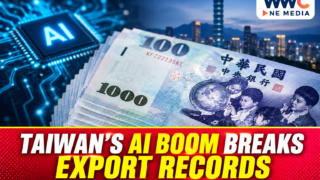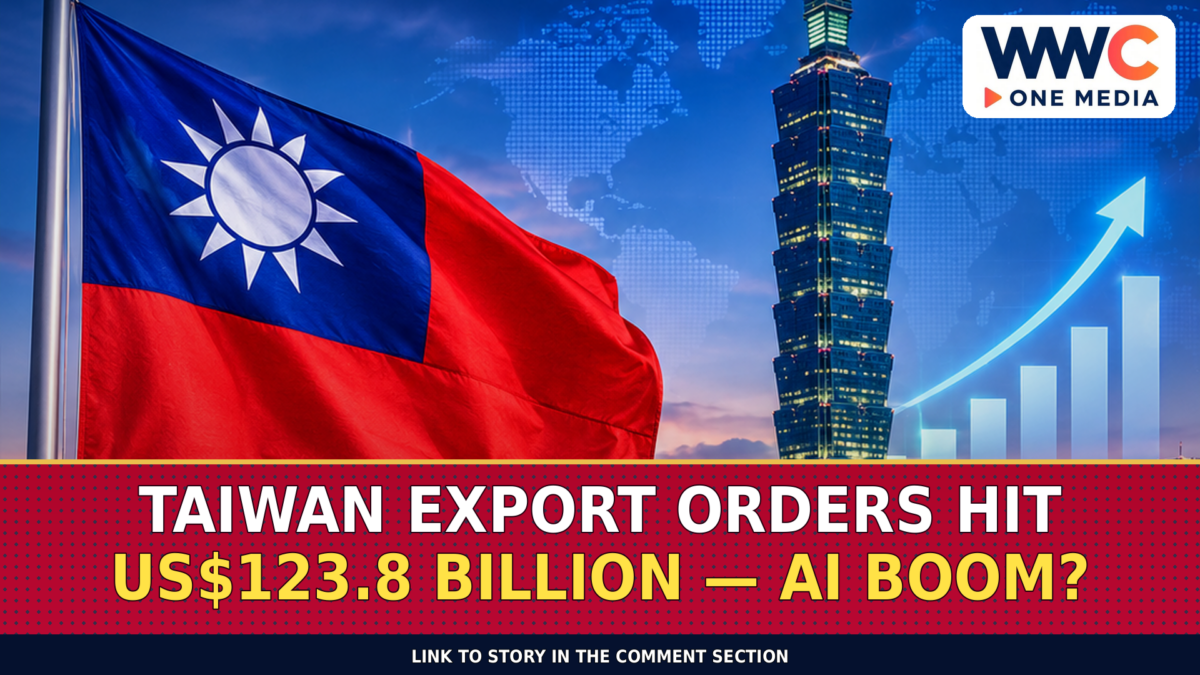
Taiwan’s export orders climbed to a record US$123.82 billion in October 2026, rising 78.3% from a year earlier as overseas demand for technology products strengthened. The increase marked the fastest annual growth on record and extended the country’s run of year-on-year gains to 21 consecutive months.
The result puts Taiwan’s technology manufacturing sector at the centre of an extraordinary expansion in global demand for artificial intelligence infrastructure. But the scale of the increase also raises a bigger question: how much of Taiwan’s economic momentum now depends on continued spending on AI computing, chips and data centres?
The October figures show that the expansion reaches beyond individual semiconductor makers. It involves a wider network of electronics suppliers, communications equipment producers and manufacturers serving the global technology industry. Focus Taiwan+1
Taiwan export orders reveal the scale of the AI supply chain
The Ministry of Economic Affairs reported that October export orders totalled US$123.82 billion, up 78.3% year on year. Orders for the first 10 months reached US$943.02 billion, an increase of 58.6% compared with the same period in 2025.
The cumulative figure had already exceeded Taiwan’s full-year export-order total for 2025, highlighting how quickly demand has expanded during 2026.
Two product groups led the October increase. Orders for information and communications products reached US$46.77 billion, up 107.2% from a year earlier. Electronic-product orders climbed 89.8% to US$53.91 billion.
Together, the two categories accounted for more than US$100 billion in orders during the month. Their performance reflects the importance of Taiwan’s manufacturers to the global supply chain for computing hardware, communications equipment and electronic components. Focus Taiwan+1
Why AI demand is reaching beyond chipmakers
Artificial intelligence requires more than advanced processors. Large-scale AI systems also depend on servers, memory, networking equipment, storage and the supporting infrastructure needed to operate data centres.
That creates business opportunities across several layers of the technology supply chain.
Taiwan has an established manufacturing base serving many of these requirements. Its industrial ecosystem includes semiconductor production, electronics assembly, component manufacturing and suppliers of equipment used in advanced production.
The strength of October’s information and communications orders suggests that demand is spreading across a broader range of products rather than being confined to one category.
This connects with the manufacturing expansion examined in WWC’s report on Central Taiwan Science Park’s record first-half revenue. The park’s performance offered an earlier indication of how AI-related demand was supporting Taiwan’s industrial activity.
The latest orders add another dimension: overseas customers are placing substantial commitments for products that Taiwanese manufacturers are expected to supply.
Traditional industries are also benefiting, but unevenly
The October increase was not limited to electronics.
Orders for basic metals rose 22% to US$2.34 billion, while machinery orders increased 36.3% to US$2.44 billion. Demand for materials used in the AI supply chain and equipment required for semiconductor capacity expansion contributed to the gains.
These figures matter because they show how investment in advanced computing can affect suppliers outside the most visible technology companies.
However, the improvement has not reached every manufacturer equally. The Ministry’s reported assessment also pointed to pressure from low-priced Chinese exports on some Taiwanese producers.
That contrast is important. A strong headline figure does not mean every industrial sector is experiencing the same conditions. Companies serving fast-growing AI supply chains may be benefiting while others continue to face pricing competition and weaker demand.
The difference between export orders and actual exports
Export orders are an important indicator of future manufacturing activity, but they should not be confused with completed shipments.
An order records demand received by a company. The goods may be produced and shipped later, and the timing can depend on production schedules, component availability and customer requirements.
That distinction is especially relevant when monthly orders rise sharply. A record order figure does not mean the same amount of merchandise has already crossed Taiwan’s borders or been recognised as completed exports.
Taiwan’s actual trade data provides a separate measure. The Ministry of Finance reported that October merchandise exports reached US$96.76 billion, up 58.9% from a year earlier. The export-orders figure was higher, but the two statistics measure different stages of economic activity. mof.gov.tw+1
WWC has previously examined the relationship between Taiwan’s technology trade and financial conditions in its coverage of the island’s AI-driven export growth and currency pressure. Strong orders and shipments can support industrial activity, but they do not automatically remove exposure to exchange-rate movements or international market volatility.
November outlook points to another large month
The Ministry of Economic Affairs forecast November export orders at between US$115 billion and US$118.7 billion. That would represent annual growth of 57.6% to 62.7%, based on the Ministry’s reported outlook.
The forecast would bring cumulative orders for the first 11 months to between US$1.058 trillion and US$1.062 trillion.
The Ministry also indicated that full-year orders exceeding US$1.1 trillion were highly likely, although reaching US$1.2 trillion would be more difficult.
Those projections are not guaranteed outcomes. They depend on whether global demand remains strong, manufacturers can meet delivery requirements and customers continue placing orders at the current pace.
For Philippine businesses, Taiwan’s performance is worth watching because the island is an important regional supplier of electronics and technology-related products. WWC’s coverage of Taiwan’s technology companies presenting products and business opportunities in the Philippines also illustrates the commercial links between the two markets.
What happens next?
The next major test will be whether November orders remain close to the Ministry’s forecast range and whether the strength in electronics and information and communications products continues.
Investors and manufacturers will also be watching for signs that AI-related spending is translating into sustained demand across the supply chain, rather than a temporary wave of orders concentrated in a few product categories.
Taiwan’s October result is a powerful indicator of the scale of the current technology cycle. But the longer-term measure of its strength will be whether manufacturers can turn those orders into completed production, shipments and durable business growth.
For now, the figures point to an economy benefiting significantly from the global build-out of AI infrastructure — while leaving the sustainability and breadth of that demand as the questions to watch.
Frequently asked questions
How much were Taiwan’s export orders in October 2026?
Taiwan’s export orders reached US$123.82 billion in October 2026, according to the figures attributed to the Ministry of Economic Affairs.
How much did Taiwan’s export orders increase?
Orders rose 78.3% compared with October 2025, the fastest annual increase on record.
Which industries drove Taiwan’s October export orders?
Information and communications products and electronic products were the largest contributors. Their orders reached US$46.77 billion and US$53.91 billion, respectively.
Why is AI important to Taiwan’s export growth?
AI infrastructure requires semiconductors, servers, memory, networking equipment and other electronic components. Taiwan has manufacturers and suppliers serving several parts of that global supply chain.
Are export orders the same as actual exports?
No. Export orders measure demand received by manufacturers, while export statistics measure goods shipped abroad. Orders may be fulfilled in later months.